CWE-400
DiscouragedUncontrolled Resource Consumption
Abstraction: Class · Status: Draft
The product does not properly control the allocation and maintenance of a limited resource.
6331 vulnerabilities reference this CWE, most recent first.
GHSA-CMH9-RX85-XJ38
Vulnerability from github – Published: 2024-02-13 18:34 – Updated: 2024-02-20 16:40Summary
Cross site scripting (XSS) potentially exposing cookies / sessions / localStorage, fixed by sidekiq-unique-jobs v8.0.7.
Specifically, this is a Reflected (Server-Side), Non-Self, Cross Site Scripting vulnerability, considered a P3 on the BugCrowd taxonomy with the following categorization: Cross-Site Scripting (XSS) > Reflected > Non-Self
It was initially thought there was a second vulnerability (RCE), but it was a false alarm. Injection is impossible with Redis:
String escaping and NoSQL injection The Redis protocol has no concept of string escaping, so injection is impossible under normal circumstances using a normal client library. The protocol uses prefixed-length strings and is completely binary safe.
Ref: https://redis.io/docs/management/security/
XSS Vulnerability
Specially crafted GET request parameters handled by any of the following endpoints of sidekiq-unique-jobs' "admin" web UI, allow a super-user attacker, or an unwitting, but authorized, victim, who has received a disguised / crafted link, to successfully execute malicious code, which could potentially steal cookies, session data, or local storage data from the app the sidekiq-unique-jobs web UI is mounted in.
/changelogs/locks/expiring_locks
This means if your sidekiq-unique-jobs web UI is mounted at /sidekiq, the vulnerable paths are:
/sidekiq/changelogs/sidekiq/locks/sidekiq/expiring_locks
XSS vulnerability is an instance of CAPEC-32: XSS Through HTTP Query Strings, which is related to CWE-80. In certain cases where it results in a server error with status 500, it could be considered a vector for uncontrolled resource consumption, given that errors can be much more resource intensive that normal requests, and thus CWE-400 & CWE-754 may also be relevant.
Details
Fix for the XSS vulnerability was released in sidekiq-unique-jobs v8.0.7.
This is an analogous attack vector to that which affected sidekiq gem from version v7.0.4 to v7.0.7, and was given identifiers GHSA-h3r8-h5qw-4r35 & CVE-2023-1892.
The vulnerability in sidekiq-unique-jobs' was not fixed by sidekiq v7.0.8, nor the more recent sidekiq v7.2.0 releases; they are similar but unrelated, distinct vulnerabilities in adjacent projects.
Note #1: The admin web UI for sidekiq-unique-jobs is not protected by any authorization constraint in the default configuration. Auth constraints must be configured by the programmer. It is recommended and expected that users will configure authorization constrains on the "admin" UI. This is not specifically related to the vulnerability but may make users who fail to constrain their "admin" UI even more vulnerable.
Note #2: Most users of the library will not have configured the UI on a sandboxed subdomain, making all their cookies, localStorage data and session secrets vulnerable to exposure. The purpose of a sandboxed subdomain is expressly to prevent leaking sensitive data through XSS attacks.
XSS Fix PR: https://github.com/mhenrixon/sidekiq-unique-jobs/pull/829
PoC
XSS
Use a string like:
%22%3E%3Cimg/src/onerror=alert(document.domain)%3E
as the value for one of the parameters that are handled without escaping. Reference: https://liveoverflow.com/do-not-use-alert-1-in-xss/
- Visit /sidekiq/changelogs - with a crafted query string like one of the following:
a. Screenshot:
b.
filteris XSS vulnerable:?filter=%22%3E%3Cimg/src/onerror=alert(document.domain)%3Ec.countis vulnerable to triggering an application error (status 500), potentially allowing resource exhaustion?count=%22%3E%3Cimg/src/onerror=alert(document.domain)%3E- Screenshot:
- Screenshot:
- Visit /sidekiq/locks - with a crafted query string like one of the following:
a. Screenshot:
b.
filteris XSS vulnerable:?filter=%22%3E%3Cimg/src/onerror=alert(document.domain)%3Ec.countis vulnerable to triggering an application error (status 500), potentially allowing resource exhaustion?count=%22%3E%3Cimg/src/onerror=alert(document.domain)%3E- Screenshot:
- Screenshot:
- Visit /sidekiq/expiring_locks - with a crafted query string like one of the following:
a. Screenshot:
b.
filteris XSS vulnerable:?filter=%22%3E%3Cimg/src/onerror=alert(document.domain)%3E
Impact
This is a vulnerability of critical severity, which impacts many thousands of sites, since sidekiq-unique-jobs is widely deployed across the industry, with multiple attack vectors.
{
"affected": [
{
"package": {
"ecosystem": "RubyGems",
"name": "sidekiq-unique-jobs"
},
"ranges": [
{
"events": [
{
"introduced": "8.0.0"
},
{
"fixed": "8.0.7"
}
],
"type": "ECOSYSTEM"
}
]
},
{
"package": {
"ecosystem": "RubyGems",
"name": "sidekiq-unique-jobs"
},
"ranges": [
{
"events": [
{
"introduced": "6.0.0.rc7"
},
{
"fixed": "7.1.33"
}
],
"type": "ECOSYSTEM"
}
]
}
],
"aliases": [
"CVE-2024-25122"
],
"database_specific": {
"cwe_ids": [
"CWE-400",
"CWE-754",
"CWE-79",
"CWE-80"
],
"github_reviewed": true,
"github_reviewed_at": "2024-02-13T18:34:16Z",
"nvd_published_at": "2024-02-13T19:15:11Z",
"severity": "HIGH"
},
"details": "### Summary\n\nCross site scripting (XSS) potentially exposing cookies / sessions / localStorage, fixed by `sidekiq-unique-jobs` v8.0.7.\n\nSpecifically, this is a Reflected (Server-Side), Non-Self, Cross Site Scripting vulnerability, considered a **_P3_** on the BugCrowd [taxonomy](https://bugcrowd.com/vulnerability-rating-taxonomy) with the following categorization:\nCross-Site Scripting (XSS) \u003e Reflected \u003e Non-Self\n\nIt was initially thought there was a second vulnerability (RCE), but it was a false alarm. Injection is impossible with Redis:\n\n\u003e String escaping and NoSQL injection\n\u003e The Redis protocol has no concept of string escaping, so injection is impossible under normal circumstances using a normal client library. The protocol uses prefixed-length strings and is completely binary safe.\n\nRef: https://redis.io/docs/management/security/\n\n**XSS Vulnerability**\n\nSpecially crafted `GET` request parameters handled by any of the following endpoints of `sidekiq-unique-jobs`\u0027 \"admin\" web UI, allow a super-user attacker, or an unwitting, but authorized, victim, who has received a disguised / crafted link, to successfully execute malicious code, which could potentially steal cookies, session data, or local storage data from the app the `sidekiq-unique-jobs` web UI is mounted in.\n\n1. `/changelogs`\n2. `/locks`\n3. `/expiring_locks`\n\nThis means if your `sidekiq-unique-jobs` web UI is mounted at `/sidekiq`, the vulnerable paths are:\n\n1. `/sidekiq/changelogs`\n2. `/sidekiq/locks`\n3. `/sidekiq/expiring_locks`\n\nXSS vulnerability is an instance of [CAPEC-32: XSS Through HTTP Query Strings](https://capec.mitre.org/data/definitions/32.html), which is related to [CWE-80](https://cwe.mitre.org/data/definitions/80.html). In certain cases where it results in a server error with status 500, it could be considered a vector for uncontrolled resource consumption, given that errors can be much more resource intensive that normal requests, and thus [CWE-400](https://cwe.mitre.org/data/definitions/400.html) \u0026 [CWE-754](https://cwe.mitre.org/data/definitions/754.html) may also be relevant.\n\n### Details\n\nFix for the XSS vulnerability was released in `sidekiq-unique-jobs` [v8.0.7](https://github.com/mhenrixon/sidekiq-unique-jobs/releases/tag/v8.0.7).\n\nThis is an analogous attack vector to that which affected `sidekiq` gem from version v7.0.4 to v7.0.7, and was given identifiers [GHSA-h3r8-h5qw-4r35](https://github.com/advisories/GHSA-h3r8-h5qw-4r35) \u0026 [CVE-2023-1892](https://github.com/advisories/GHSA-h3r8-h5qw-4r35).\n\nThe vulnerability in `sidekiq-unique-jobs`\u0027 was *not* fixed by `sidekiq` [v7.0.8](https://github.com/sidekiq/sidekiq/blob/main/Changes.md#708), nor the more recent `sidekiq` [v7.2.0](https://github.com/sidekiq/sidekiq/blob/main/Changes.md#720) releases; they are similar but unrelated, distinct vulnerabilities in adjacent projects.\n\nNote #1: The admin web UI for `sidekiq-unique-jobs` is not protected by any authorization constraint in the default configuration. Auth constraints must be configured by the programmer. It is recommended and expected that users will configure authorization constrains on the \"admin\" UI. This is not specifically related to the vulnerability but may make users who fail to constrain their \"admin\" UI even more vulnerable.\n\nNote #2: Most users of the library will not have configured the UI on a sandboxed subdomain, making all their cookies, localStorage data and session secrets [vulnerable to exposure](https://liveoverflow.com/do-not-use-alert-1-in-xss/). The purpose of a sandboxed subdomain is expressly to prevent leaking sensitive data through XSS attacks.\n\nXSS Fix PR: https://github.com/mhenrixon/sidekiq-unique-jobs/pull/829\n\n### PoC\n\n**XSS**\n\nUse a string like:\n```\n%22%3E%3Cimg/src/onerror=alert(document.domain)%3E\n```\nas the value for one of the parameters that are handled without escaping.\nReference: https://liveoverflow.com/do-not-use-alert-1-in-xss/\n\n1. Visit [/sidekiq/changelogs](http://localhost:3000/sidekiq/changelogs) - with a crafted query string like one of the following:\n a. Screenshot: 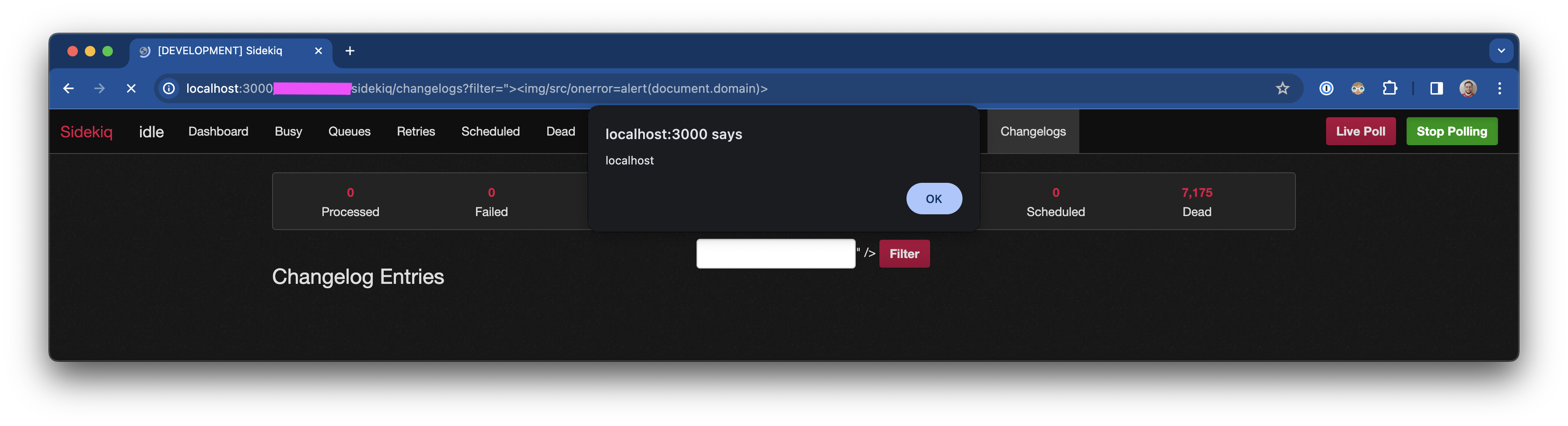\n b. `filter` is XSS vulnerable: `?filter=%22%3E%3Cimg/src/onerror=alert(document.domain)%3E`\n c. `count` is vulnerable to triggering an application error (status 500), potentially allowing resource exhaustion `?count=%22%3E%3Cimg/src/onerror=alert(document.domain)%3E`\n 1. Screenshot: 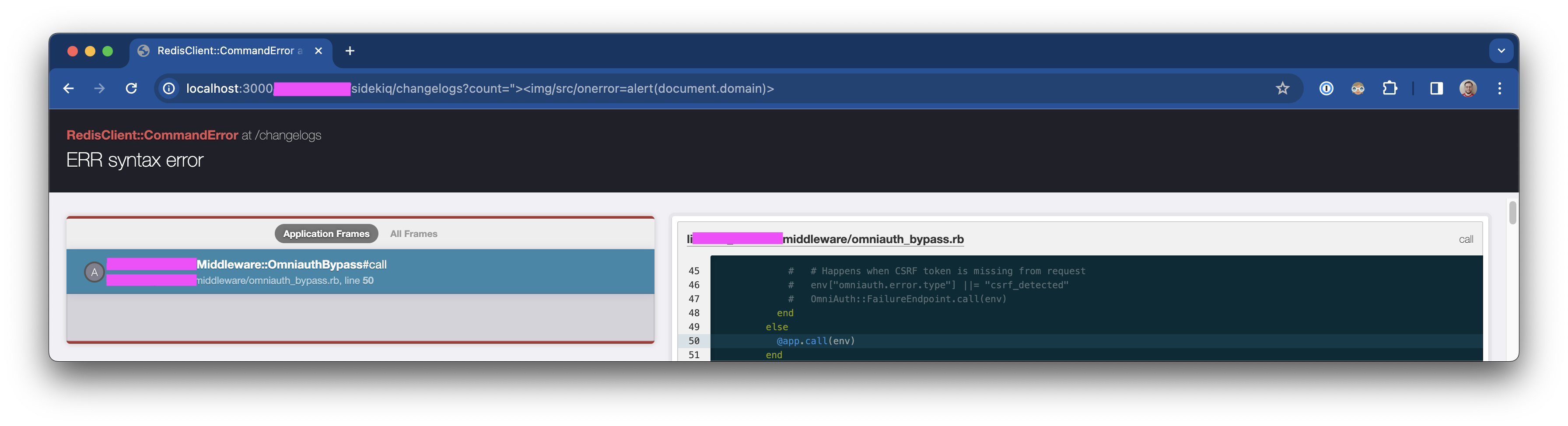\n2. Visit [/sidekiq/locks](http://localhost:3000/sidekiq/locks) - with a crafted query string like one of the following:\n a. Screenshot: 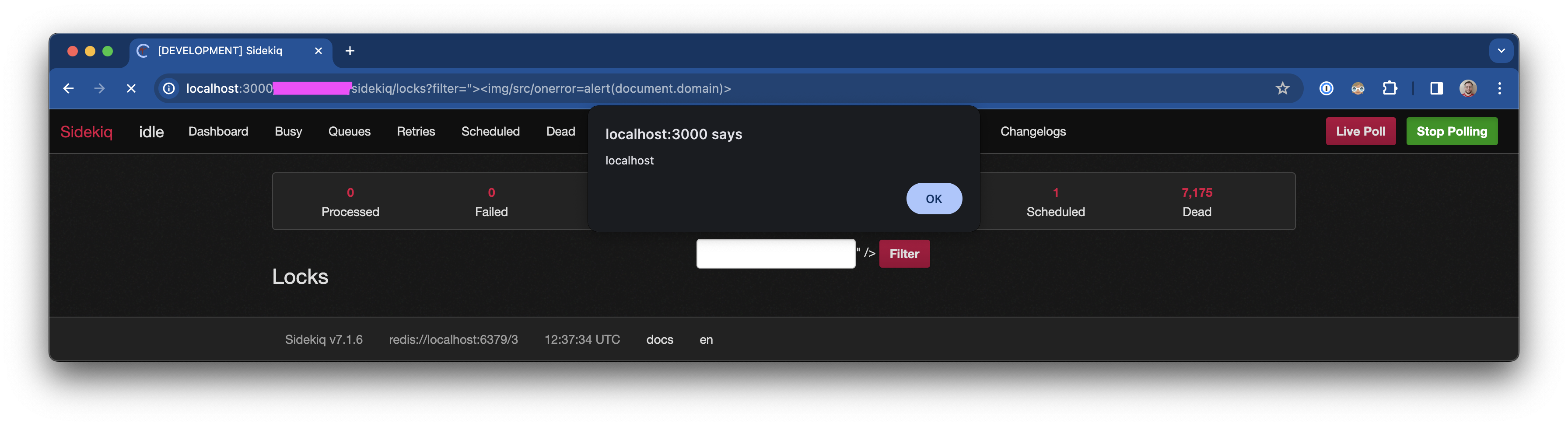\n b. `filter` is XSS vulnerable: `?filter=%22%3E%3Cimg/src/onerror=alert(document.domain)%3E`\n c. `count` is vulnerable to triggering an application error (status 500), potentially allowing resource exhaustion `?count=%22%3E%3Cimg/src/onerror=alert(document.domain)%3E`\n 1. Screenshot: 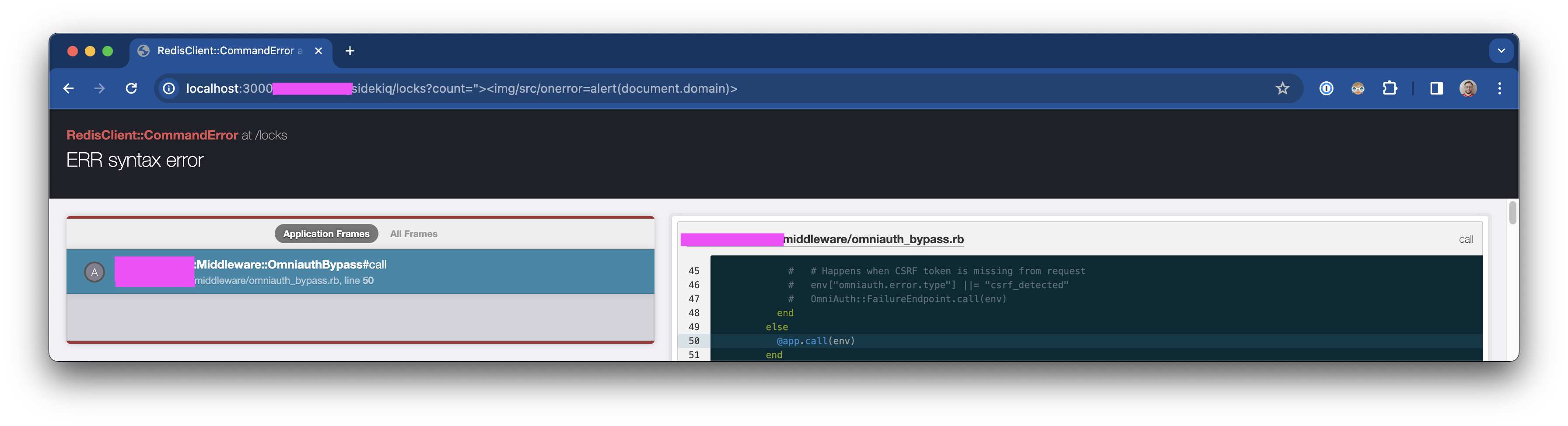\n3. Visit [/sidekiq/expiring_locks](http://localhost:3000/sidekiq/expiring_locks) - with a crafted query string like one of the following: \n a. Screenshot: 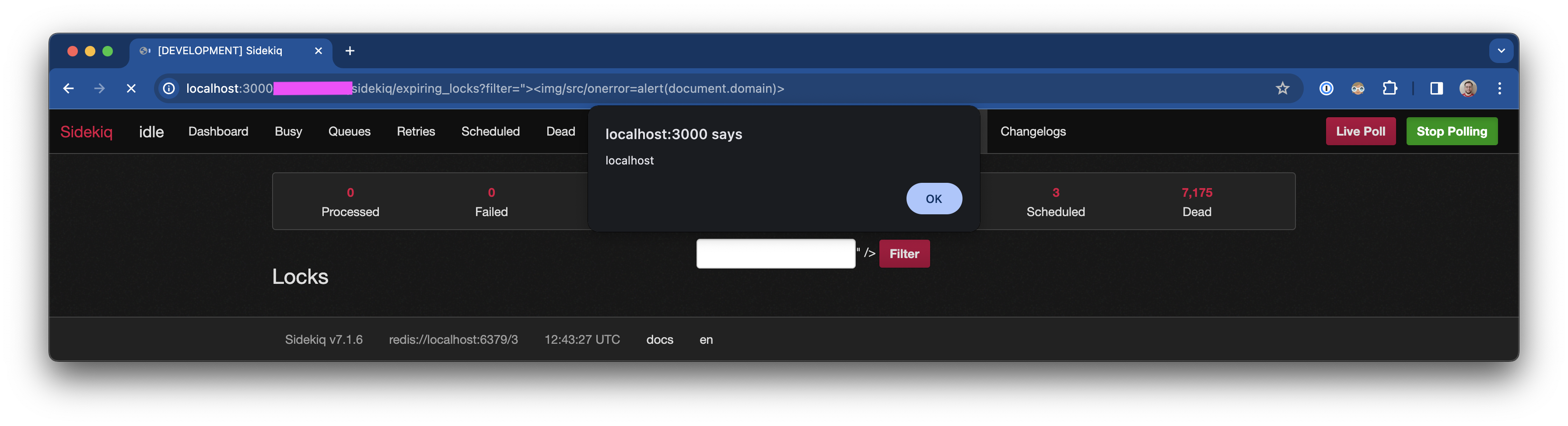\n b. `filter` is XSS vulnerable: `?filter=%22%3E%3Cimg/src/onerror=alert(document.domain)%3E`\n\n### Impact\n\nThis is a vulnerability of critical severity, which impacts many thousands of sites, since `sidekiq-unique-jobs` is widely deployed across the industry, with multiple attack vectors.",
"id": "GHSA-cmh9-rx85-xj38",
"modified": "2024-02-20T16:40:10Z",
"published": "2024-02-13T18:34:16Z",
"references": [
{
"type": "WEB",
"url": "https://github.com/mhenrixon/sidekiq-unique-jobs/security/advisories/GHSA-cmh9-rx85-xj38"
},
{
"type": "ADVISORY",
"url": "https://nvd.nist.gov/vuln/detail/CVE-2024-25122"
},
{
"type": "WEB",
"url": "https://github.com/mhenrixon/sidekiq-unique-jobs/commit/cd09ba6108f98973b6649a6149790c3d4502b4cc"
},
{
"type": "WEB",
"url": "https://github.com/mhenrixon/sidekiq-unique-jobs/commit/ec3afd920c1b55843c72f748a87baac7f8be82ed"
},
{
"type": "PACKAGE",
"url": "https://github.com/mhenrixon/sidekiq-unique-jobs"
},
{
"type": "WEB",
"url": "https://github.com/rubysec/ruby-advisory-db/blob/master/gems/sidekiq-unique-jobs/CVE-2024-25122.yml"
}
],
"schema_version": "1.4.0",
"severity": [
{
"score": "CVSS:3.1/AV:N/AC:L/PR:N/UI:R/S:C/C:L/I:L/A:L",
"type": "CVSS_V3"
}
],
"summary": "XSS sidekiq-unique-jobs UI server vulnerability"
}
GHSA-CMHX-CQ75-C4MJ
Vulnerability from github – Published: 2021-08-04 21:03 – Updated: 2023-02-21 18:57A denial of service vulnerability exists when .NET Framework and .NET Core improperly process RegEx strings, aka '.NET Framework and .NET Core Denial of Service Vulnerability'. This CVE ID is unique from CVE-2019-0980, CVE-2019-0981.
{
  "affected": [
    {
      "package": {
        "ecosystem": "NuGet",
        "name": "System.Text.RegularExpressions"
      },
      "ranges": [
        {
          "events": [
            {
              "introduced": "4.3.0"
            },
            {
              "fixed": "4.3.1"
            }
          ],
          "type": "ECOSYSTEM"
        }
      ]
    }
  ],
  "aliases": [
    "CVE-2019-0820"
  ],
  "database_specific": {
    "cwe_ids": [
      "CWE-1333",
      "CWE-400"
    ],
    "github_reviewed": true,
    "github_reviewed_at": "2021-08-04T21:03:27Z",
    "nvd_published_at": "2019-05-16T19:29:00Z",
    "severity": "HIGH"
  },
  "details": "A denial of service vulnerability exists when .NET Framework and .NET Core improperly process RegEx strings, aka \u0027.NET Framework and .NET Core Denial of Service Vulnerability\u0027. This CVE ID is unique from CVE-2019-0980, CVE-2019-0981.",
  "id": "GHSA-cmhx-cq75-c4mj",
  "modified": "2023-02-21T18:57:08Z",
  "published": "2021-08-04T21:03:46Z",
  "references": [
    {
      "type": "ADVISORY",
      "url": "https://nvd.nist.gov/vuln/detail/CVE-2019-0820"
    },
    {
      "type": "WEB",
      "url": "https://access.redhat.com/errata/RHSA-2019:1259"
    },
    {
      "type": "WEB",
      "url": "https://portal.msrc.microsoft.com/en-US/security-guidance/advisory/CVE-2019-0820"
    }
  ],
  "schema_version": "1.4.0",
  "severity": [
    {
      "score": "CVSS:3.1/AV:N/AC:L/PR:N/UI:N/S:U/C:N/I:N/A:H",
      "type": "CVSS_V3"
    }
  ],
  "summary": "Regular Expression Denial of Service in System.Text.RegularExpressions"
}
GHSA-CMJ7-8JRJ-42G2
Vulnerability from github – Published: 2024-09-17 00:31 – Updated: 2025-11-04 18:31This issue was addressed through improved state management. This issue is fixed in iOS 18 and iPadOS 18. A remote attacker may be able to cause a denial-of-service.
{
  "affected": [],
  "aliases": [
    "CVE-2024-27874"
  ],
  "database_specific": {
    "cwe_ids": [
      "CWE-400"
    ],
    "github_reviewed": false,
    "github_reviewed_at": null,
    "nvd_published_at": "2024-09-17T00:15:47Z",
    "severity": "HIGH"
  },
  "details": "This issue was addressed through improved state management. This issue is fixed in iOS 18 and iPadOS 18. A remote attacker may be able to cause a denial-of-service.",
  "id": "GHSA-cmj7-8jrj-42g2",
  "modified": "2025-11-04T18:31:19Z",
  "published": "2024-09-17T00:31:03Z",
  "references": [
    {
      "type": "ADVISORY",
      "url": "https://nvd.nist.gov/vuln/detail/CVE-2024-27874"
    },
    {
      "type": "WEB",
      "url": "https://support.apple.com/en-us/121250"
    },
    {
      "type": "WEB",
      "url": "http://seclists.org/fulldisclosure/2024/Sep/32"
    }
  ],
  "schema_version": "1.4.0",
  "severity": [
    {
      "score": "CVSS:3.1/AV:N/AC:L/PR:N/UI:N/S:U/C:H/I:N/A:N",
      "type": "CVSS_V3"
    }
  ]
}
GHSA-CMJJ-4JJR-C8VV
Vulnerability from github – Published: 2022-05-13 01:15 – Updated: 2022-05-13 01:15The VNC websocket frame decoder in QEMU allows remote attackers to cause a denial of service (memory and CPU consumption) via a large (1) websocket payload or (2) HTTP headers section.
{
  "affected": [],
  "aliases": [
    "CVE-2015-1779"
  ],
  "database_specific": {
    "cwe_ids": [
      "CWE-400"
    ],
    "github_reviewed": false,
    "github_reviewed_at": null,
    "nvd_published_at": "2016-01-12T19:59:00Z",
    "severity": "HIGH"
  },
  "details": "The VNC websocket frame decoder in QEMU allows remote attackers to cause a denial of service (memory and CPU consumption) via a large (1) websocket payload or (2) HTTP headers section.",
  "id": "GHSA-cmjj-4jjr-c8vv",
  "modified": "2022-05-13T01:15:00Z",
  "published": "2022-05-13T01:15:00Z",
  "references": [
    {
      "type": "ADVISORY",
      "url": "https://nvd.nist.gov/vuln/detail/CVE-2015-1779"
    },
    {
      "type": "WEB",
      "url": "https://access.redhat.com/errata/RHSA-2015:1931"
    },
    {
      "type": "WEB",
      "url": "https://access.redhat.com/errata/RHSA-2015:1943"
    },
    {
      "type": "WEB",
      "url": "https://access.redhat.com/security/cve/CVE-2015-1779"
    },
    {
      "type": "WEB",
      "url": "https://bugzilla.redhat.com/show_bug.cgi?id=1199572"
    },
    {
      "type": "WEB",
      "url": "https://lists.gnu.org/archive/html/qemu-devel/2015-03/msg04894.html"
    },
    {
      "type": "WEB",
      "url": "https://lists.gnu.org/archive/html/qemu-devel/2015-03/msg04895.html"
    },
    {
      "type": "WEB",
      "url": "https://lists.gnu.org/archive/html/qemu-devel/2015-03/msg04896.html"
    },
    {
      "type": "WEB",
      "url": "https://security.gentoo.org/glsa/201602-01"
    },
    {
      "type": "WEB",
      "url": "http://lists.fedoraproject.org/pipermail/package-announce/2015-April/154656.html"
    },
    {
      "type": "WEB",
      "url": "http://lists.fedoraproject.org/pipermail/package-announce/2015-April/155196.html"
    },
    {
      "type": "WEB",
      "url": "http://lists.opensuse.org/opensuse-security-announce/2015-05/msg00033.html"
    },
    {
      "type": "WEB",
      "url": "http://lists.opensuse.org/opensuse-security-announce/2015-05/msg00042.html"
    },
    {
      "type": "WEB",
      "url": "http://rhn.redhat.com/errata/RHSA-2015-1931.html"
    },
    {
      "type": "WEB",
      "url": "http://rhn.redhat.com/errata/RHSA-2015-1943.html"
    },
    {
      "type": "WEB",
      "url": "http://www.debian.org/security/2015/dsa-3259"
    },
    {
      "type": "WEB",
      "url": "http://www.openwall.com/lists/oss-security/2015/03/24/9"
    },
    {
      "type": "WEB",
      "url": "http://www.openwall.com/lists/oss-security/2015/04/09/6"
    },
    {
      "type": "WEB",
      "url": "http://www.oracle.com/technetwork/topics/security/linuxbulletinoct2015-2719645.html"
    },
    {
      "type": "WEB",
      "url": "http://www.securityfocus.com/bid/73303"
    },
    {
      "type": "WEB",
      "url": "http://www.securitytracker.com/id/1033975"
    },
    {
      "type": "WEB",
      "url": "http://www.ubuntu.com/usn/USN-2608-1"
    }
  ],
  "schema_version": "1.4.0",
  "severity": [
    {
      "score": "CVSS:3.1/AV:N/AC:L/PR:N/UI:N/S:C/C:N/I:N/A:H",
      "type": "CVSS_V3"
    }
  ]
}
GHSA-CMQ9-P2JC-99CW
Vulnerability from github – Published: 2025-01-14 18:32 – Updated: 2025-01-14 18:32Windows Connected Devices Platform Service (Cdpsvc) Denial of Service Vulnerability
{
  "affected": [],
  "aliases": [
    "CVE-2025-21207"
  ],
  "database_specific": {
    "cwe_ids": [
      "CWE-400"
    ],
    "github_reviewed": false,
    "github_reviewed_at": null,
    "nvd_published_at": "2025-01-14T18:15:32Z",
    "severity": "HIGH"
  },
  "details": "Windows Connected Devices Platform Service (Cdpsvc) Denial of Service Vulnerability",
  "id": "GHSA-cmq9-p2jc-99cw",
  "modified": "2025-01-14T18:32:02Z",
  "published": "2025-01-14T18:32:02Z",
  "references": [
    {
      "type": "ADVISORY",
      "url": "https://nvd.nist.gov/vuln/detail/CVE-2025-21207"
    },
    {
      "type": "WEB",
      "url": "https://msrc.microsoft.com/update-guide/vulnerability/CVE-2025-21207"
    }
  ],
  "schema_version": "1.4.0",
  "severity": [
    {
      "score": "CVSS:3.1/AV:N/AC:L/PR:N/UI:N/S:U/C:N/I:N/A:H",
      "type": "CVSS_V3"
    }
  ]
}
GHSA-CMV9-RHXG-F4XC
Vulnerability from github – Published: 2023-08-22 21:30 – Updated: 2024-04-04 07:06An issue was discovered in function nl80211_send_chandef in rtl8812au v5.6.4.2 allows attackers to cause a denial of service.
{
  "affected": [],
  "aliases": [
    "CVE-2020-26652"
  ],
  "database_specific": {
    "cwe_ids": [
      "CWE-400"
    ],
    "github_reviewed": false,
    "github_reviewed_at": null,
    "nvd_published_at": "2023-08-22T19:16:19Z",
    "severity": "HIGH"
  },
  "details": "An issue was discovered in function nl80211_send_chandef in rtl8812au v5.6.4.2 allows attackers to cause a denial of service.",
  "id": "GHSA-cmv9-rhxg-f4xc",
  "modified": "2024-04-04T07:06:34Z",
  "published": "2023-08-22T21:30:26Z",
  "references": [
    {
      "type": "ADVISORY",
      "url": "https://nvd.nist.gov/vuln/detail/CVE-2020-26652"
    },
    {
      "type": "WEB",
      "url": "https://github.com/aircrack-ng/rtl8812au/issues/730"
    }
  ],
  "schema_version": "1.4.0",
  "severity": [
    {
      "score": "CVSS:3.1/AV:N/AC:L/PR:N/UI:N/S:U/C:N/I:N/A:H",
      "type": "CVSS_V3"
    }
  ]
}
GHSA-CMW4-GVF3-7PV4
Vulnerability from github – Published: 2022-05-24 16:57 – Updated: 2024-04-04 02:07A vulnerability in the web-based management interface of Cisco IC3000 Industrial Compute Gateway could allow an authenticated, remote attacker to cause a denial of service (DoS) condition on an affected device. The vulnerability exists because the affected software improperly manages system resources. An attacker could exploit this vulnerability by opening a large number of simultaneous sessions on the web-based management interface of an affected device. A successful exploit could allow the attacker to cause a DoS condition of the web-based management interface, preventing normal management operations.
{
  "affected": [],
  "aliases": [
    "CVE-2019-12714"
  ],
  "database_specific": {
    "cwe_ids": [
      "CWE-400",
      "CWE-770"
    ],
    "github_reviewed": false,
    "github_reviewed_at": null,
    "nvd_published_at": "2019-10-02T19:15:00Z",
    "severity": "MODERATE"
  },
  "details": "A vulnerability in the web-based management interface of Cisco IC3000 Industrial Compute Gateway could allow an authenticated, remote attacker to cause a denial of service (DoS) condition on an affected device. The vulnerability exists because the affected software improperly manages system resources. An attacker could exploit this vulnerability by opening a large number of simultaneous sessions on the web-based management interface of an affected device. A successful exploit could allow the attacker to cause a DoS condition of the web-based management interface, preventing normal management operations.",
  "id": "GHSA-cmw4-gvf3-7pv4",
  "modified": "2024-04-04T02:07:44Z",
  "published": "2022-05-24T16:57:40Z",
  "references": [
    {
      "type": "ADVISORY",
      "url": "https://nvd.nist.gov/vuln/detail/CVE-2019-12714"
    },
    {
      "type": "WEB",
      "url": "https://tools.cisco.com/security/center/content/CiscoSecurityAdvisory/cisco-sa-20191002-ic3000-icg-dos"
    }
  ],
  "schema_version": "1.4.0",
  "severity": [
    {
      "score": "CVSS:3.1/AV:N/AC:L/PR:L/UI:N/S:U/C:N/I:N/A:H",
      "type": "CVSS_V3"
    }
  ]
}
GHSA-CP3V-GFW2-FM24
Vulnerability from github – Published: 2022-05-13 01:47 – Updated: 2022-05-13 01:47In all Qualcomm products with Android releases from CAF using the Linux kernel, if there is more than one thread doing the device open operation, the device may be opened more than once. This would lead to get_pid being called more than once, however put_pid being called only once in function "msm_close".
{
  "affected": [],
  "aliases": [
    "CVE-2017-8247"
  ],
  "database_specific": {
    "cwe_ids": [
      "CWE-400"
    ],
    "github_reviewed": false,
    "github_reviewed_at": null,
    "nvd_published_at": "2017-09-21T15:29:00Z",
    "severity": "HIGH"
  },
  "details": "In all Qualcomm products with Android releases from CAF using the Linux kernel, if there is more than one thread doing the device open operation, the device may be opened more than once. This would lead to get_pid being called more than once, however put_pid being called only once in function \"msm_close\".",
  "id": "GHSA-cp3v-gfw2-fm24",
  "modified": "2022-05-13T01:47:23Z",
  "published": "2022-05-13T01:47:23Z",
  "references": [
    {
      "type": "ADVISORY",
      "url": "https://nvd.nist.gov/vuln/detail/CVE-2017-8247"
    },
    {
      "type": "WEB",
      "url": "https://source.android.com/security/bulletin/2017-09-01"
    },
    {
      "type": "WEB",
      "url": "http://www.securityfocus.com/bid/100658"
    }
  ],
  "schema_version": "1.4.0",
  "severity": [
    {
      "score": "CVSS:3.0/AV:L/AC:L/PR:N/UI:R/S:U/C:H/I:H/A:H",
      "type": "CVSS_V3"
    }
  ]
}
GHSA-CP7P-C3XV-F5G5
Vulnerability from github – Published: 2022-05-24 17:05 – Updated: 2022-05-24 17:05GNU LibreDWG 0.9.3.2564 has an attempted excessive memory allocation in read_sections_map in decode_r2007.c.
{
  "affected": [],
  "aliases": [
    "CVE-2020-6610"
  ],
  "database_specific": {
    "cwe_ids": [
      "CWE-400",
      "CWE-770"
    ],
    "github_reviewed": false,
    "github_reviewed_at": null,
    "nvd_published_at": "2020-01-08T21:15:00Z",
    "severity": "MODERATE"
  },
  "details": "GNU LibreDWG 0.9.3.2564 has an attempted excessive memory allocation in read_sections_map in decode_r2007.c.",
  "id": "GHSA-cp7p-c3xv-f5g5",
  "modified": "2022-05-24T17:05:55Z",
  "published": "2022-05-24T17:05:55Z",
  "references": [
    {
      "type": "ADVISORY",
      "url": "https://nvd.nist.gov/vuln/detail/CVE-2020-6610"
    },
    {
      "type": "WEB",
      "url": "https://github.com/LibreDWG/libredwg/issues/179#issuecomment-570447120"
    },
    {
      "type": "WEB",
      "url": "http://lists.opensuse.org/opensuse-security-announce/2020-01/msg00046.html"
    },
    {
      "type": "WEB",
      "url": "http://lists.opensuse.org/opensuse-security-announce/2020-01/msg00052.html"
    }
  ],
  "schema_version": "1.4.0",
  "severity": []
}
GHSA-CPF9-PH2J-CCR9
Vulnerability from github – Published: 2026-04-16 21:09 – Updated: 2026-04-24 20:48Summary endpoints.GetSessionCookie parses an attacker-supplied cookie chunk count and calls make([]string, count) with no upper bound before any token validation occurs. The function is reached on every request to an OAuth-protected proxy share, allowing an unauthenticated remote attacker to trigger gigabyte-scale heap allocations per request, leading to process-level OOM termination or repeated goroutine panics. Both publicProxy and dynamicProxy are affected.
- Attack Vector: Network — exploitable via a single HTTP request with a crafted Cookie header.
- Attack Complexity: Low — no preconditions or chaining required; the attacker only needs to know the cookie name (publicly derivable from any OAuth redirect).
- Privileges Required: None — reached before JWT validation or any authentication check.
- User Interaction: None.
- Scope: Unchanged — impact is confined to the affected proxy process.
- Confidentiality Impact: None.
- Integrity Impact: None.
Availability Impact: High — sustained or concurrent requests cause OOM process termination, taking down the proxy for all users of all shares it serves.
Affected Components - endpoints/oauthCookies.go — GetSessionCookie (line 81) - endpoints/publicProxy/authOAuth.go — handleOAuth (line 50) — call site, pre-auth - endpoints/dynamicProxy/cookies.go — getSessionCookie (line 29) — call site
{
  "affected": [
    {
      "package": {
        "ecosystem": "Go",
        "name": "github.com/openziti/zrok"
      },
      "ranges": [
        {
          "events": [
            {
              "introduced": "0"
            },
            {
              "last_affected": "1.1.11"
            }
          ],
          "type": "ECOSYSTEM"
        }
      ]
    },
    {
      "package": {
        "ecosystem": "Go",
        "name": "github.com/openziti/zrok/v2"
      },
      "ranges": [
        {
          "events": [
            {
              "introduced": "0"
            },
            {
              "fixed": "2.0.1"
            }
          ],
          "type": "ECOSYSTEM"
        }
      ]
    }
  ],
  "aliases": [
    "CVE-2026-40303"
  ],
  "database_specific": {
    "cwe_ids": [
      "CWE-400",
      "CWE-789"
    ],
    "github_reviewed": true,
    "github_reviewed_at": "2026-04-16T21:09:08Z",
    "nvd_published_at": "2026-04-17T21:16:35Z",
    "severity": "HIGH"
  },
  "details": "**Summary**\nendpoints.GetSessionCookie parses an attacker-supplied cookie chunk count and calls make([]string, count) with no upper bound before any token validation occurs. The function is reached on every request to an OAuth-protected proxy share, allowing an unauthenticated remote attacker to trigger gigabyte-scale heap allocations per request, leading to process-level OOM termination or repeated goroutine panics. Both publicProxy and dynamicProxy are affected.\n\n- Attack Vector: Network \u2014 exploitable via a single HTTP request with a crafted Cookie header.\n- Attack Complexity: Low \u2014 no preconditions or chaining required; the attacker only needs to know the cookie name (publicly derivable from any OAuth redirect).\n- Privileges Required: None \u2014 reached before JWT validation or any authentication check.\n- User Interaction: None.\n- Scope: Unchanged \u2014 impact is confined to the affected proxy process.\n- Confidentiality Impact: None.\n- Integrity Impact: None.\n\nAvailability Impact: High \u2014 sustained or concurrent requests cause OOM process termination, taking down the proxy for all users of all shares it serves.\n\n**Affected Components**\n- endpoints/oauthCookies.go \u2014 GetSessionCookie (line 81)\n- endpoints/publicProxy/authOAuth.go \u2014 handleOAuth (line 50) \u2014 call site, pre-auth\n- endpoints/dynamicProxy/cookies.go \u2014 getSessionCookie (line 29) \u2014 call site",
  "id": "GHSA-cpf9-ph2j-ccr9",
  "modified": "2026-04-24T20:48:49Z",
  "published": "2026-04-16T21:09:08Z",
  "references": [
    {
      "type": "WEB",
      "url": "https://github.com/openziti/zrok/security/advisories/GHSA-cpf9-ph2j-ccr9"
    },
    {
      "type": "ADVISORY",
      "url": "https://nvd.nist.gov/vuln/detail/CVE-2026-40303"
    },
    {
      "type": "PACKAGE",
      "url": "https://github.com/openziti/zrok"
    },
    {
      "type": "WEB",
      "url": "https://github.com/openziti/zrok/releases/tag/v2.0.1"
    }
  ],
  "schema_version": "1.4.0",
  "severity": [
    {
      "score": "CVSS:3.1/AV:N/AC:L/PR:N/UI:N/S:U/C:N/I:N/A:H",
      "type": "CVSS_V3"
    }
  ],
  "summary": "zrok: Unauthenticated DoS via unbounded memory allocation in striped session cookie parsing"
}
Mitigation
Design throttling mechanisms into the system architecture. The best protection is to limit the amount of resources that an unauthorized user can cause to be expended. A strong authentication and access control model will help prevent such attacks from occurring in the first place. The login application should be protected against DoS attacks as much as possible. Limiting the database access, perhaps by caching result sets, can help minimize the resources expended. To further limit the potential for a DoS attack, consider tracking the rate of requests received from users and blocking requests that exceed a defined rate threshold.
Mitigation
- Mitigation of resource exhaustion attacks requires that the target system either:
- The first of these solutions is an issue in itself though, since it may allow attackers to prevent the use of the system by a particular valid user. If the attacker impersonates the valid user, they may be able to prevent the user from accessing the server in question.
- The second solution is simply difficult to effectively institute -- and even when properly done, it does not provide a full solution. It simply makes the attack require more resources on the part of the attacker.
- recognizes the attack and denies that user further access for a given amount of time, or
- uniformly throttles all requests in order to make it more difficult to consume resources more quickly than they can again be freed.
Mitigation
Ensure that protocols have specific limits of scale placed on them.
Mitigation
Ensure that all failures in resource allocation place the system into a safe posture.
CAPEC-147: XML Ping of the Death
An attacker initiates a resource depletion attack where a large number of small XML messages are delivered at a sufficiently rapid rate to cause a denial of service or crash of the target. Transactions such as repetitive SOAP transactions can deplete resources faster than a simple flooding attack because of the additional resources used by the SOAP protocol and the resources necessary to process SOAP messages. The transactions used are immaterial as long as they cause resource utilization on the target. In other words, this is a normal flooding attack augmented by using messages that will require extra processing on the target.
CAPEC-227: Sustained Client Engagement
An adversary attempts to deny legitimate users access to a resource by continually engaging a specific resource in an attempt to keep the resource tied up as long as possible. The adversary's primary goal is not to crash or flood the target, which would alert defenders; rather it is to repeatedly perform actions or abuse algorithmic flaws such that a given resource is tied up and not available to a legitimate user. By carefully crafting a requests that keep the resource engaged through what is seemingly benign requests, legitimate users are limited or completely denied access to the resource.
CAPEC-492: Regular Expression Exponential Blowup
An adversary may execute an attack on a program that uses a poor Regular Expression(Regex) implementation by choosing input that results in an extreme situation for the Regex. A typical extreme situation operates at exponential time compared to the input size. This is due to most implementations using a Nondeterministic Finite Automaton(NFA) state machine to be built by the Regex algorithm since NFA allows backtracking and thus more complex regular expressions.