CWE-400
DiscouragedUncontrolled Resource Consumption
Abstraction: Class · Status: Draft
The product does not properly control the allocation and maintenance of a limited resource.
6324 vulnerabilities reference this CWE, most recent first.
GHSA-CJP5-W3HM-4QP4
Vulnerability from github – Published: 2022-04-23 00:40 – Updated: 2024-04-03 23:53A denial of service flaw was found in the way the server component of Freeciv before 2.3.4 processed certain packets. A remote attacker could send a specially-crafted packet that, when processed would lead to memory exhaustion or excessive CPU consumption.
{
  "affected": [],
  "aliases": [
    "CVE-2012-5645"
  ],
  "database_specific": {
    "cwe_ids": [
      "CWE-400"
    ],
    "github_reviewed": false,
    "github_reviewed_at": null,
    "nvd_published_at": "2019-12-30T20:15:00Z",
    "severity": "HIGH"
  },
  "details": "A denial of service flaw was found in the way the server component of Freeciv before 2.3.4 processed certain packets. A remote attacker could send a specially-crafted packet that, when processed would lead to memory exhaustion or excessive CPU consumption.",
  "id": "GHSA-cjp5-w3hm-4qp4",
  "modified": "2024-04-03T23:53:05Z",
  "published": "2022-04-23T00:40:27Z",
  "references": [
    {
      "type": "ADVISORY",
      "url": "https://nvd.nist.gov/vuln/detail/CVE-2012-5645"
    },
    {
      "type": "WEB",
      "url": "https://access.redhat.com/security/cve/cve-2012-5645"
    },
    {
      "type": "WEB",
      "url": "https://bugs.debian.org/cgi-bin/bugreport.cgi?bug=696306"
    },
    {
      "type": "WEB",
      "url": "https://bugzilla.redhat.com/show_bug.cgi?id=CVE-2012-5645"
    },
    {
      "type": "WEB",
      "url": "https://security-tracker.debian.org/tracker/CVE-2012-5645"
    },
    {
      "type": "WEB",
      "url": "http://lists.fedoraproject.org/pipermail/package-announce/2013-January/095378.html"
    },
    {
      "type": "WEB",
      "url": "http://lists.fedoraproject.org/pipermail/package-announce/2013-January/095381.html"
    },
    {
      "type": "WEB",
      "url": "http://lists.fedoraproject.org/pipermail/package-announce/2013-January/096391.html"
    },
    {
      "type": "WEB",
      "url": "http://www.openwall.com/lists/oss-security/2012/12/18/5"
    },
    {
      "type": "WEB",
      "url": "http://www.openwall.com/lists/oss-security/2012/12/22/4"
    },
    {
      "type": "WEB",
      "url": "http://www.openwall.com/lists/oss-security/2012/12/30/11"
    },
    {
      "type": "WEB",
      "url": "http://www.openwall.com/lists/oss-security/2012/12/30/8"
    },
    {
      "type": "WEB",
      "url": "http://www.openwall.com/lists/oss-security/2012/12/31/2"
    },
    {
      "type": "WEB",
      "url": "http://www.securityfocus.com/bid/41352"
    }
  ],
  "schema_version": "1.4.0",
  "severity": [
    {
      "score": "CVSS:3.1/AV:N/AC:L/PR:N/UI:N/S:U/C:N/I:N/A:H",
      "type": "CVSS_V3"
    }
  ]
}
GHSA-CJQJ-7Q2Q-JX9C
Vulnerability from github – Published: 2026-01-15 15:31 – Updated: 2026-04-22 12:30A flaw was found in the libxml2 library. This uncontrolled resource consumption vulnerability occurs when processing XML catalogs that contain repeated elements pointing to the same downstream catalog. A remote attacker can exploit this by supplying crafted catalogs, causing the parser to redundantly traverse catalog chains. This leads to excessive CPU consumption and degrades application availability, resulting in a denial-of-service condition.
{
  "affected": [],
  "aliases": [
    "CVE-2026-0992"
  ],
  "database_specific": {
    "cwe_ids": [
      "CWE-400"
    ],
    "github_reviewed": false,
    "github_reviewed_at": null,
    "nvd_published_at": "2026-01-15T15:15:52Z",
    "severity": "LOW"
  },
  "details": "A flaw was found in the libxml2 library. This uncontrolled resource consumption vulnerability occurs when processing XML catalogs that contain repeated \u003cnextCatalog\u003e elements pointing to the same downstream catalog. A remote attacker can exploit this by supplying crafted catalogs, causing the parser to redundantly traverse catalog chains. This leads to excessive CPU consumption and degrades application availability, resulting in a denial-of-service condition.",
  "id": "GHSA-cjqj-7q2q-jx9c",
  "modified": "2026-04-22T12:30:29Z",
  "published": "2026-01-15T15:31:21Z",
  "references": [
    {
      "type": "ADVISORY",
      "url": "https://nvd.nist.gov/vuln/detail/CVE-2026-0992"
    },
    {
      "type": "WEB",
      "url": "https://access.redhat.com/errata/RHSA-2026:7519"
    },
    {
      "type": "WEB",
      "url": "https://access.redhat.com/security/cve/CVE-2026-0992"
    },
    {
      "type": "WEB",
      "url": "https://bugzilla.redhat.com/show_bug.cgi?id=2429975"
    },
    {
      "type": "WEB",
      "url": "https://gitlab.gnome.org/GNOME/libxml2/-/issues/1019"
    }
  ],
  "schema_version": "1.4.0",
  "severity": [
    {
      "score": "CVSS:3.1/AV:L/AC:H/PR:N/UI:N/S:U/C:N/I:N/A:L",
      "type": "CVSS_V3"
    }
  ]
}
GHSA-CJWG-QFPM-7377
Vulnerability from github – Published: 2024-04-26 00:30 – Updated: 2025-02-18 22:46python-jose through 3.3.0 allows attackers to cause a denial of service (resource consumption) during a decode via a crafted JSON Web Encryption (JWE) token with a high compression ratio, aka a "JWT bomb." This is similar to CVE-2024-21319.
{
  "affected": [
    {
      "package": {
        "ecosystem": "PyPI",
        "name": "python-jose"
      },
      "ranges": [
        {
          "events": [
            {
              "introduced": "0"
            },
            {
              "fixed": "3.4.0"
            }
          ],
          "type": "ECOSYSTEM"
        }
      ]
    }
  ],
  "aliases": [
    "CVE-2024-33664"
  ],
  "database_specific": {
    "cwe_ids": [
      "CWE-400"
    ],
    "github_reviewed": true,
    "github_reviewed_at": "2024-04-26T16:58:04Z",
    "nvd_published_at": "2024-04-26T00:15:09Z",
    "severity": "MODERATE"
  },
  "details": "python-jose through 3.3.0 allows attackers to cause a denial of service (resource consumption) during a decode via a crafted JSON Web Encryption (JWE) token with a high compression ratio, aka a \"JWT bomb.\" This is similar to CVE-2024-21319.",
  "id": "GHSA-cjwg-qfpm-7377",
  "modified": "2025-02-18T22:46:48Z",
  "published": "2024-04-26T00:30:35Z",
  "references": [
    {
      "type": "ADVISORY",
      "url": "https://nvd.nist.gov/vuln/detail/CVE-2024-33664"
    },
    {
      "type": "WEB",
      "url": "https://github.com/mpdavis/python-jose/issues/344"
    },
    {
      "type": "WEB",
      "url": "https://github.com/mpdavis/python-jose/pull/345"
    },
    {
      "type": "PACKAGE",
      "url": "https://github.com/mpdavis/python-jose"
    },
    {
      "type": "WEB",
      "url": "https://github.com/mpdavis/python-jose/releases/tag/3.4.0"
    },
    {
      "type": "WEB",
      "url": "https://github.com/pypa/advisory-database/tree/main/vulns/python-jose/PYSEC-2024-233.yaml"
    },
    {
      "type": "WEB",
      "url": "https://www.vicarius.io/vsociety/posts/jwt-bomb-in-python-jose-cve-2024-33664"
    }
  ],
  "schema_version": "1.4.0",
  "severity": [
    {
      "score": "CVSS:3.1/AV:N/AC:L/PR:N/UI:N/S:U/C:N/I:N/A:L",
      "type": "CVSS_V3"
    }
  ],
  "summary": "python-jose denial of service via compressed JWE content"
}
GHSA-CM33-6792-R9FM
Vulnerability from github – Published: 2026-05-07 00:12 – Updated: 2026-05-14 20:40Security Vulnerability Report: DNS Codec Input Validation Bypass in Netty (Encoder + Decoder)
1. Vulnerability Summary
| Field | Value |
|---|---|
| Product | Netty |
| Version | 4.2.12.Final (and all prior versions with codec-dns) |
| Component | io.netty.handler.codec.dns.DnsCodecUtil |
| Vulnerability Type | CWE-20: Improper Input Validation / CWE-626: Null Byte Interaction Error / CWE-400: Uncontrolled Resource Consumption |
| Impact | DNS Cache Poisoning / Domain Validation Bypass / Denial of Service / Malformed DNS Packets |
2. Affected Components
Both the encoder and decoder in the same file are affected:
io.netty.handler.codec.dns.DnsCodecUtil—encodeDomainName()method (lines 31-51):- No null byte validation in domain name labels
- No per-label length validation (RFC 1035 max: 63 bytes)
- No total domain name length validation (RFC 1035 max: 255 bytes)
-
Empty labels silently truncate the domain name
-
io.netty.handler.codec.dns.DnsCodecUtil—decodeDomainName()method (lines 53-118): - No per-label length validation (max 63)
- No total domain name length validation (max 255)
- Unbounded StringBuilder growth from attacker-controlled DNS responses
3. Vulnerability Description
Netty's DNS codec does not enforce RFC 1035 domain name constraints during either encoding or decoding. This creates a bidirectional attack surface: malicious DNS responses can exploit the decoder, and user-influenced hostnames can exploit the encoder.
3.1 Encoder Side — Null Byte Injection (CWE-626)
A domain name containing a null byte (e.g., "evil\0.example.com") is encoded with the null byte embedded in the label data. This creates a domain name that different DNS implementations interpret differently:
- Java (full string): sees
"evil\0.example.com"as a single label containing a null - C/native DNS libraries: truncate at the null byte, seeing only
"evil" - DNS servers: may accept or reject based on implementation
This differential interpretation enables DNS cache poisoning and domain validation bypass.
3.2 Encoder Side — Overlength Label (RFC 1035 Violation)
Labels exceeding 63 bytes are accepted by the encoder. The length byte is written as a single unsigned byte, so a 200-byte label writes 0xC8 (200) as the length. Per RFC 1035, values 192-255 indicate compression pointers. This means:
- A 200-byte label length
0xC8would be interpreted as a compression pointer by standards-compliant DNS parsers - This creates parser confusion between label and pointer interpretation
3.3 Encoder Side — Silent Truncation via Empty Labels
encodeDomainName("a..b.com", buf);
// Encodes as: [01] 'a' [00]
// Only "a." is encoded, ".b.com" is silently dropped!
An attacker can craft input like "safe-domain..evil.com" which gets truncated to just "safe-domain.", potentially bypassing domain allowlists.
3.4 Decoder Side — Unbounded Memory Allocation
The decoder accepts labels of any length (0-255 bytes) without checking the RFC 1035 per-label limit of 63 bytes or the total domain name limit of 255 bytes. A malicious DNS server can return responses with oversized labels, causing excessive memory allocation.
Root Cause — Encoder
// DnsCodecUtil.java:31-51
static void encodeDomainName(String name, ByteBuf buf) {
    if (ROOT.equals(name)) {
        buf.writeByte(0);
        return;
    }
    final String[] labels = name.split("\\.");
    for (String label : labels) {
        final int labelLen = label.length();
        if (labelLen == 0) {
            break;  // NO ERROR - silently truncates!
        }
        // NO check: labelLen > 63
        // NO check: label contains null bytes
        // NO check: total name > 255 bytes
        buf.writeByte(labelLen);                    // Can write values > 63!
        ByteBufUtil.writeAscii(buf, label);         // Null bytes pass through!
    }
    buf.writeByte(0);
}
Root Cause — Decoder
// DnsCodecUtil.java:94-99 (decodeDomainName)
} else if (len != 0) {
    if (!in.isReadable(len)) {  // Only checks if bytes EXIST, not if len <= 63
        throw new CorruptedFrameException("truncated label in a name");
    }
    name.append(in.toString(in.readerIndex(), len, CharsetUtil.UTF_8)).append('.');
    //    ^^^^^^ StringBuilder grows WITHOUT any length limit
    in.skipBytes(len);
}
Missing checks in decoder:
- No if (len > 63) check per RFC 1035 Section 2.3.4
- No if (name.length() > 255) check for total domain name length
4. Exploitability Prerequisites
Encoder Side (outbound)
- An application constructs DNS queries using Netty's DNS codec with user-influenced domain names
- The constructed DNS packets are sent to DNS servers or resolvers
Decoder Side (inbound)
- An application uses Netty's
codec-dnsorresolver-dnsmodule to process DNS responses - The application communicates with a malicious or compromised DNS server
Attack surface: Any Netty application using DNS resolution (DnsNameResolver) is potentially affected on the decoder side, as DNS responses from the network are attacker-controlled. The encoder side requires user-controlled hostnames.
5. Attack Scenarios
Scenario 1: DNS Cache Poisoning via Null Byte (Encoder)
String hostname = userInput;  // "evil\0.trusted.com"
DnsQuery query = new DefaultDnsQuery(...)
    .addRecord(DnsSection.QUESTION,
        new DefaultDnsQuestion(hostname, DnsRecordType.A));
The DNS query for "evil\0.trusted.com" may be interpreted by some resolvers as a query for "evil" (truncated at null). If the attacker controls the DNS for "evil", they can return a response that gets cached for "evil\0.trusted.com" (or vice versa), poisoning the cache.
Scenario 2: Label/Pointer Confusion (Encoder)
A 200-byte label writes length byte 0xC8. Standards-compliant parsers interpret 0xC0-0xFF as compression pointer prefixes (RFC 1035 Section 4.1.4). The resulting DNS packet is structurally ambiguous:
Byte:  [C8] [61 61 61 ... (200 bytes)]
         ↑
   Label interpretation: 200-byte label starting with 'a'
   Pointer interpretation: pointer to offset 0x0861 = 2145
Scenario 3: Memory Exhaustion via Large Labels (Decoder)
A malicious DNS server returns a response with a 255-byte label (RFC limit: 63). Netty decodes it without error, creating a 260+ character String. With compression pointers, a small DNS response can cause megabytes of StringBuilder allocation.
Scenario 4: Domain Truncation via Empty Label (Encoder)
encodeDomainName("safe-domain..evil.com", buf);
// Only "safe-domain." is encoded, "evil.com" silently dropped
This can bypass domain allowlists that check the input string.
Scenario 5: Downstream Processing Failures (Decoder)
Applications that pass decoded domain names to other DNS libraries, certificate validators, or URL parsers may crash or behave incorrectly when receiving names > 255 bytes, as these systems typically assume RFC 1035 compliance.
6. Proof of Concept
PoC 1: Encoder Null Byte and Overlength (DnsEncoderNullBytePoC.java)
import io.netty.buffer.ByteBuf;
import io.netty.buffer.Unpooled;
import java.lang.reflect.Method;
import java.nio.charset.StandardCharsets;

public class DnsEncoderNullBytePoC {
    public static void main(String[] args) throws Exception {
        System.out.println("=== Netty DNS Encoder Validation Bypass PoC ===\n");

        Class<?> clazz = Class.forName("io.netty.handler.codec.dns.DnsCodecUtil");
        Method encode = clazz.getDeclaredMethod("encodeDomainName",
            String.class, ByteBuf.class);
        encode.setAccessible(true);

        // Test 1: Null byte in domain name
        ByteBuf buf = Unpooled.buffer(256);
        encode.invoke(null, "evil\0.example.com", buf);
        byte[] bytes = new byte[buf.readableBytes()];
        buf.readBytes(bytes);
        buf.release();
        System.out.print("[TEST 1] Null byte - Encoded: ");
        for (byte b : bytes) System.out.printf("%02x ", b & 0xff);
        System.out.println("\nVULNERABLE: Null byte 0x00 in label data!");

        // Test 2: 200-byte label
        ByteBuf buf2 = Unpooled.buffer(512);
        encode.invoke(null, "a".repeat(200) + ".com", buf2);
        System.out.println("\n[TEST 2] 200-byte label encoded: " + buf2.readableBytes() + " bytes");
        System.out.println("VULNERABLE: Overlength label accepted!");
        buf2.release();

        // Test 3: Empty label truncation
        ByteBuf buf3 = Unpooled.buffer(256);
        encode.invoke(null, "a..b.com", buf3);
        byte[] bytes3 = new byte[buf3.readableBytes()];
        buf3.readBytes(bytes3);
        buf3.release();
        System.out.print("\n[TEST 3] Empty label - Encoded: ");
        for (byte b : bytes3) System.out.printf("%02x ", b & 0xff);
        System.out.println("\nVULNERABLE: Domain silently truncated!");
    }
}
PoC 2: Decoder Length Bypass (DnsDecoderLengthPoC.java)
import io.netty.buffer.ByteBuf;
import io.netty.buffer.Unpooled;
import java.lang.reflect.Method;
import java.nio.charset.StandardCharsets;

public class DnsDecoderLengthPoC {
    public static void main(String[] args) throws Exception {
        System.out.println("=== Netty DNS Decoder Length Bypass PoC ===\n");

        Class<?> clazz = Class.forName("io.netty.handler.codec.dns.DnsCodecUtil");
        Method decode = clazz.getDeclaredMethod("decodeDomainName", ByteBuf.class);
        decode.setAccessible(true);

        // Test 1: 100-byte label (RFC limit: 63)
        ByteBuf buf1 = Unpooled.buffer(256);
        buf1.writeByte(100);
        buf1.writeBytes("a".repeat(100).getBytes(StandardCharsets.US_ASCII));
        buf1.writeByte(3);
        buf1.writeBytes("com".getBytes(StandardCharsets.US_ASCII));
        buf1.writeByte(0);
        String r1 = (String) decode.invoke(null, buf1);
        buf1.release();
        System.out.println("[TEST 1] 100-byte label: length=" + r1.length() +
            " VULNERABLE=" + (r1.length() > 64));

        // Test 2: 5 x 60-byte labels = 305 bytes (RFC limit: 255)
        ByteBuf buf2 = Unpooled.buffer(512);
        for (int i = 0; i < 5; i++) {
            buf2.writeByte(60);
            buf2.writeBytes(String.valueOf((char)('a'+i)).repeat(60)
                .getBytes(StandardCharsets.US_ASCII));
        }
        buf2.writeByte(0);
        String r2 = (String) decode.invoke(null, buf2);
        buf2.release();
        System.out.println("[TEST 2] 305-byte domain: length=" + r2.length() +
            " VULNERABLE=" + (r2.length() > 255));
    }
}
How to Compile and Run
JARS=$(find ~/.m2/repository/io/netty -name "netty-*.jar" -path "*/4.2.12.Final/*" \
  | grep -v sources | grep -v javadoc | tr '\n' ':')

# Encoder PoC
javac -cp "$JARS" DnsEncoderNullBytePoC.java
java --add-opens java.base/java.lang=ALL-UNNAMED -cp "$JARS:." DnsEncoderNullBytePoC

# Decoder PoC
javac -cp "$JARS" DnsDecoderLengthPoC.java
java --add-opens java.base/java.lang=ALL-UNNAMED -cp "$JARS:." DnsDecoderLengthPoC
PoC Execution Output (Verified on Netty 4.2.12.Final)
Encoder PoC:
=== Netty DNS Encoder Validation Bypass PoC ===

[TEST 1] Null byte in domain name
  Input: "evil\0.example.com"
  Encoded bytes: 05 65 76 69 6c 00 07 65 78 61 6d 70 6c 65 03 63 6f 6d 00
  Null byte in label data: true
  VULNERABLE: YES - Null byte accepted!

[TEST 2] Label > 63 bytes in encoder
  Input: "aaaaaa..." (200-char label)
  Encoded bytes: 206
  VULNERABLE: YES - Overlength label accepted in encoder!

[TEST 3] Empty labels (consecutive dots)
  Input: "a..b.com"
  Encoded bytes: 01 61 00
  Note: Empty label truncates the name (may lose data)
Decoder PoC:
=== Netty DNS Decoder Length Bypass PoC ===

[TEST 1] Label > 63 bytes (RFC 1035 violation)
  Label length: 100 bytes (RFC limit: 63)
  Decoded name length: 105
  VULNERABLE: YES - Label > 63 bytes accepted!

[TEST 2] Domain > 255 bytes via multiple labels
  5 labels x 60 bytes = 300+ bytes total
  RFC 1035 limit: 255 bytes
  Decoded name length: 305
  VULNERABLE: YES - Domain > 255 bytes accepted!
7. Impact Analysis
| Impact Category | Description |
|---|---|
| Integrity | HIGH — Null byte injection causes differential interpretation across DNS implementations |
| Availability | HIGH — Malicious DNS responses can cause unbounded memory allocation via decoder |
| DNS Cache Poisoning | Different parsers see different domain names from the same encoded packet |
| Domain Validation Bypass | Null bytes can bypass allowlist/blocklist checks in DNS proxies |
| Label/Pointer Confusion | Length bytes > 63 conflict with RFC 1035 compression pointer encoding |
| Silent Truncation | Empty labels silently drop the remainder of the domain name |
| Downstream Failures | Oversized domain names may crash certificate validators, URL parsers, or other DNS-aware libraries |
8. Remediation Recommendations
Fix for Encoder (encodeDomainName)
static void encodeDomainName(String name, ByteBuf buf) {
    if (ROOT.equals(name)) {
        buf.writeByte(0);
        return;
    }
    int totalLength = 0;
    final String[] labels = name.split("\\.");
    for (String label : labels) {
        final int labelLen = label.length();
        if (labelLen == 0) {
            throw new IllegalArgumentException("DNS name contains empty label: " + name);
        }
        if (labelLen > 63) {
            throw new IllegalArgumentException(
                "DNS label length " + labelLen + " exceeds maximum of 63: " + name);
        }
        for (int i = 0; i < label.length(); i++) {
            if (label.charAt(i) == '\0') {
                throw new IllegalArgumentException(
                    "DNS label contains null byte at index " + i);
            }
        }
        totalLength += 1 + labelLen;
        if (totalLength > 254) {
            throw new IllegalArgumentException(
                "DNS name exceeds maximum length of 255: " + name);
        }
        buf.writeByte(labelLen);
        ByteBufUtil.writeAscii(buf, label);
    }
    buf.writeByte(0);
}
Fix for Decoder (decodeDomainName)
// Add after "} else if (len != 0) {":
if (len > 63) {
    throw new CorruptedFrameException("DNS label length " + len + " exceeds maximum of 63");
}
// Add after "name.append(...)":
if (name.length() > 255) {
    throw new CorruptedFrameException("DNS domain name length exceeds maximum of 255");
}
9. Resources
{
  "affected": [
    {
      "database_specific": {
        "last_known_affected_version_range": "\u003c= 4.2.12.Final"
      },
      "package": {
        "ecosystem": "Maven",
        "name": "io.netty:netty-codec-dns"
      },
      "ranges": [
        {
          "events": [
            {
              "introduced": "4.2.0.Alpha1"
            },
            {
              "fixed": "4.2.13.Final"
            }
          ],
          "type": "ECOSYSTEM"
        }
      ]
    },
    {
      "database_specific": {
        "last_known_affected_version_range": "\u003c= 4.1.132.Final"
      },
      "package": {
        "ecosystem": "Maven",
        "name": "io.netty:netty-codec-dns"
      },
      "ranges": [
        {
          "events": [
            {
              "introduced": "0"
            },
            {
              "fixed": "4.1.133.Final"
            }
          ],
          "type": "ECOSYSTEM"
        }
      ]
    }
  ],
  "aliases": [
    "CVE-2026-42579"
  ],
  "database_specific": {
    "cwe_ids": [
      "CWE-20",
      "CWE-400",
      "CWE-626"
    ],
    "github_reviewed": true,
    "github_reviewed_at": "2026-05-07T00:12:47Z",
    "nvd_published_at": "2026-05-13T19:17:23Z",
    "severity": "HIGH"
  },
  "details": "# Security Vulnerability Report: DNS Codec Input Validation Bypass in Netty (Encoder + Decoder)\n\n## 1. Vulnerability Summary\n\n| Field | Value |\n|-------|-------|\n| **Product** | Netty |\n| **Version** | 4.2.12.Final (and all prior versions with codec-dns) |\n| **Component** | `io.netty.handler.codec.dns.DnsCodecUtil` |\n| **Vulnerability Type** | CWE-20: Improper Input Validation / CWE-626: Null Byte Interaction Error / CWE-400: Uncontrolled Resource Consumption |\n| **Impact** | DNS Cache Poisoning / Domain Validation Bypass / Denial of Service / Malformed DNS Packets |\n\n## 2. Affected Components\n\nBoth the encoder and decoder in the same file are affected:\n\n- `io.netty.handler.codec.dns.DnsCodecUtil` \u2014 `encodeDomainName()` method (lines 31-51):\n  - No null byte validation in domain name labels\n  - No per-label length validation (RFC 1035 max: 63 bytes)\n  - No total domain name length validation (RFC 1035 max: 255 bytes)\n  - Empty labels silently truncate the domain name\n\n- `io.netty.handler.codec.dns.DnsCodecUtil` \u2014 `decodeDomainName()` method (lines 53-118):\n  - No per-label length validation (max 63)\n  - No total domain name length validation (max 255)\n  - Unbounded StringBuilder growth from attacker-controlled DNS responses\n\n## 3. Vulnerability Description\n\nNetty\u0027s DNS codec does **not enforce RFC 1035 domain name constraints** during either encoding or decoding. This creates a bidirectional attack surface: malicious DNS responses can exploit the decoder, and user-influenced hostnames can exploit the encoder.\n\n### 3.1 Encoder Side \u2014 Null Byte Injection (CWE-626)\n\nA domain name containing a null byte (e.g., `\"evil\\0.example.com\"`) is encoded with the null byte embedded in the label data. This creates a domain name that different DNS implementations interpret differently:\n\n- **Java (full string)**: sees `\"evil\\0.example.com\"` as a single label containing a null\n- **C/native DNS libraries**: truncate at the null byte, seeing only `\"evil\"`\n- **DNS servers**: may accept or reject based on implementation\n\nThis differential interpretation enables **DNS cache poisoning** and **domain validation bypass**.\n\n### 3.2 Encoder Side \u2014 Overlength Label (RFC 1035 Violation)\n\nLabels exceeding 63 bytes are accepted by the encoder. The length byte is written as a single unsigned byte, so a 200-byte label writes `0xC8` (200) as the length. Per RFC 1035, values 192-255 indicate **compression pointers**. This means:\n\n- A 200-byte label length `0xC8` would be interpreted as a **compression pointer** by standards-compliant DNS parsers\n- This creates **parser confusion** between label and pointer interpretation\n\n### 3.3 Encoder Side \u2014 Silent Truncation via Empty Labels\n\n```java\nencodeDomainName(\"a..b.com\", buf);\n// Encodes as: [01] \u0027a\u0027 [00]\n// Only \"a.\" is encoded, \".b.com\" is silently dropped!\n```\n\nAn attacker can craft input like `\"safe-domain..evil.com\"` which gets truncated to just `\"safe-domain.\"`, potentially bypassing domain allowlists.\n\n### 3.4 Decoder Side \u2014 Unbounded Memory Allocation\n\nThe decoder accepts labels of any length (0-255 bytes) without checking the RFC 1035 per-label limit of 63 bytes or the total domain name limit of 255 bytes. A malicious DNS server can return responses with oversized labels, causing excessive memory allocation.\n\n### Root Cause \u2014 Encoder\n\n```java\n// DnsCodecUtil.java:31-51\nstatic void encodeDomainName(String name, ByteBuf buf) {\n    if (ROOT.equals(name)) {\n        buf.writeByte(0);\n        return;\n    }\n    final String[] labels = name.split(\"\\\\.\");\n    for (String label : labels) {\n        final int labelLen = label.length();\n        if (labelLen == 0) {\n            break;  // NO ERROR - silently truncates!\n        }\n        // NO check: labelLen \u003e 63\n        // NO check: label contains null bytes\n        // NO check: total name \u003e 255 bytes\n        buf.writeByte(labelLen);                    // Can write values \u003e 63!\n        ByteBufUtil.writeAscii(buf, label);         // Null bytes pass through!\n    }\n    buf.writeByte(0);\n}\n```\n\n### Root Cause \u2014 Decoder\n\n```java\n// DnsCodecUtil.java:94-99 (decodeDomainName)\n} else if (len != 0) {\n    if (!in.isReadable(len)) {  // Only checks if bytes EXIST, not if len \u003c= 63\n        throw new CorruptedFrameException(\"truncated label in a name\");\n    }\n    name.append(in.toString(in.readerIndex(), len, CharsetUtil.UTF_8)).append(\u0027.\u0027);\n    //    ^^^^^^ StringBuilder grows WITHOUT any length limit\n    in.skipBytes(len);\n}\n```\n\n**Missing checks in decoder**:\n- No `if (len \u003e 63)` check per RFC 1035 Section 2.3.4\n- No `if (name.length() \u003e 255)` check for total domain name length\n\n## 4. Exploitability Prerequisites\n\n### Encoder Side (outbound)\n1. An application constructs DNS queries using Netty\u0027s DNS codec with user-influenced domain names\n2. The constructed DNS packets are sent to DNS servers or resolvers\n\n### Decoder Side (inbound)\n1. An application uses Netty\u0027s `codec-dns` or `resolver-dns` module to process DNS responses\n2. The application communicates with a malicious or compromised DNS server\n\n**Attack surface**: Any Netty application using DNS resolution (`DnsNameResolver`) is potentially affected on the decoder side, as DNS responses from the network are attacker-controlled. The encoder side requires user-controlled hostnames.\n\n## 5. Attack Scenarios\n\n### Scenario 1: DNS Cache Poisoning via Null Byte (Encoder)\n\n```java\nString hostname = userInput;  // \"evil\\0.trusted.com\"\nDnsQuery query = new DefaultDnsQuery(...)\n    .addRecord(DnsSection.QUESTION,\n        new DefaultDnsQuestion(hostname, DnsRecordType.A));\n```\n\nThe DNS query for `\"evil\\0.trusted.com\"` may be interpreted by some resolvers as a query for `\"evil\"` (truncated at null). If the attacker controls the DNS for `\"evil\"`, they can return a response that gets cached for `\"evil\\0.trusted.com\"` (or vice versa), poisoning the cache.\n\n### Scenario 2: Label/Pointer Confusion (Encoder)\n\nA 200-byte label writes length byte `0xC8`. Standards-compliant parsers interpret `0xC0-0xFF` as **compression pointer** prefixes (RFC 1035 Section 4.1.4). The resulting DNS packet is structurally ambiguous:\n\n```\nByte:  [C8] [61 61 61 ... (200 bytes)]\n         \u2191\n   Label interpretation: 200-byte label starting with \u0027a\u0027\n   Pointer interpretation: pointer to offset 0x0861 = 2145\n```\n\n### Scenario 3: Memory Exhaustion via Large Labels (Decoder)\n\nA malicious DNS server returns a response with a 255-byte label (RFC limit: 63). Netty decodes it without error, creating a 260+ character String. With compression pointers, a small DNS response can cause megabytes of StringBuilder allocation.\n\n### Scenario 4: Domain Truncation via Empty Label (Encoder)\n\n```java\nencodeDomainName(\"safe-domain..evil.com\", buf);\n// Only \"safe-domain.\" is encoded, \"evil.com\" silently dropped\n```\n\nThis can bypass domain allowlists that check the input string.\n\n### Scenario 5: Downstream Processing Failures (Decoder)\n\nApplications that pass decoded domain names to other DNS libraries, certificate validators, or URL parsers may crash or behave incorrectly when receiving names \u003e 255 bytes, as these systems typically assume RFC 1035 compliance.\n\n## 6. Proof of Concept\n\n### PoC 1: Encoder Null Byte and Overlength (DnsEncoderNullBytePoC.java)\n\n```java\nimport io.netty.buffer.ByteBuf;\nimport io.netty.buffer.Unpooled;\nimport java.lang.reflect.Method;\nimport java.nio.charset.StandardCharsets;\n\npublic class DnsEncoderNullBytePoC {\n    public static void main(String[] args) throws Exception {\n        System.out.println(\"=== Netty DNS Encoder Validation Bypass PoC ===\\n\");\n\n        Class\u003c?\u003e clazz = Class.forName(\"io.netty.handler.codec.dns.DnsCodecUtil\");\n        Method encode = clazz.getDeclaredMethod(\"encodeDomainName\",\n            String.class, ByteBuf.class);\n        encode.setAccessible(true);\n\n        // Test 1: Null byte in domain name\n        ByteBuf buf = Unpooled.buffer(256);\n        encode.invoke(null, \"evil\\0.example.com\", buf);\n        byte[] bytes = new byte[buf.readableBytes()];\n        buf.readBytes(bytes);\n        buf.release();\n        System.out.print(\"[TEST 1] Null byte - Encoded: \");\n        for (byte b : bytes) System.out.printf(\"%02x \", b \u0026 0xff);\n        System.out.println(\"\\nVULNERABLE: Null byte 0x00 in label data!\");\n\n        // Test 2: 200-byte label\n        ByteBuf buf2 = Unpooled.buffer(512);\n        encode.invoke(null, \"a\".repeat(200) + \".com\", buf2);\n        System.out.println(\"\\n[TEST 2] 200-byte label encoded: \" + buf2.readableBytes() + \" bytes\");\n        System.out.println(\"VULNERABLE: Overlength label accepted!\");\n        buf2.release();\n\n        // Test 3: Empty label truncation\n        ByteBuf buf3 = Unpooled.buffer(256);\n        encode.invoke(null, \"a..b.com\", buf3);\n        byte[] bytes3 = new byte[buf3.readableBytes()];\n        buf3.readBytes(bytes3);\n        buf3.release();\n        System.out.print(\"\\n[TEST 3] Empty label - Encoded: \");\n        for (byte b : bytes3) System.out.printf(\"%02x \", b \u0026 0xff);\n        System.out.println(\"\\nVULNERABLE: Domain silently truncated!\");\n    }\n}\n```\n\n### PoC 2: Decoder Length Bypass (DnsDecoderLengthPoC.java)\n\n```java\nimport io.netty.buffer.ByteBuf;\nimport io.netty.buffer.Unpooled;\nimport java.lang.reflect.Method;\nimport java.nio.charset.StandardCharsets;\n\npublic class DnsDecoderLengthPoC {\n    public static void main(String[] args) throws Exception {\n        System.out.println(\"=== Netty DNS Decoder Length Bypass PoC ===\\n\");\n\n        Class\u003c?\u003e clazz = Class.forName(\"io.netty.handler.codec.dns.DnsCodecUtil\");\n        Method decode = clazz.getDeclaredMethod(\"decodeDomainName\", ByteBuf.class);\n        decode.setAccessible(true);\n\n        // Test 1: 100-byte label (RFC limit: 63)\n        ByteBuf buf1 = Unpooled.buffer(256);\n        buf1.writeByte(100);\n        buf1.writeBytes(\"a\".repeat(100).getBytes(StandardCharsets.US_ASCII));\n        buf1.writeByte(3);\n        buf1.writeBytes(\"com\".getBytes(StandardCharsets.US_ASCII));\n        buf1.writeByte(0);\n        String r1 = (String) decode.invoke(null, buf1);\n        buf1.release();\n        System.out.println(\"[TEST 1] 100-byte label: length=\" + r1.length() +\n            \" VULNERABLE=\" + (r1.length() \u003e 64));\n\n        // Test 2: 5 x 60-byte labels = 305 bytes (RFC limit: 255)\n        ByteBuf buf2 = Unpooled.buffer(512);\n        for (int i = 0; i \u003c 5; i++) {\n            buf2.writeByte(60);\n            buf2.writeBytes(String.valueOf((char)(\u0027a\u0027+i)).repeat(60)\n                .getBytes(StandardCharsets.US_ASCII));\n        }\n        buf2.writeByte(0);\n        String r2 = (String) decode.invoke(null, buf2);\n        buf2.release();\n        System.out.println(\"[TEST 2] 305-byte domain: length=\" + r2.length() +\n            \" VULNERABLE=\" + (r2.length() \u003e 255));\n    }\n}\n```\n\n### How to Compile and Run\n\n```bash\nJARS=$(find ~/.m2/repository/io/netty -name \"netty-*.jar\" -path \"*/4.2.12.Final/*\" \\\n  | grep -v sources | grep -v javadoc | tr \u0027\\n\u0027 \u0027:\u0027)\n\n# Encoder PoC\njavac -cp \"$JARS\" DnsEncoderNullBytePoC.java\njava --add-opens java.base/java.lang=ALL-UNNAMED -cp \"$JARS:.\" DnsEncoderNullBytePoC\n\n# Decoder PoC\njavac -cp \"$JARS\" DnsDecoderLengthPoC.java\njava --add-opens java.base/java.lang=ALL-UNNAMED -cp \"$JARS:.\" DnsDecoderLengthPoC\n```\n\n### PoC Execution Output (Verified on Netty 4.2.12.Final)\n\n**Encoder PoC:**\n```\n=== Netty DNS Encoder Validation Bypass PoC ===\n\n[TEST 1] Null byte in domain name\n  Input: \"evil\\0.example.com\"\n  Encoded bytes: 05 65 76 69 6c 00 07 65 78 61 6d 70 6c 65 03 63 6f 6d 00\n  Null byte in label data: true\n  VULNERABLE: YES - Null byte accepted!\n\n[TEST 2] Label \u003e 63 bytes in encoder\n  Input: \"aaaaaa...\" (200-char label)\n  Encoded bytes: 206\n  VULNERABLE: YES - Overlength label accepted in encoder!\n\n[TEST 3] Empty labels (consecutive dots)\n  Input: \"a..b.com\"\n  Encoded bytes: 01 61 00\n  Note: Empty label truncates the name (may lose data)\n```\n\n**Decoder PoC:**\n```\n=== Netty DNS Decoder Length Bypass PoC ===\n\n[TEST 1] Label \u003e 63 bytes (RFC 1035 violation)\n  Label length: 100 bytes (RFC limit: 63)\n  Decoded name length: 105\n  VULNERABLE: YES - Label \u003e 63 bytes accepted!\n\n[TEST 2] Domain \u003e 255 bytes via multiple labels\n  5 labels x 60 bytes = 300+ bytes total\n  RFC 1035 limit: 255 bytes\n  Decoded name length: 305\n  VULNERABLE: YES - Domain \u003e 255 bytes accepted!\n```\n\n## 7. Impact Analysis\n\n| Impact Category | Description |\n|----------------|-------------|\n| **Integrity** | HIGH \u2014 Null byte injection causes differential interpretation across DNS implementations |\n| **Availability** | HIGH \u2014 Malicious DNS responses can cause unbounded memory allocation via decoder |\n| **DNS Cache Poisoning** | Different parsers see different domain names from the same encoded packet |\n| **Domain Validation Bypass** | Null bytes can bypass allowlist/blocklist checks in DNS proxies |\n| **Label/Pointer Confusion** | Length bytes \u003e 63 conflict with RFC 1035 compression pointer encoding |\n| **Silent Truncation** | Empty labels silently drop the remainder of the domain name |\n| **Downstream Failures** | Oversized domain names may crash certificate validators, URL parsers, or other DNS-aware libraries |\n\n## 8. Remediation Recommendations\n\n### Fix for Encoder (encodeDomainName)\n\n```java\nstatic void encodeDomainName(String name, ByteBuf buf) {\n    if (ROOT.equals(name)) {\n        buf.writeByte(0);\n        return;\n    }\n    int totalLength = 0;\n    final String[] labels = name.split(\"\\\\.\");\n    for (String label : labels) {\n        final int labelLen = label.length();\n        if (labelLen == 0) {\n            throw new IllegalArgumentException(\"DNS name contains empty label: \" + name);\n        }\n        if (labelLen \u003e 63) {\n            throw new IllegalArgumentException(\n                \"DNS label length \" + labelLen + \" exceeds maximum of 63: \" + name);\n        }\n        for (int i = 0; i \u003c label.length(); i++) {\n            if (label.charAt(i) == \u0027\\0\u0027) {\n                throw new IllegalArgumentException(\n                    \"DNS label contains null byte at index \" + i);\n            }\n        }\n        totalLength += 1 + labelLen;\n        if (totalLength \u003e 254) {\n            throw new IllegalArgumentException(\n                \"DNS name exceeds maximum length of 255: \" + name);\n        }\n        buf.writeByte(labelLen);\n        ByteBufUtil.writeAscii(buf, label);\n    }\n    buf.writeByte(0);\n}\n```\n\n### Fix for Decoder (decodeDomainName)\n\n```java\n// Add after \"} else if (len != 0) {\":\nif (len \u003e 63) {\n    throw new CorruptedFrameException(\"DNS label length \" + len + \" exceeds maximum of 63\");\n}\n// Add after \"name.append(...)\":\nif (name.length() \u003e 255) {\n    throw new CorruptedFrameException(\"DNS domain name length exceeds maximum of 255\");\n}\n```\n\n## 9. Resources\n\n- [RFC 1035 Section 2.3.4: Size Limits](https://tools.ietf.org/html/rfc1035#section-2.3.4)\n- [RFC 1035 Section 4.1.4: Message Compression](https://tools.ietf.org/html/rfc1035#section-4.1.4)\n- [CWE-20: Improper Input Validation](https://cwe.mitre.org/data/definitions/20.html)\n- [CWE-400: Uncontrolled Resource Consumption](https://cwe.mitre.org/data/definitions/400.html)\n- [CWE-626: Null Byte Interaction Error](https://cwe.mitre.org/data/definitions/626.html)",
  "id": "GHSA-cm33-6792-r9fm",
  "modified": "2026-05-14T20:40:58Z",
  "published": "2026-05-07T00:12:47Z",
  "references": [
    {
      "type": "WEB",
      "url": "https://github.com/netty/netty/security/advisories/GHSA-cm33-6792-r9fm"
    },
    {
      "type": "ADVISORY",
      "url": "https://nvd.nist.gov/vuln/detail/CVE-2026-42579"
    },
    {
      "type": "PACKAGE",
      "url": "https://github.com/netty/netty"
    },
    {
      "type": "WEB",
      "url": "https://tools.ietf.org/html/rfc1035#section-2.3.4"
    },
    {
      "type": "WEB",
      "url": "https://tools.ietf.org/html/rfc1035#section-4.1.4"
    }
  ],
  "schema_version": "1.4.0",
  "severity": [
    {
      "score": "CVSS:3.1/AV:N/AC:L/PR:N/UI:N/S:U/C:N/I:H/A:N",
      "type": "CVSS_V3"
    }
  ],
  "summary": "Netty has a DNS Codec Input Validation Bypass (Encoder + Decoder)"
}
GHSA-CM5Q-FCM3-4M7V
Vulnerability from github – Published: 2022-09-14 00:00 – Updated: 2022-09-14 00:00{
"affected": [],
"aliases": [
"CVE-2022-35838"
],
"database_specific": {
"cwe_ids": [
"CWE-400"
],
"github_reviewed": false,
"github_reviewed_at": null,
"nvd_published_at": "2022-09-13T19:15:00Z",
"severity": "HIGH"
},
"details": "HTTP V3 Denial of Service Vulnerability.",
"id": "GHSA-cm5q-fcm3-4m7v",
"modified": "2022-09-14T00:00:44Z",
"published": "2022-09-14T00:00:44Z",
"references": [
{
"type": "ADVISORY",
"url": "https://nvd.nist.gov/vuln/detail/CVE-2022-35838"
},
{
"type": "WEB",
"url": "https://msrc.microsoft.com/update-guide/vulnerability/CVE-2022-35838"
},
{
"type": "WEB",
"url": "https://portal.msrc.microsoft.com/en-US/security-guidance/advisory/CVE-2022-35838"
}
],
"schema_version": "1.4.0",
"severity": [
{
"score": "CVSS:3.1/AV:N/AC:L/PR:N/UI:N/S:U/C:N/I:N/A:H",
"type": "CVSS_V3"
}
]
}
GHSA-CM9M-HP76-GRCQ
Vulnerability from github – Published: 2024-08-22 06:30 – Updated: 2026-09-16 21:31The Mirai botnet through 2024-08-19 mishandles simultaneous TCP connections to the CNC (command and control) server. Unauthenticated sessions remain open, causing resource consumption. For example, an attacker can send a recognized username (such as root), or can send arbitrary data.
{
  "affected": [],
  "aliases": [
    "CVE-2024-45163"
  ],
  "database_specific": {
    "cwe_ids": [
      "CWE-400"
    ],
    "github_reviewed": false,
    "github_reviewed_at": null,
    "nvd_published_at": "2024-08-22T04:15:20Z",
    "severity": "CRITICAL"
  },
  "details": "The Mirai botnet through 2024-08-19 mishandles simultaneous TCP connections to the CNC (command and control) server. Unauthenticated sessions remain open, causing resource consumption. For example, an attacker can send a recognized username (such as root), or can send arbitrary data.",
  "id": "GHSA-cm9m-hp76-grcq",
  "modified": "2026-09-16T21:31:31Z",
  "published": "2024-08-22T06:30:29Z",
  "references": [
    {
      "type": "ADVISORY",
      "url": "https://nvd.nist.gov/vuln/detail/CVE-2024-45163"
    },
    {
      "type": "WEB",
      "url": "https://cypressthatkid.medium.com/remote-dos-exploit-found-in-mirai-botnet-source-code-27a1aad284f1"
    },
    {
      "type": "WEB",
      "url": "https://flowtriq.com/blog/cve-2024-45163-mirai-botnet-kill-switch"
    },
    {
      "type": "WEB",
      "url": "https://pastebin.com/6tqHnCva"
    },
    {
      "type": "WEB",
      "url": "https://traztech.ca/research"
    },
    {
      "type": "WEB",
      "url": "https://youtu.be/aJkvSr85ML8"
    }
  ],
  "schema_version": "1.4.0",
  "severity": [
    {
      "score": "CVSS:3.1/AV:N/AC:L/PR:N/UI:N/S:U/C:N/I:H/A:H",
      "type": "CVSS_V3"
    }
  ]
}
GHSA-CMF5-6CMW-5M74
Vulnerability from github – Published: 2026-09-15 21:32 – Updated: 2026-09-15 21:32Vulnerability in the Siebel CRM Deployment product of Oracle Siebel CRM (component: Server Infrastructure). Supported versions that are affected are 17.0-26.7. Easily exploitable vulnerability allows unauthenticated attacker with network access via HTTP to compromise Siebel CRM Deployment. Successful attacks of this vulnerability can result in unauthorized ability to cause a hang or frequently repeatable crash (complete DOS) of Siebel CRM Deployment. CVSS 3.1 Base Score 7.5 (Availability impacts). CVSS Vector: (CVSS:3.1/AV:N/AC:L/PR:N/UI:N/S:U/C:N/I:N/A:H).
{
  "affected": [],
  "aliases": [
    "CVE-2026-83183"
  ],
  "database_specific": {
    "cwe_ids": [
      "CWE-400"
    ],
    "github_reviewed": false,
    "github_reviewed_at": null,
    "nvd_published_at": "2026-09-15T20:18:29Z",
    "severity": "HIGH"
  },
  "details": "Vulnerability in the Siebel CRM Deployment product of Oracle Siebel CRM (component: Server Infrastructure).  Supported versions that are affected are 17.0-26.7. Easily exploitable vulnerability allows unauthenticated attacker with network access via HTTP to compromise Siebel CRM Deployment.  Successful attacks of this vulnerability can result in unauthorized ability to cause a hang or frequently repeatable crash (complete DOS) of Siebel CRM Deployment. CVSS 3.1 Base Score 7.5 (Availability impacts).  CVSS Vector: (CVSS:3.1/AV:N/AC:L/PR:N/UI:N/S:U/C:N/I:N/A:H).",
  "id": "GHSA-cmf5-6cmw-5m74",
  "modified": "2026-09-15T21:32:17Z",
  "published": "2026-09-15T21:32:17Z",
  "references": [
    {
      "type": "ADVISORY",
      "url": "https://nvd.nist.gov/vuln/detail/CVE-2026-83183"
    },
    {
      "type": "WEB",
      "url": "https://www.oracle.com/security-alerts/cspusep2026.html"
    }
  ],
  "schema_version": "1.4.0",
  "severity": [
    {
      "score": "CVSS:3.1/AV:N/AC:L/PR:N/UI:N/S:U/C:N/I:N/A:H",
      "type": "CVSS_V3"
    }
  ]
}
GHSA-CMH9-RX85-XJ38
Vulnerability from github – Published: 2024-02-13 18:34 – Updated: 2024-02-20 16:40Summary
Cross site scripting (XSS) potentially exposing cookies / sessions / localStorage, fixed by sidekiq-unique-jobs v8.0.7.
Specifically, this is a Reflected (Server-Side), Non-Self, Cross Site Scripting vulnerability, considered a P3 on the BugCrowd taxonomy with the following categorization: Cross-Site Scripting (XSS) > Reflected > Non-Self
It was initially thought there was a second vulnerability (RCE), but it was a false alarm. Injection is impossible with Redis:
String escaping and NoSQL injection The Redis protocol has no concept of string escaping, so injection is impossible under normal circumstances using a normal client library. The protocol uses prefixed-length strings and is completely binary safe.
Ref: https://redis.io/docs/management/security/
XSS Vulnerability
Specially crafted GET request parameters handled by any of the following endpoints of sidekiq-unique-jobs' "admin" web UI, allow a super-user attacker, or an unwitting, but authorized, victim, who has received a disguised / crafted link, to successfully execute malicious code, which could potentially steal cookies, session data, or local storage data from the app the sidekiq-unique-jobs web UI is mounted in.
/changelogs/locks/expiring_locks
This means if your sidekiq-unique-jobs web UI is mounted at /sidekiq, the vulnerable paths are:
/sidekiq/changelogs/sidekiq/locks/sidekiq/expiring_locks
XSS vulnerability is an instance of CAPEC-32: XSS Through HTTP Query Strings, which is related to CWE-80. In certain cases where it results in a server error with status 500, it could be considered a vector for uncontrolled resource consumption, given that errors can be much more resource intensive that normal requests, and thus CWE-400 & CWE-754 may also be relevant.
Details
Fix for the XSS vulnerability was released in sidekiq-unique-jobs v8.0.7.
This is an analogous attack vector to that which affected sidekiq gem from version v7.0.4 to v7.0.7, and was given identifiers GHSA-h3r8-h5qw-4r35 & CVE-2023-1892.
The vulnerability in sidekiq-unique-jobs' was not fixed by sidekiq v7.0.8, nor the more recent sidekiq v7.2.0 releases; they are similar but unrelated, distinct vulnerabilities in adjacent projects.
Note #1: The admin web UI for sidekiq-unique-jobs is not protected by any authorization constraint in the default configuration. Auth constraints must be configured by the programmer. It is recommended and expected that users will configure authorization constrains on the "admin" UI. This is not specifically related to the vulnerability but may make users who fail to constrain their "admin" UI even more vulnerable.
Note #2: Most users of the library will not have configured the UI on a sandboxed subdomain, making all their cookies, localStorage data and session secrets vulnerable to exposure. The purpose of a sandboxed subdomain is expressly to prevent leaking sensitive data through XSS attacks.
XSS Fix PR: https://github.com/mhenrixon/sidekiq-unique-jobs/pull/829
PoC
XSS
Use a string like:
%22%3E%3Cimg/src/onerror=alert(document.domain)%3E
as the value for one of the parameters that are handled without escaping. Reference: https://liveoverflow.com/do-not-use-alert-1-in-xss/
- Visit /sidekiq/changelogs - with a crafted query string like one of the following:
a. Screenshot:
b.
filteris XSS vulnerable:?filter=%22%3E%3Cimg/src/onerror=alert(document.domain)%3Ec.countis vulnerable to triggering an application error (status 500), potentially allowing resource exhaustion?count=%22%3E%3Cimg/src/onerror=alert(document.domain)%3E- Screenshot:
- Screenshot:
- Visit /sidekiq/locks - with a crafted query string like one of the following:
a. Screenshot:
b.
filteris XSS vulnerable:?filter=%22%3E%3Cimg/src/onerror=alert(document.domain)%3Ec.countis vulnerable to triggering an application error (status 500), potentially allowing resource exhaustion?count=%22%3E%3Cimg/src/onerror=alert(document.domain)%3E- Screenshot:
- Screenshot:
- Visit /sidekiq/expiring_locks - with a crafted query string like one of the following:
a. Screenshot:
b.
filteris XSS vulnerable:?filter=%22%3E%3Cimg/src/onerror=alert(document.domain)%3E
Impact
This is a vulnerability of critical severity, which impacts many thousands of sites, since sidekiq-unique-jobs is widely deployed across the industry, with multiple attack vectors.
{
"affected": [
{
"package": {
"ecosystem": "RubyGems",
"name": "sidekiq-unique-jobs"
},
"ranges": [
{
"events": [
{
"introduced": "8.0.0"
},
{
"fixed": "8.0.7"
}
],
"type": "ECOSYSTEM"
}
]
},
{
"package": {
"ecosystem": "RubyGems",
"name": "sidekiq-unique-jobs"
},
"ranges": [
{
"events": [
{
"introduced": "6.0.0.rc7"
},
{
"fixed": "7.1.33"
}
],
"type": "ECOSYSTEM"
}
]
}
],
"aliases": [
"CVE-2024-25122"
],
"database_specific": {
"cwe_ids": [
"CWE-400",
"CWE-754",
"CWE-79",
"CWE-80"
],
"github_reviewed": true,
"github_reviewed_at": "2024-02-13T18:34:16Z",
"nvd_published_at": "2024-02-13T19:15:11Z",
"severity": "HIGH"
},
"details": "### Summary\n\nCross site scripting (XSS) potentially exposing cookies / sessions / localStorage, fixed by `sidekiq-unique-jobs` v8.0.7.\n\nSpecifically, this is a Reflected (Server-Side), Non-Self, Cross Site Scripting vulnerability, considered a **_P3_** on the BugCrowd [taxonomy](https://bugcrowd.com/vulnerability-rating-taxonomy) with the following categorization:\nCross-Site Scripting (XSS) \u003e Reflected \u003e Non-Self\n\nIt was initially thought there was a second vulnerability (RCE), but it was a false alarm. Injection is impossible with Redis:\n\n\u003e String escaping and NoSQL injection\n\u003e The Redis protocol has no concept of string escaping, so injection is impossible under normal circumstances using a normal client library. The protocol uses prefixed-length strings and is completely binary safe.\n\nRef: https://redis.io/docs/management/security/\n\n**XSS Vulnerability**\n\nSpecially crafted `GET` request parameters handled by any of the following endpoints of `sidekiq-unique-jobs`\u0027 \"admin\" web UI, allow a super-user attacker, or an unwitting, but authorized, victim, who has received a disguised / crafted link, to successfully execute malicious code, which could potentially steal cookies, session data, or local storage data from the app the `sidekiq-unique-jobs` web UI is mounted in.\n\n1. `/changelogs`\n2. `/locks`\n3. `/expiring_locks`\n\nThis means if your `sidekiq-unique-jobs` web UI is mounted at `/sidekiq`, the vulnerable paths are:\n\n1. `/sidekiq/changelogs`\n2. `/sidekiq/locks`\n3. `/sidekiq/expiring_locks`\n\nXSS vulnerability is an instance of [CAPEC-32: XSS Through HTTP Query Strings](https://capec.mitre.org/data/definitions/32.html), which is related to [CWE-80](https://cwe.mitre.org/data/definitions/80.html). In certain cases where it results in a server error with status 500, it could be considered a vector for uncontrolled resource consumption, given that errors can be much more resource intensive that normal requests, and thus [CWE-400](https://cwe.mitre.org/data/definitions/400.html) \u0026 [CWE-754](https://cwe.mitre.org/data/definitions/754.html) may also be relevant.\n\n### Details\n\nFix for the XSS vulnerability was released in `sidekiq-unique-jobs` [v8.0.7](https://github.com/mhenrixon/sidekiq-unique-jobs/releases/tag/v8.0.7).\n\nThis is an analogous attack vector to that which affected `sidekiq` gem from version v7.0.4 to v7.0.7, and was given identifiers [GHSA-h3r8-h5qw-4r35](https://github.com/advisories/GHSA-h3r8-h5qw-4r35) \u0026 [CVE-2023-1892](https://github.com/advisories/GHSA-h3r8-h5qw-4r35).\n\nThe vulnerability in `sidekiq-unique-jobs`\u0027 was *not* fixed by `sidekiq` [v7.0.8](https://github.com/sidekiq/sidekiq/blob/main/Changes.md#708), nor the more recent `sidekiq` [v7.2.0](https://github.com/sidekiq/sidekiq/blob/main/Changes.md#720) releases; they are similar but unrelated, distinct vulnerabilities in adjacent projects.\n\nNote #1: The admin web UI for `sidekiq-unique-jobs` is not protected by any authorization constraint in the default configuration. Auth constraints must be configured by the programmer. It is recommended and expected that users will configure authorization constrains on the \"admin\" UI. This is not specifically related to the vulnerability but may make users who fail to constrain their \"admin\" UI even more vulnerable.\n\nNote #2: Most users of the library will not have configured the UI on a sandboxed subdomain, making all their cookies, localStorage data and session secrets [vulnerable to exposure](https://liveoverflow.com/do-not-use-alert-1-in-xss/). The purpose of a sandboxed subdomain is expressly to prevent leaking sensitive data through XSS attacks.\n\nXSS Fix PR: https://github.com/mhenrixon/sidekiq-unique-jobs/pull/829\n\n### PoC\n\n**XSS**\n\nUse a string like:\n```\n%22%3E%3Cimg/src/onerror=alert(document.domain)%3E\n```\nas the value for one of the parameters that are handled without escaping.\nReference: https://liveoverflow.com/do-not-use-alert-1-in-xss/\n\n1. Visit [/sidekiq/changelogs](http://localhost:3000/sidekiq/changelogs) - with a crafted query string like one of the following:\n a. Screenshot: 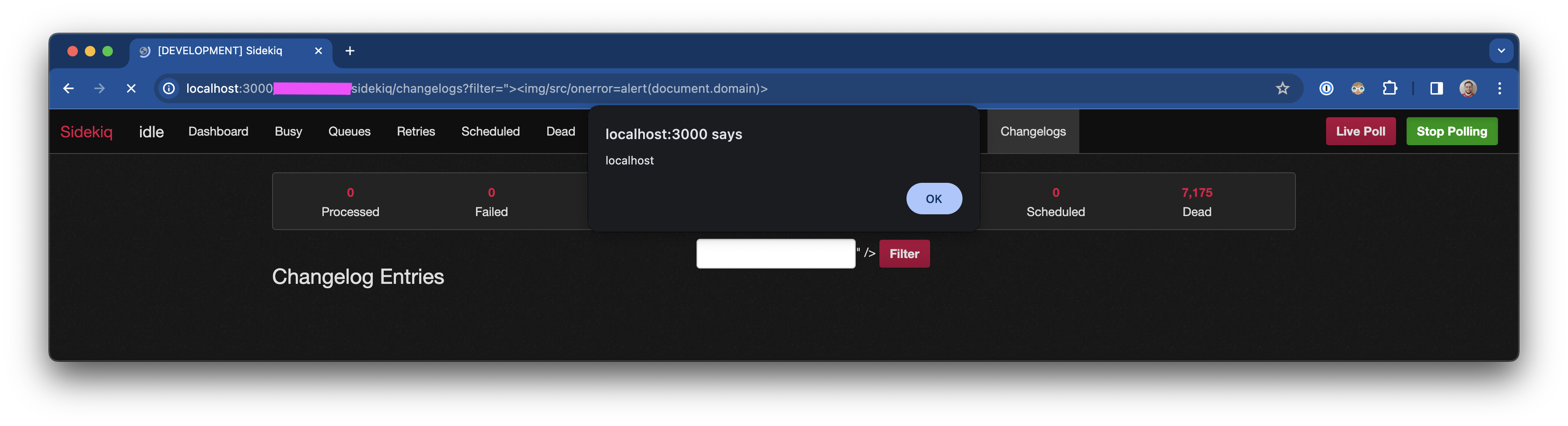\n b. `filter` is XSS vulnerable: `?filter=%22%3E%3Cimg/src/onerror=alert(document.domain)%3E`\n c. `count` is vulnerable to triggering an application error (status 500), potentially allowing resource exhaustion `?count=%22%3E%3Cimg/src/onerror=alert(document.domain)%3E`\n 1. Screenshot: 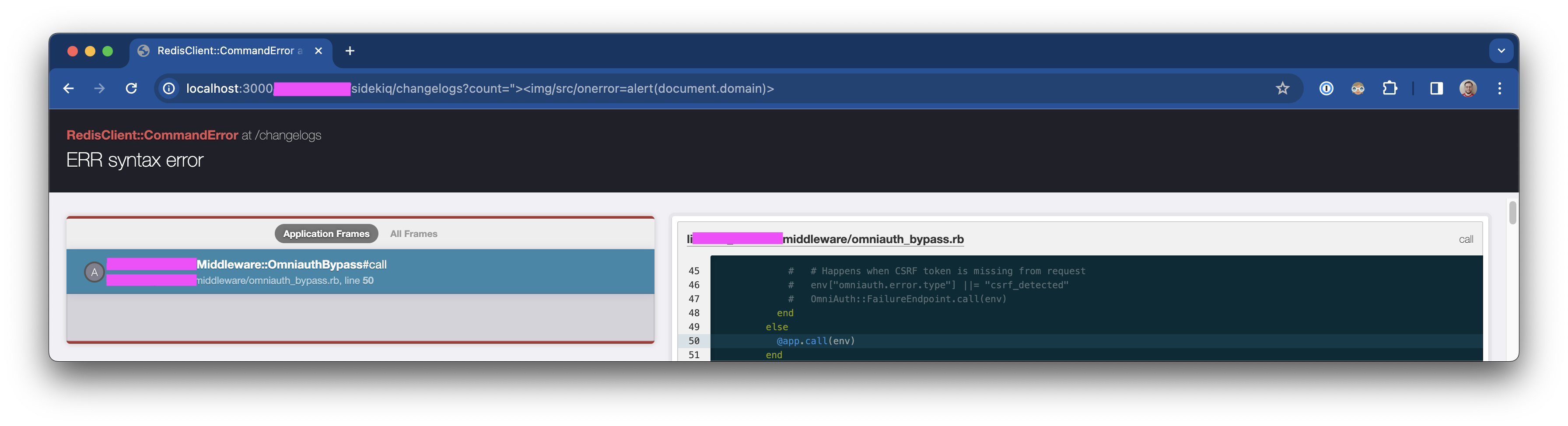\n2. Visit [/sidekiq/locks](http://localhost:3000/sidekiq/locks) - with a crafted query string like one of the following:\n a. Screenshot: 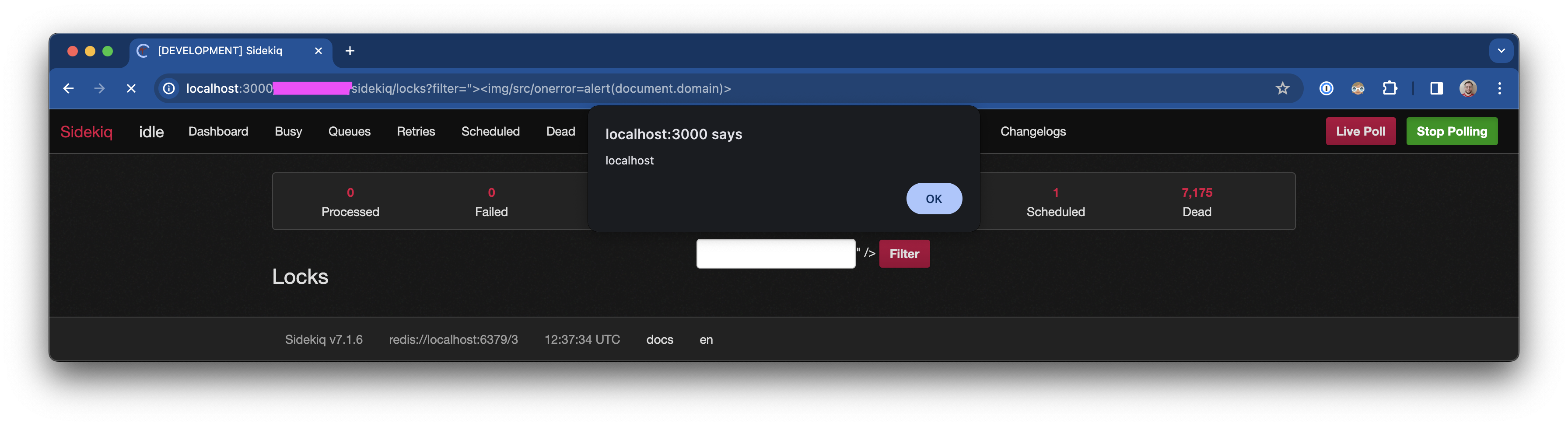\n b. `filter` is XSS vulnerable: `?filter=%22%3E%3Cimg/src/onerror=alert(document.domain)%3E`\n c. `count` is vulnerable to triggering an application error (status 500), potentially allowing resource exhaustion `?count=%22%3E%3Cimg/src/onerror=alert(document.domain)%3E`\n 1. Screenshot: 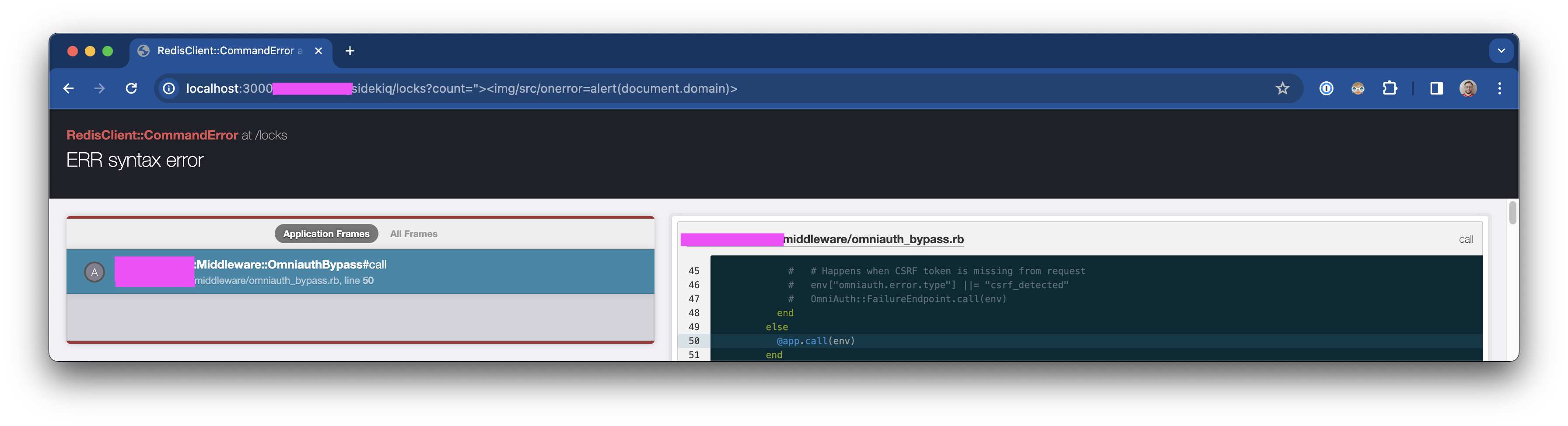\n3. Visit [/sidekiq/expiring_locks](http://localhost:3000/sidekiq/expiring_locks) - with a crafted query string like one of the following: \n a. Screenshot: 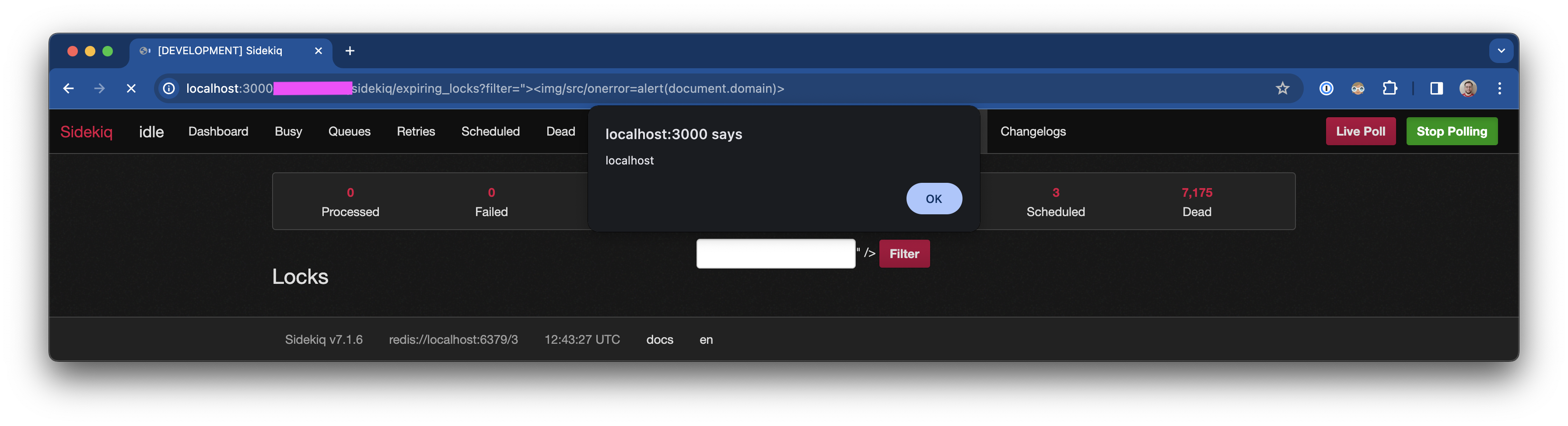\n b. `filter` is XSS vulnerable: `?filter=%22%3E%3Cimg/src/onerror=alert(document.domain)%3E`\n\n### Impact\n\nThis is a vulnerability of critical severity, which impacts many thousands of sites, since `sidekiq-unique-jobs` is widely deployed across the industry, with multiple attack vectors.",
"id": "GHSA-cmh9-rx85-xj38",
"modified": "2024-02-20T16:40:10Z",
"published": "2024-02-13T18:34:16Z",
"references": [
{
"type": "WEB",
"url": "https://github.com/mhenrixon/sidekiq-unique-jobs/security/advisories/GHSA-cmh9-rx85-xj38"
},
{
"type": "ADVISORY",
"url": "https://nvd.nist.gov/vuln/detail/CVE-2024-25122"
},
{
"type": "WEB",
"url": "https://github.com/mhenrixon/sidekiq-unique-jobs/commit/cd09ba6108f98973b6649a6149790c3d4502b4cc"
},
{
"type": "WEB",
"url": "https://github.com/mhenrixon/sidekiq-unique-jobs/commit/ec3afd920c1b55843c72f748a87baac7f8be82ed"
},
{
"type": "PACKAGE",
"url": "https://github.com/mhenrixon/sidekiq-unique-jobs"
},
{
"type": "WEB",
"url": "https://github.com/rubysec/ruby-advisory-db/blob/master/gems/sidekiq-unique-jobs/CVE-2024-25122.yml"
}
],
"schema_version": "1.4.0",
"severity": [
{
"score": "CVSS:3.1/AV:N/AC:L/PR:N/UI:R/S:C/C:L/I:L/A:L",
"type": "CVSS_V3"
}
],
"summary": "XSS sidekiq-unique-jobs UI server vulnerability"
}
GHSA-CMHX-CQ75-C4MJ
Vulnerability from github – Published: 2021-08-04 21:03 – Updated: 2023-02-21 18:57A denial of service vulnerability exists when .NET Framework and .NET Core improperly process RegEx strings, aka '.NET Framework and .NET Core Denial of Service Vulnerability'. This CVE ID is unique from CVE-2019-0980, CVE-2019-0981.
{
  "affected": [
    {
      "package": {
        "ecosystem": "NuGet",
        "name": "System.Text.RegularExpressions"
      },
      "ranges": [
        {
          "events": [
            {
              "introduced": "4.3.0"
            },
            {
              "fixed": "4.3.1"
            }
          ],
          "type": "ECOSYSTEM"
        }
      ]
    }
  ],
  "aliases": [
    "CVE-2019-0820"
  ],
  "database_specific": {
    "cwe_ids": [
      "CWE-1333",
      "CWE-400"
    ],
    "github_reviewed": true,
    "github_reviewed_at": "2021-08-04T21:03:27Z",
    "nvd_published_at": "2019-05-16T19:29:00Z",
    "severity": "HIGH"
  },
  "details": "A denial of service vulnerability exists when .NET Framework and .NET Core improperly process RegEx strings, aka \u0027.NET Framework and .NET Core Denial of Service Vulnerability\u0027. This CVE ID is unique from CVE-2019-0980, CVE-2019-0981.",
  "id": "GHSA-cmhx-cq75-c4mj",
  "modified": "2023-02-21T18:57:08Z",
  "published": "2021-08-04T21:03:46Z",
  "references": [
    {
      "type": "ADVISORY",
      "url": "https://nvd.nist.gov/vuln/detail/CVE-2019-0820"
    },
    {
      "type": "WEB",
      "url": "https://access.redhat.com/errata/RHSA-2019:1259"
    },
    {
      "type": "WEB",
      "url": "https://portal.msrc.microsoft.com/en-US/security-guidance/advisory/CVE-2019-0820"
    }
  ],
  "schema_version": "1.4.0",
  "severity": [
    {
      "score": "CVSS:3.1/AV:N/AC:L/PR:N/UI:N/S:U/C:N/I:N/A:H",
      "type": "CVSS_V3"
    }
  ],
  "summary": "Regular Expression Denial of Service in System.Text.RegularExpressions"
}
GHSA-CMJ7-8JRJ-42G2
Vulnerability from github – Published: 2024-09-17 00:31 – Updated: 2025-11-04 18:31This issue was addressed through improved state management. This issue is fixed in iOS 18 and iPadOS 18. A remote attacker may be able to cause a denial-of-service.
{
  "affected": [],
  "aliases": [
    "CVE-2024-27874"
  ],
  "database_specific": {
    "cwe_ids": [
      "CWE-400"
    ],
    "github_reviewed": false,
    "github_reviewed_at": null,
    "nvd_published_at": "2024-09-17T00:15:47Z",
    "severity": "HIGH"
  },
  "details": "This issue was addressed through improved state management. This issue is fixed in iOS 18 and iPadOS 18. A remote attacker may be able to cause a denial-of-service.",
  "id": "GHSA-cmj7-8jrj-42g2",
  "modified": "2025-11-04T18:31:19Z",
  "published": "2024-09-17T00:31:03Z",
  "references": [
    {
      "type": "ADVISORY",
      "url": "https://nvd.nist.gov/vuln/detail/CVE-2024-27874"
    },
    {
      "type": "WEB",
      "url": "https://support.apple.com/en-us/121250"
    },
    {
      "type": "WEB",
      "url": "http://seclists.org/fulldisclosure/2024/Sep/32"
    }
  ],
  "schema_version": "1.4.0",
  "severity": [
    {
      "score": "CVSS:3.1/AV:N/AC:L/PR:N/UI:N/S:U/C:H/I:N/A:N",
      "type": "CVSS_V3"
    }
  ]
}
Mitigation
Design throttling mechanisms into the system architecture. The best protection is to limit the amount of resources that an unauthorized user can cause to be expended. A strong authentication and access control model will help prevent such attacks from occurring in the first place. The login application should be protected against DoS attacks as much as possible. Limiting the database access, perhaps by caching result sets, can help minimize the resources expended. To further limit the potential for a DoS attack, consider tracking the rate of requests received from users and blocking requests that exceed a defined rate threshold.
Mitigation
- Mitigation of resource exhaustion attacks requires that the target system either:
- The first of these solutions is an issue in itself though, since it may allow attackers to prevent the use of the system by a particular valid user. If the attacker impersonates the valid user, they may be able to prevent the user from accessing the server in question.
- The second solution is simply difficult to effectively institute -- and even when properly done, it does not provide a full solution. It simply makes the attack require more resources on the part of the attacker.
- recognizes the attack and denies that user further access for a given amount of time, or
- uniformly throttles all requests in order to make it more difficult to consume resources more quickly than they can again be freed.
Mitigation
Ensure that protocols have specific limits of scale placed on them.
Mitigation
Ensure that all failures in resource allocation place the system into a safe posture.
CAPEC-147: XML Ping of the Death
An attacker initiates a resource depletion attack where a large number of small XML messages are delivered at a sufficiently rapid rate to cause a denial of service or crash of the target. Transactions such as repetitive SOAP transactions can deplete resources faster than a simple flooding attack because of the additional resources used by the SOAP protocol and the resources necessary to process SOAP messages. The transactions used are immaterial as long as they cause resource utilization on the target. In other words, this is a normal flooding attack augmented by using messages that will require extra processing on the target.
CAPEC-227: Sustained Client Engagement
An adversary attempts to deny legitimate users access to a resource by continually engaging a specific resource in an attempt to keep the resource tied up as long as possible. The adversary's primary goal is not to crash or flood the target, which would alert defenders; rather it is to repeatedly perform actions or abuse algorithmic flaws such that a given resource is tied up and not available to a legitimate user. By carefully crafting a requests that keep the resource engaged through what is seemingly benign requests, legitimate users are limited or completely denied access to the resource.
CAPEC-492: Regular Expression Exponential Blowup
An adversary may execute an attack on a program that uses a poor Regular Expression(Regex) implementation by choosing input that results in an extreme situation for the Regex. A typical extreme situation operates at exponential time compared to the input size. This is due to most implementations using a Nondeterministic Finite Automaton(NFA) state machine to be built by the Regex algorithm since NFA allows backtracking and thus more complex regular expressions.