CWE-94
Allowed-with-ReviewImproper Control of Generation of Code ('Code Injection')
Abstraction: Base · Status: Draft
The product constructs all or part of a code segment using externally-influenced input from an upstream component, but it does not neutralize or incorrectly neutralizes special elements that could modify the syntax or behavior of the intended code segment.
9284 vulnerabilities reference this CWE, most recent first.
GHSA-4FGQ-FPQ9-MR3G
Vulnerability from github – Published: 2025-10-03 14:16 – Updated: 2025-10-03 14:16Due to a bug in the startup trust dialog implementation, Claude Code could be tricked to execute code contained in a project before the user accepted the startup trust dialog. Exploiting this requires a user to start Claude Code in an untrusted directory.
Users on standard Claude Code auto-update will have received this fix automatically. Users performing manual updates are advised to update to the latest version.
Thank you to https://hackerone.com/avivdon for reporting this issue!
{
  "affected": [
    {
      "package": {
        "ecosystem": "npm",
        "name": "@anthropic-ai/claude-code"
      },
      "ranges": [
        {
          "events": [
            {
              "introduced": "0"
            },
            {
              "fixed": "1.0.111"
            }
          ],
          "type": "ECOSYSTEM"
        }
      ]
    }
  ],
  "aliases": [
    "CVE-2025-59536"
  ],
  "database_specific": {
    "cwe_ids": [
      "CWE-94"
    ],
    "github_reviewed": true,
    "github_reviewed_at": "2025-10-03T14:16:34Z",
    "nvd_published_at": "2025-10-03T07:15:44Z",
    "severity": "HIGH"
  },
  "details": "Due to a bug in the startup trust dialog implementation, Claude Code could be tricked to execute code contained in a project before the user accepted the startup trust dialog. Exploiting this requires a user to start Claude Code in an untrusted directory. \n\nUsers on standard Claude Code auto-update will have received this fix automatically. Users performing manual updates are advised to update to the latest version.\n\nThank you to https://hackerone.com/avivdon for reporting this issue!",
  "id": "GHSA-4fgq-fpq9-mr3g",
  "modified": "2025-10-03T14:16:34Z",
  "published": "2025-10-03T14:16:34Z",
  "references": [
    {
      "type": "WEB",
      "url": "https://github.com/anthropics/claude-code/security/advisories/GHSA-4fgq-fpq9-mr3g"
    },
    {
      "type": "ADVISORY",
      "url": "https://nvd.nist.gov/vuln/detail/CVE-2025-59536"
    },
    {
      "type": "PACKAGE",
      "url": "https://github.com/anthropics/claude-code"
    }
  ],
  "schema_version": "1.4.0",
  "severity": [
    {
      "score": "CVSS:4.0/AV:N/AC:L/AT:N/PR:N/UI:P/VC:H/VI:H/VA:H/SC:N/SI:N/SA:N",
      "type": "CVSS_V4"
    }
  ],
  "summary": "Claude Code can execute commands prior to the startup trust dialog "
}
GHSA-4FQ3-MR56-CG6R
Vulnerability from github – Published: 2018-10-17 17:23 – Updated: 2024-03-20 14:20Spring Data Commons, versions prior to 1.13 to 1.13.10, 2.0 to 2.0.5, and older unsupported versions, contain a property binder vulnerability caused by improper neutralization of special elements. An unauthenticated remote malicious user (or attacker) can supply specially crafted request parameters against Spring Data REST backed HTTP resources or using Spring Data's projection-based request payload binding that can lead to a remote code execution attack.
{
  "affected": [
    {
      "package": {
        "ecosystem": "Maven",
        "name": "org.springframework.data:spring-data-commons"
      },
      "ranges": [
        {
          "events": [
            {
              "introduced": "1.13.0"
            },
            {
              "fixed": "1.13.11"
            }
          ],
          "type": "ECOSYSTEM"
        }
      ]
    },
    {
      "package": {
        "ecosystem": "Maven",
        "name": "org.springframework.data:spring-data-commons"
      },
      "ranges": [
        {
          "events": [
            {
              "introduced": "2.0.0"
            },
            {
              "fixed": "2.0.6"
            }
          ],
          "type": "ECOSYSTEM"
        }
      ]
    }
  ],
  "aliases": [
    "CVE-2018-1273"
  ],
  "database_specific": {
    "cwe_ids": [
      "CWE-20",
      "CWE-94"
    ],
    "github_reviewed": true,
    "github_reviewed_at": "2020-06-16T20:58:14Z",
    "nvd_published_at": "2018-04-11T13:29:00Z",
    "severity": "CRITICAL"
  },
  "details": "Spring Data Commons, versions prior to 1.13 to 1.13.10, 2.0 to 2.0.5, and older unsupported versions, contain a property binder vulnerability caused by improper neutralization of special elements. An unauthenticated remote malicious user (or attacker) can supply specially crafted request parameters against Spring Data REST backed HTTP resources or using Spring Data\u0027s projection-based request payload binding that can lead to a remote code execution attack.",
  "id": "GHSA-4fq3-mr56-cg6r",
  "modified": "2024-03-20T14:20:41Z",
  "published": "2018-10-17T17:23:24Z",
  "references": [
    {
      "type": "ADVISORY",
      "url": "https://nvd.nist.gov/vuln/detail/CVE-2018-1273"
    },
    {
      "type": "WEB",
      "url": "https://github.com/spring-projects/spring-data-commons/issues/1721"
    },
    {
      "type": "WEB",
      "url": "https://github.com/spring-projects/spring-data-commons/commit/ae1dd2741ce06d44a0966ecbd6f47beabde2b653"
    },
    {
      "type": "WEB",
      "url": "https://github.com/spring-projects/spring-data-commons/commit/b1a20ae1e82a63f99b3afc6f2aaedb3bf4dc432a"
    },
    {
      "type": "ADVISORY",
      "url": "https://github.com/advisories/GHSA-4fq3-mr56-cg6r"
    },
    {
      "type": "PACKAGE",
      "url": "https://github.com/spring-projects/spring-data-commons"
    },
    {
      "type": "WEB",
      "url": "https://pivotal.io/security/cve-2018-1273"
    },
    {
      "type": "WEB",
      "url": "https://www.oracle.com/security-alerts/cpujul2022.html"
    },
    {
      "type": "WEB",
      "url": "http://mail-archives.apache.org/mod_mbox/ignite-dev/201807.mbox/%3CCAK0qHnqzfzmCDFFi6c5Jok19zNkVCz5Xb4sU%3D0f2J_1i4p46zQ%40mail.gmail.com%3E"
    }
  ],
  "schema_version": "1.4.0",
  "severity": [
    {
      "score": "CVSS:3.0/AV:N/AC:L/PR:N/UI:N/S:U/C:H/I:H/A:H",
      "type": "CVSS_V3"
    }
  ],
  "summary": "Spring Data Commons remote code injection vulnerability"
}
GHSA-4FQW-Q7F5-3C39
Vulnerability from github – Published: 2022-05-13 01:13 – Updated: 2025-04-12 12:43Unrestricted file upload vulnerability in uploadScript.php in InfiniteWP Admin Panel before 2.4.4, when the allWPFiles query parameter is set, allows remote attackers to execute arbitrary code by uploading a file with a double extension, then accessing it via a direct request to the file in the uploads directory, as demonstrated by the .php.swp filename.
{
  "affected": [],
  "aliases": [
    "CVE-2014-9521"
  ],
  "database_specific": {
    "cwe_ids": [
      "CWE-94"
    ],
    "github_reviewed": false,
    "github_reviewed_at": null,
    "nvd_published_at": "2015-01-05T20:59:00Z",
    "severity": "HIGH"
  },
  "details": "Unrestricted file upload vulnerability in uploadScript.php in InfiniteWP Admin Panel before 2.4.4, when the allWPFiles query parameter is set, allows remote attackers to execute arbitrary code by uploading a file with a double extension, then accessing it via a direct request to the file in the uploads directory, as demonstrated by the .php.swp filename.",
  "id": "GHSA-4fqw-q7f5-3c39",
  "modified": "2025-04-12T12:43:45Z",
  "published": "2022-05-13T01:13:20Z",
  "references": [
    {
      "type": "ADVISORY",
      "url": "https://nvd.nist.gov/vuln/detail/CVE-2014-9521"
    },
    {
      "type": "WEB",
      "url": "https://lifeforms.nl/20141210/infinitewp-vulnerabilities"
    },
    {
      "type": "WEB",
      "url": "http://seclists.org/fulldisclosure/2014/Dec/43"
    }
  ],
  "schema_version": "1.4.0",
  "severity": []
}
GHSA-4FRQ-G5PX-8JFP
Vulnerability from github – Published: 2026-02-05 18:30 – Updated: 2026-02-06 18:30An issue in ChestnutCMS v.1.5.8 and before allows a remote attacker to execute arbitrary code via the template creation function
{
  "affected": [],
  "aliases": [
    "CVE-2025-70073"
  ],
  "database_specific": {
    "cwe_ids": [
      "CWE-94"
    ],
    "github_reviewed": false,
    "github_reviewed_at": null,
    "nvd_published_at": "2026-02-05T18:16:10Z",
    "severity": "CRITICAL"
  },
  "details": "An issue in ChestnutCMS v.1.5.8 and before allows a remote attacker to execute arbitrary code via the template creation function",
  "id": "GHSA-4frq-g5px-8jfp",
  "modified": "2026-02-06T18:30:31Z",
  "published": "2026-02-05T18:30:32Z",
  "references": [
    {
      "type": "ADVISORY",
      "url": "https://nvd.nist.gov/vuln/detail/CVE-2025-70073"
    },
    {
      "type": "WEB",
      "url": "https://github.com/liweiyi/ChestnutCMS/issues/8"
    }
  ],
  "schema_version": "1.4.0",
  "severity": [
    {
      "score": "CVSS:3.1/AV:N/AC:L/PR:N/UI:N/S:U/C:H/I:H/A:H",
      "type": "CVSS_V3"
    }
  ]
}
GHSA-4FV8-FM6J-XC9R
Vulnerability from github – Published: 2024-04-10 21:30 – Updated: 2025-04-16 00:31An issue in the kiosk mode of Secure Lockdown Multi Application Edition v2.00.219 allows attackers to execute arbitrary code via running a ClickOnce application instance.
{
  "affected": [],
  "aliases": [
    "CVE-2024-29500"
  ],
  "database_specific": {
    "cwe_ids": [
      "CWE-94"
    ],
    "github_reviewed": false,
    "github_reviewed_at": null,
    "nvd_published_at": "2024-04-10T20:15:07Z",
    "severity": "CRITICAL"
  },
  "details": "An issue in the kiosk mode of Secure Lockdown Multi Application Edition v2.00.219 allows attackers to execute arbitrary code via running a ClickOnce application instance.",
  "id": "GHSA-4fv8-fm6j-xc9r",
  "modified": "2025-04-16T00:31:30Z",
  "published": "2024-04-10T21:30:33Z",
  "references": [
    {
      "type": "ADVISORY",
      "url": "https://nvd.nist.gov/vuln/detail/CVE-2024-29500"
    },
    {
      "type": "WEB",
      "url": "https://raeph123.github.io/BlogPosts/inteset/Inteset_Secure_Lockdown_Multi_Application_Edition_-_Vulnerabilities_and_Hardening_Measures_en.html"
    },
    {
      "type": "WEB",
      "url": "https://www.drive-byte.de/en/blog/inteset-bugs-and-hardening"
    }
  ],
  "schema_version": "1.4.0",
  "severity": [
    {
      "score": "CVSS:3.1/AV:N/AC:L/PR:N/UI:N/S:U/C:H/I:H/A:H",
      "type": "CVSS_V3"
    }
  ]
}
GHSA-4FVG-M2XR-4CXG
Vulnerability from github – Published: 2022-05-17 05:08 – Updated: 2022-05-17 05:08The WebView class in the Cybozu Live application 1.0.4 and earlier for Android allows remote attackers to execute arbitrary JavaScript code, and obtain sensitive information, via a crafted application that places this code into a local file associated with a file: URL.
{
  "affected": [],
  "aliases": [
    "CVE-2012-4009"
  ],
  "database_specific": {
    "cwe_ids": [
      "CWE-94"
    ],
    "github_reviewed": false,
    "github_reviewed_at": null,
    "nvd_published_at": "2012-08-31T14:55:00Z",
    "severity": "MODERATE"
  },
  "details": "The WebView class in the Cybozu Live application 1.0.4 and earlier for Android allows remote attackers to execute arbitrary JavaScript code, and obtain sensitive information, via a crafted application that places this code into a local file associated with a file: URL.",
  "id": "GHSA-4fvg-m2xr-4cxg",
  "modified": "2022-05-17T05:08:40Z",
  "published": "2022-05-17T05:08:40Z",
  "references": [
    {
      "type": "ADVISORY",
      "url": "https://nvd.nist.gov/vuln/detail/CVE-2012-4009"
    },
    {
      "type": "WEB",
      "url": "http://jvn.jp/en/jp/JVN77393797/index.html"
    },
    {
      "type": "WEB",
      "url": "http://jvndb.jvn.jp/jvndb/JVNDB-2012-000082"
    },
    {
      "type": "WEB",
      "url": "http://magazine.cybozulive.com/2012/08/291200.html"
    }
  ],
  "schema_version": "1.4.0",
  "severity": []
}
GHSA-4FWJ-V7F6-PQ59
Vulnerability from github – Published: 2022-05-01 18:21 – Updated: 2022-05-01 18:21Multiple eval injection vulnerabilities in the com_search component in Joomla! 1.5 beta before RC1 (aka Mapya) allow remote attackers to execute arbitrary PHP code via PHP sequences in the searchword parameter, related to default_results.php in (1) components/com_search/views/search/tmpl/ and (2) templates/beez/html/com_search/search/.
{
  "affected": [],
  "aliases": [
    "CVE-2007-4187"
  ],
  "database_specific": {
    "cwe_ids": [
      "CWE-94"
    ],
    "github_reviewed": false,
    "github_reviewed_at": null,
    "nvd_published_at": "2007-08-08T01:17:00Z",
    "severity": "HIGH"
  },
  "details": "Multiple eval injection vulnerabilities in the com_search component in Joomla! 1.5 beta before RC1 (aka Mapya) allow remote attackers to execute arbitrary PHP code via PHP sequences in the searchword parameter, related to default_results.php in (1) components/com_search/views/search/tmpl/ and (2) templates/beez/html/com_search/search/.",
  "id": "GHSA-4fwj-v7f6-pq59",
  "modified": "2022-05-01T18:21:10Z",
  "published": "2022-05-01T18:21:10Z",
  "references": [
    {
      "type": "ADVISORY",
      "url": "https://nvd.nist.gov/vuln/detail/CVE-2007-4187"
    },
    {
      "type": "WEB",
      "url": "http://joomlacode.org/gf/project/joomla/scmsvn/?action=browse\u0026path=%2Fdevelopment%2Ftrunk%2Fcomponents%2Fcom_search%2Fviews%2Fsearch%2Fview.php\u0026r1=7455\u0026r2=7456"
    },
    {
      "type": "WEB",
      "url": "http://osvdb.org/41260"
    },
    {
      "type": "WEB",
      "url": "http://securityreason.com/securityalert/2969"
    },
    {
      "type": "WEB",
      "url": "http://www.securityfocus.com/archive/1/474417/100/100/threaded"
    }
  ],
  "schema_version": "1.4.0",
  "severity": []
}
GHSA-4G2F-Q935-7PPV
Vulnerability from github – Published: 2022-05-01 07:30 – Updated: 2025-04-09 03:32PHP remote file inclusion vulnerability in end.php in ask_rave 0.9 PR, and other versions before 0.9b, allows remote attackers to execute arbitrary PHP code via a URL in the footfile parameter.
{
  "affected": [],
  "aliases": [
    "CVE-2006-5621"
  ],
  "database_specific": {
    "cwe_ids": [
      "CWE-94"
    ],
    "github_reviewed": false,
    "github_reviewed_at": null,
    "nvd_published_at": "2006-10-31T20:07:00Z",
    "severity": "HIGH"
  },
  "details": "PHP remote file inclusion vulnerability in end.php in ask_rave 0.9 PR, and other versions before 0.9b, allows remote attackers to execute arbitrary PHP code via a URL in the footfile parameter.",
  "id": "GHSA-4g2f-q935-7ppv",
  "modified": "2025-04-09T03:32:55Z",
  "published": "2022-05-01T07:30:08Z",
  "references": [
    {
      "type": "ADVISORY",
      "url": "https://nvd.nist.gov/vuln/detail/CVE-2006-5621"
    },
    {
      "type": "WEB",
      "url": "https://exchange.xforce.ibmcloud.com/vulnerabilities/29825"
    },
    {
      "type": "WEB",
      "url": "https://www.exploit-db.com/exploits/2654"
    },
    {
      "type": "WEB",
      "url": "http://rave.jk-digital.com/blog/2006/12/08/ask_rave-09b-released"
    },
    {
      "type": "WEB",
      "url": "http://www.securityfocus.com/bid/20758"
    },
    {
      "type": "WEB",
      "url": "http://www.vupen.com/english/advisories/2006/4211"
    }
  ],
  "schema_version": "1.4.0",
  "severity": []
}
GHSA-4G2X-VQ5P-5VJ6
Vulnerability from github – Published: 2024-03-01 20:09 – Updated: 2024-08-15 17:02Impact
Previously, budibase used a library called vm2 for code execution inside the Budibase builder and apps, such as the UI below for configuring bindings in the design section.
Due to a vulnerability in vm2, any environment that executed the code server side (automations and column formulas) was susceptible to this vulnerability, allowing users to escape the sandbox provided by vm2, and to expose server side variables such as process.env. It's recommended by the authors of vm2 themselves that you should move to another solution for remote JS execution due to this vulnerability.
Patches
We moved our entire JS sandbox infrastructure over to isolated-vm, a much more secure and recommended library for remote code execution in 2.20.0. This also comes with a performance benefit in the way we cache and execute your JS server side. The budibase cloud platform has been patched already and is not running vm2, but self host users will need to manage the updates by themselves.
If you are a self hosted user, you can take the following steps to reproduce the exploit and to verify if your installation is currently affected.
Create a new formula column on one of your tables in the data section with the following configuration.
Add the following JS function to the formula and save.
If your installation is vulnerable, when the formula evaluates you will be able to see the printed process.env in your new formula field. If not, your installation is not affected.
Workarounds
There is no workaround at this time for any budibase app that uses JS. You must fully migrate post version 2.20.0 to patch the vulnerability.
References
- https://github.com/advisories/GHSA-cchq-frgv-rjh5
{
"affected": [
{
"package": {
"ecosystem": "npm",
"name": "@budibase/server"
},
"ranges": [
{
"events": [
{
"introduced": "0"
},
{
"fixed": "2.20.0"
}
],
"type": "ECOSYSTEM"
}
]
}
],
"aliases": [],
"database_specific": {
"cwe_ids": [
"CWE-94"
],
"github_reviewed": true,
"github_reviewed_at": "2024-03-01T20:09:00Z",
"nvd_published_at": null,
"severity": "CRITICAL"
},
"details": "### Impact\nPreviously, budibase used a library called `vm2` for code execution inside the Budibase builder and apps, such as the UI below for configuring bindings in the design section.\n\n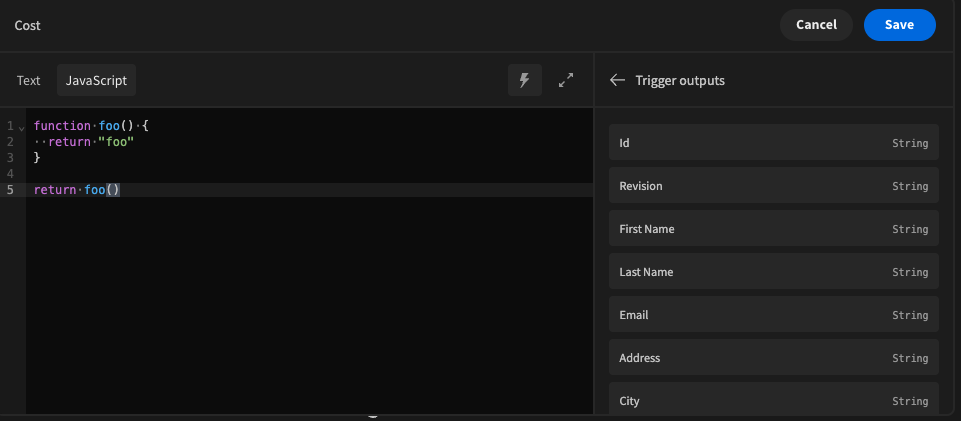\n\nDue to a [vulnerability in vm2](https://github.com/advisories/GHSA-cchq-frgv-rjh5), any environment that executed the code server side (automations and column formulas) was susceptible to this vulnerability, allowing users to escape the sandbox provided by `vm2`, and to expose server side variables such as `process.env`. It\u0027s recommended by the authors of `vm2` themselves that you should move to another solution for remote JS execution due to this vulnerability.\n\n### Patches\nWe moved our entire JS sandbox infrastructure over to `isolated-vm`, a much more secure and recommended library for remote code execution in 2.20.0. This also comes with a performance benefit in the way we cache and execute your JS server side. The budibase cloud platform has been patched already and is not running `vm2`, but self host users will need to manage the updates by themselves.\n\nIf you are a self hosted user, you can take the following steps to reproduce the exploit and to verify if your installation is currently affected.\n\nCreate a new formula column on one of your tables in the data section with the following configuration.\n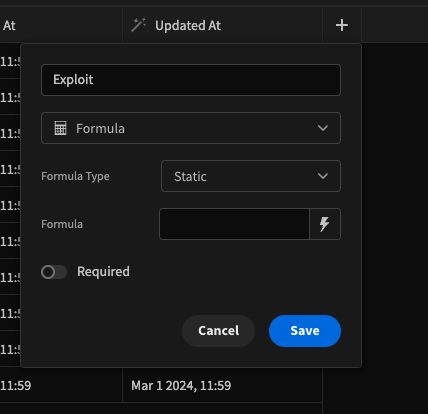\n\nAdd the following JS function to the formula and save.\n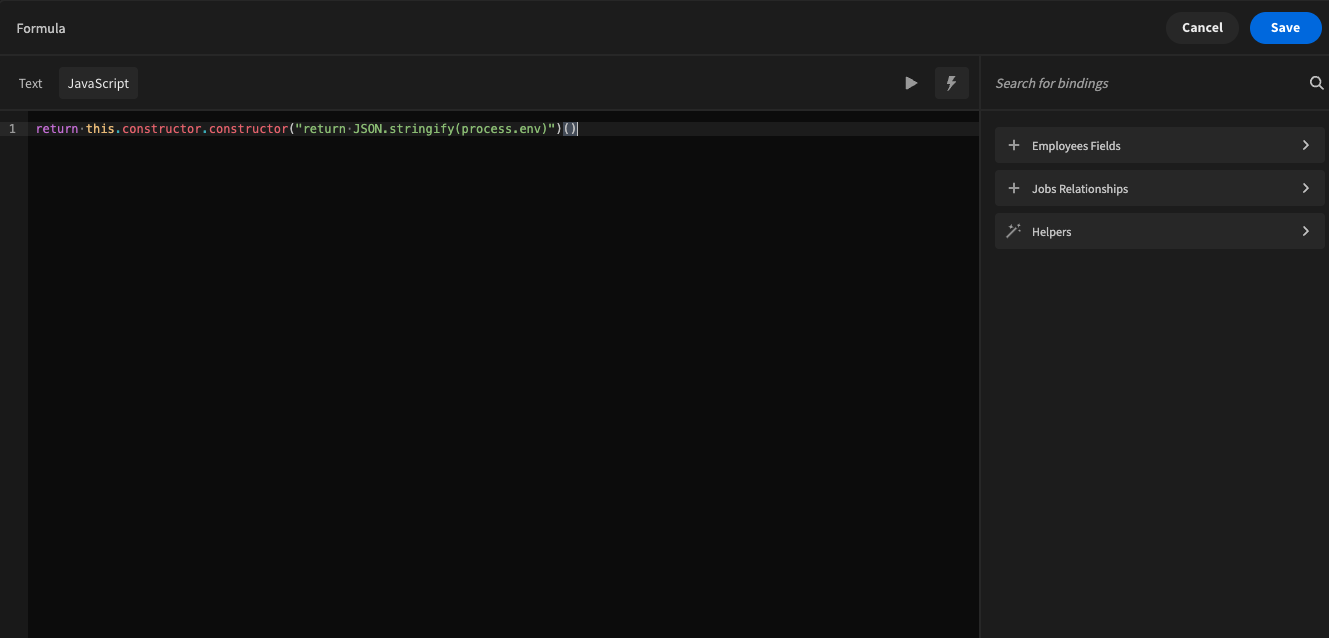\n\nIf your installation is vulnerable, when the formula evaluates you will be able to see the printed `process.env` in your new formula field. If not, your installation is not affected.\n\n### Workarounds\nThere is no workaround at this time for any budibase app that uses JS. You must fully migrate post version 2.20.0 to patch the vulnerability.\n\n### References\n- https://github.com/advisories/GHSA-cchq-frgv-rjh5\n",
"id": "GHSA-4g2x-vq5p-5vj6",
"modified": "2024-08-15T17:02:27Z",
"published": "2024-03-01T20:09:00Z",
"references": [
{
"type": "WEB",
"url": "https://github.com/Budibase/budibase/security/advisories/GHSA-4g2x-vq5p-5vj6"
},
{
"type": "WEB",
"url": "https://github.com/patriksimek/vm2/security/advisories/GHSA-cchq-frgv-rjh5"
},
{
"type": "WEB",
"url": "https://github.com/Budibase/budibase/commit/601c02a4acc695b1cc602bf611f0ae66d6e5868f"
},
{
"type": "PACKAGE",
"url": "https://github.com/Budibase/budibase"
}
],
"schema_version": "1.4.0",
"severity": [
{
"score": "CVSS:3.1/AV:N/AC:L/PR:N/UI:N/S:U/C:H/I:H/A:H",
"type": "CVSS_V3"
}
],
"summary": "Budibase affected by VM2 Constructor Escape Vulnerability"
}
GHSA-4G74-883W-RRGV
Vulnerability from github – Published: 2022-05-02 06:21 – Updated: 2022-05-02 06:21Multiple PHP remote file inclusion vulnerabilities in FAQEngine 4.24.00 allow remote attackers to execute arbitrary PHP code via a URL in the path_faqe parameter to (1) attachs.php, (2) backup.php, (3) badwords.php, (4) categories.php, (5) changepw.php, (6) colorchooser.php, (7) colorwheel.php, (8) dbfiles.php, (9) diraccess.php, (10) faq.php, (11) index.php, (12) kb.php, and (13) stats.php.
{
  "affected": [],
  "aliases": [
    "CVE-2010-1360"
  ],
  "database_specific": {
    "cwe_ids": [
      "CWE-94"
    ],
    "github_reviewed": false,
    "github_reviewed_at": null,
    "nvd_published_at": "2010-04-13T18:30:00Z",
    "severity": "HIGH"
  },
  "details": "Multiple PHP remote file inclusion vulnerabilities in FAQEngine 4.24.00 allow remote attackers to execute arbitrary PHP code via a URL in the path_faqe parameter to (1) attachs.php, (2) backup.php, (3) badwords.php, (4) categories.php, (5) changepw.php, (6) colorchooser.php, (7) colorwheel.php, (8) dbfiles.php, (9) diraccess.php, (10) faq.php, (11) index.php, (12) kb.php, and (13) stats.php.",
  "id": "GHSA-4g74-883w-rrgv",
  "modified": "2022-05-02T06:21:57Z",
  "published": "2022-05-02T06:21:57Z",
  "references": [
    {
      "type": "ADVISORY",
      "url": "https://nvd.nist.gov/vuln/detail/CVE-2010-1360"
    },
    {
      "type": "WEB",
      "url": "https://exchange.xforce.ibmcloud.com/vulnerabilities/55532"
    },
    {
      "type": "WEB",
      "url": "http://packetstormsecurity.org/1001-exploits/faqengine-rfi.txt"
    },
    {
      "type": "WEB",
      "url": "http://www.exploit-db.com/exploits/11111"
    },
    {
      "type": "WEB",
      "url": "http://www.securityfocus.com/bid/37719"
    }
  ],
  "schema_version": "1.4.0",
  "severity": []
}
Mitigation
Strategy: Refactoring
Refactor your program so that you do not have to dynamically generate code.
Mitigation
- Run your code in a "jail" or similar sandbox environment that enforces strict boundaries between the process and the operating system. This may effectively restrict which code can be executed by your product.
- Examples include the Unix chroot jail and AppArmor. In general, managed code may provide some protection.
- This may not be a feasible solution, and it only limits the impact to the operating system; the rest of your application may still be subject to compromise.
- Be careful to avoid CWE-243 and other weaknesses related to jails.
Mitigation MIT-5
Strategy: Input Validation
- Assume all input is malicious. Use an "accept known good" input validation strategy, i.e., use a list of acceptable inputs that strictly conform to specifications. Reject any input that does not strictly conform to specifications, or transform it into something that does.
- When performing input validation, consider all potentially relevant properties, including length, type of input, the full range of acceptable values, missing or extra inputs, syntax, consistency across related fields, and conformance to business rules. As an example of business rule logic, "boat" may be syntactically valid because it only contains alphanumeric characters, but it is not valid if the input is only expected to contain colors such as "red" or "blue."
- Do not rely exclusively on looking for malicious or malformed inputs. This is likely to miss at least one undesirable input, especially if the code's environment changes. This can give attackers enough room to bypass the intended validation. However, denylists can be useful for detecting potential attacks or determining which inputs are so malformed that they should be rejected outright.
- To reduce the likelihood of code injection, use stringent allowlists that limit which constructs are allowed. If you are dynamically constructing code that invokes a function, then verifying that the input is alphanumeric might be insufficient. An attacker might still be able to reference a dangerous function that you did not intend to allow, such as system(), exec(), or exit().
Mitigation
Use dynamic tools and techniques that interact with the product using large test suites with many diverse inputs, such as fuzz testing (fuzzing), robustness testing, and fault injection. The product's operation may slow down, but it should not become unstable, crash, or generate incorrect results.
Mitigation MIT-32
Strategy: Compilation or Build Hardening
Run the code in an environment that performs automatic taint propagation and prevents any command execution that uses tainted variables, such as Perl's "-T" switch. This will force the program to perform validation steps that remove the taint, although you must be careful to correctly validate your inputs so that you do not accidentally mark dangerous inputs as untainted (see CWE-183 and CWE-184).
Mitigation MIT-32
Strategy: Environment Hardening
Run the code in an environment that performs automatic taint propagation and prevents any command execution that uses tainted variables, such as Perl's "-T" switch. This will force the program to perform validation steps that remove the taint, although you must be careful to correctly validate your inputs so that you do not accidentally mark dangerous inputs as untainted (see CWE-183 and CWE-184).
Mitigation
For Python programs, it is frequently encouraged to use the ast.literal_eval() function instead of eval, since it is intentionally designed to avoid executing code. However, an adversary could still cause excessive memory or stack consumption via deeply nested structures [REF-1372], so the python documentation discourages use of ast.literal_eval() on untrusted data [REF-1373].
CAPEC-242: Code Injection
An adversary exploits a weakness in input validation on the target to inject new code into that which is currently executing. This differs from code inclusion in that code inclusion involves the addition or replacement of a reference to a code file, which is subsequently loaded by the target and used as part of the code of some application.
CAPEC-35: Leverage Executable Code in Non-Executable Files
An attack of this type exploits a system's trust in configuration and resource files. When the executable loads the resource (such as an image file or configuration file) the attacker has modified the file to either execute malicious code directly or manipulate the target process (e.g. application server) to execute based on the malicious configuration parameters. Since systems are increasingly interrelated mashing up resources from local and remote sources the possibility of this attack occurring is high.
CAPEC-77: Manipulating User-Controlled Variables
This attack targets user controlled variables (DEBUG=1, PHP Globals, and So Forth). An adversary can override variables leveraging user-supplied, untrusted query variables directly used on the application server without any data sanitization. In extreme cases, the adversary can change variables controlling the business logic of the application. For instance, in languages like PHP, a number of poorly set default configurations may allow the user to override variables.