CVE-2021-21264 (GCVE-0-2021-21264)
Vulnerability from cvelistv5 – Published: 2021-05-03 16:00 – Updated: 2024-08-03 18:09- CWE-862 - Missing Authorization
| URL | Tags |
|---|---|
| https://github.com/octobercms/october/security/ad… | x_refsource_CONFIRM |
| Vendor | Product | Version | CPE status | |
|---|---|---|---|---|
| octobercms | october |
Affected:
1.0.471
Affected: 1.1.1 |
guessed |
{
  "containers": {
    "adp": [
      {
        "providerMetadata": {
          "dateUpdated": "2024-08-03T18:09:14.926Z",
          "orgId": "af854a3a-2127-422b-91ae-364da2661108",
          "shortName": "CVE"
        },
        "references": [
          {
            "tags": [
              "x_refsource_CONFIRM",
              "x_transferred"
            ],
            "url": "https://github.com/octobercms/october/security/advisories/GHSA-fcr8-6q7r-m4wg"
          }
        ],
        "title": "CVE Program Container"
      }
    ],
    "cna": {
      "affected": [
        {
          "product": "october",
          "vendor": "octobercms",
          "versions": [
            {
              "status": "affected",
              "version": "1.0.471"
            },
            {
              "status": "affected",
              "version": "1.1.1"
            }
          ]
        }
      ],
      "descriptions": [
        {
          "lang": "en",
          "value": "October is a free, open-source, self-hosted CMS platform based on the Laravel PHP Framework. A bypass of CVE-2020-26231 (fixed in 1.0.470/471 and 1.1.1) was discovered that has the same impact as CVE-2020-26231 \u0026 CVE-2020-15247. An authenticated backend user with the `cms.manage_pages`, `cms.manage_layouts`, or `cms.manage_partials` permissions who would **normally** not be permitted to provide PHP code to be executed by the CMS due to `cms.enableSafeMode` being enabled is able to write specific Twig code to escape the Twig sandbox and execute arbitrary PHP. This is not a problem for anyone that trusts their users with those permissions to normally write \u0026 manage PHP within the CMS by not having `cms.enableSafeMode` enabled, but would be a problem for anyone relying on `cms.enableSafeMode` to ensure that users with those permissions in production do not have access to write \u0026 execute arbitrary PHP. Issue has been patched in Build 472 (v1.0.472) and v1.1.2. As a workaround, apply https://github.com/octobercms/october/commit/f63519ff1e8d375df30deba63156a2fc97aa9ee7 to your installation manually if unable to upgrade to Build 472 or v1.1.2."
        }
      ],
      "metrics": [
        {
          "cvssV3_1": {
            "attackComplexity": "LOW",
            "attackVector": "LOCAL",
            "availabilityImpact": "LOW",
            "baseScore": 5.2,
            "baseSeverity": "MEDIUM",
            "confidentialityImpact": "LOW",
            "integrityImpact": "LOW",
            "privilegesRequired": "HIGH",
            "scope": "CHANGED",
            "userInteraction": "REQUIRED",
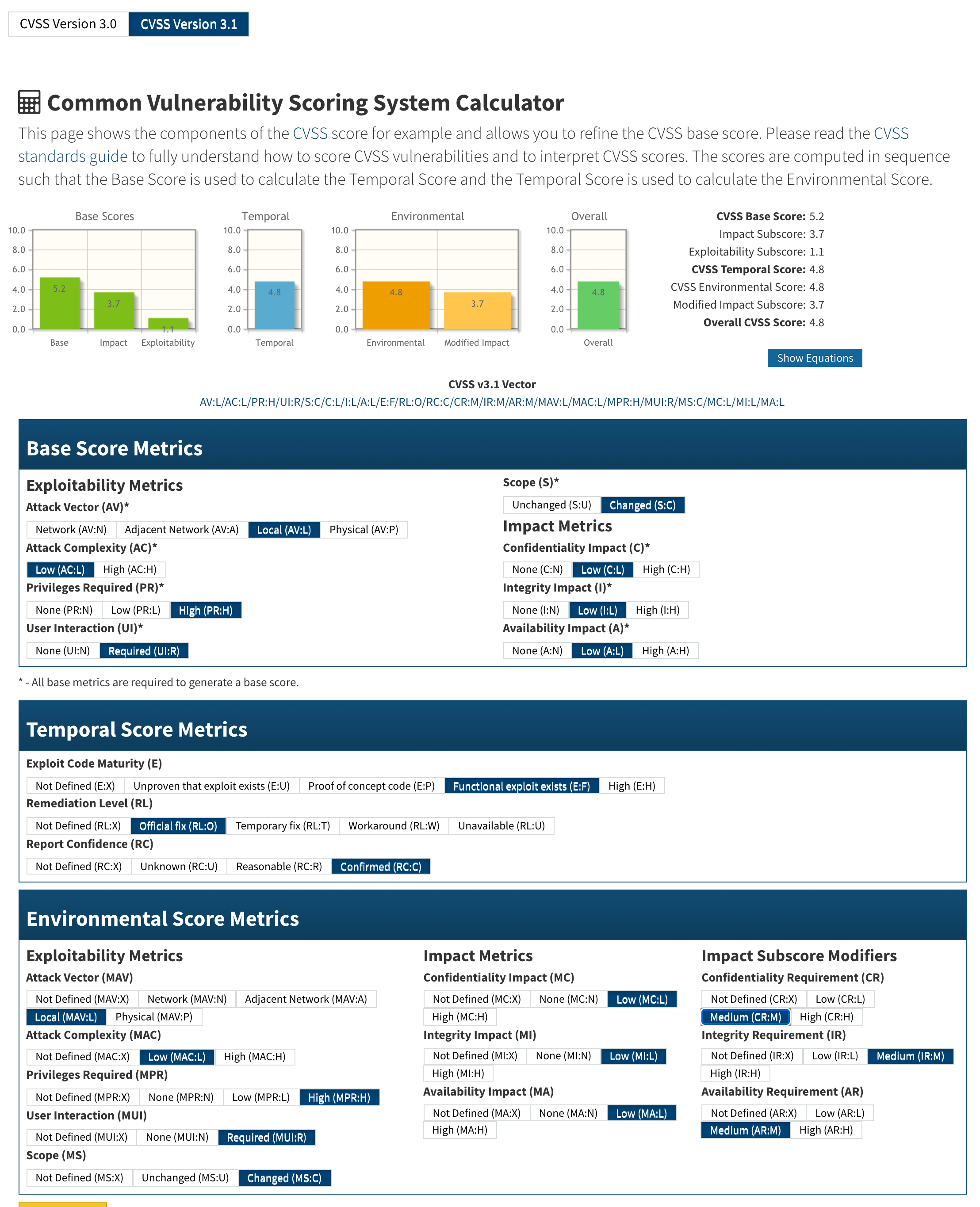
            "vectorString": "CVSS:3.1/AV:L/AC:L/PR:H/UI:R/S:C/C:L/I:L/A:L",
            "version": "3.1"
          }
        }
      ],
      "problemTypes": [
        {
          "descriptions": [
            {
              "cweId": "CWE-862",
              "description": "CWE-862 Missing Authorization",
              "lang": "en",
              "type": "CWE"
            }
          ]
        }
      ],
      "providerMetadata": {
        "dateUpdated": "2021-05-03T16:00:18.000Z",
        "orgId": "a0819718-46f1-4df5-94e2-005712e83aaa",
        "shortName": "GitHub_M"
      },
      "references": [
        {
          "tags": [
            "x_refsource_CONFIRM"
          ],
          "url": "https://github.com/octobercms/october/security/advisories/GHSA-fcr8-6q7r-m4wg"
        }
      ],
      "source": {
        "advisory": "GHSA-fcr8-6q7r-m4wg",
        "discovery": "UNKNOWN"
      },
      "title": "Bypass of fix for CVE-2020-26231, Twig sandbox escape",
      "x_legacyV4Record": {
        "CVE_data_meta": {
          "ASSIGNER": "security-advisories@github.com",
          "ID": "CVE-2021-21264",
          "STATE": "PUBLIC",
          "TITLE": "Bypass of fix for CVE-2020-26231, Twig sandbox escape"
        },
        "affects": {
          "vendor": {
            "vendor_data": [
              {
                "product": {
                  "product_data": [
                    {
                      "product_name": "october",
                      "version": {
                        "version_data": [
                          {
                            "version_value": "1.0.471"
                          },
                          {
                            "version_value": "1.1.1"
                          }
                        ]
                      }
                    }
                  ]
                },
                "vendor_name": "octobercms"
              }
            ]
          }
        },
        "data_format": "MITRE",
        "data_type": "CVE",
        "data_version": "4.0",
        "description": {
          "description_data": [
            {
              "lang": "eng",
              "value": "October is a free, open-source, self-hosted CMS platform based on the Laravel PHP Framework. A bypass of CVE-2020-26231 (fixed in 1.0.470/471 and 1.1.1) was discovered that has the same impact as CVE-2020-26231 \u0026 CVE-2020-15247. An authenticated backend user with the `cms.manage_pages`, `cms.manage_layouts`, or `cms.manage_partials` permissions who would **normally** not be permitted to provide PHP code to be executed by the CMS due to `cms.enableSafeMode` being enabled is able to write specific Twig code to escape the Twig sandbox and execute arbitrary PHP. This is not a problem for anyone that trusts their users with those permissions to normally write \u0026 manage PHP within the CMS by not having `cms.enableSafeMode` enabled, but would be a problem for anyone relying on `cms.enableSafeMode` to ensure that users with those permissions in production do not have access to write \u0026 execute arbitrary PHP. Issue has been patched in Build 472 (v1.0.472) and v1.1.2. As a workaround, apply https://github.com/octobercms/october/commit/f63519ff1e8d375df30deba63156a2fc97aa9ee7 to your installation manually if unable to upgrade to Build 472 or v1.1.2."
            }
          ]
        },
        "impact": {
          "cvss": {
            "attackComplexity": "LOW",
            "attackVector": "LOCAL",
            "availabilityImpact": "LOW",
            "baseScore": 5.2,
            "baseSeverity": "MEDIUM",
            "confidentialityImpact": "LOW",
            "integrityImpact": "LOW",
            "privilegesRequired": "HIGH",
            "scope": "CHANGED",
            "userInteraction": "REQUIRED",
            "vectorString": "CVSS:3.1/AV:L/AC:L/PR:H/UI:R/S:C/C:L/I:L/A:L",
            "version": "3.1"
          }
        },
        "problemtype": {
          "problemtype_data": [
            {
              "description": [
                {
                  "lang": "eng",
                  "value": "CWE-862 Missing Authorization"
                }
              ]
            }
          ]
        },
        "references": {
          "reference_data": [
            {
              "name": "https://github.com/octobercms/october/security/advisories/GHSA-fcr8-6q7r-m4wg",
              "refsource": "CONFIRM",
              "url": "https://github.com/octobercms/october/security/advisories/GHSA-fcr8-6q7r-m4wg"
            }
          ]
        },
        "source": {
          "advisory": "GHSA-fcr8-6q7r-m4wg",
          "discovery": "UNKNOWN"
        }
      }
    }
  },
  "cveMetadata": {
    "assignerOrgId": "a0819718-46f1-4df5-94e2-005712e83aaa",
    "assignerShortName": "GitHub_M",
    "cveId": "CVE-2021-21264",
    "datePublished": "2021-05-03T16:00:18.000Z",
    "dateReserved": "2020-12-22T00:00:00.000Z",
    "dateUpdated": "2024-08-03T18:09:14.926Z",
    "state": "PUBLISHED"
  },
  "dataType": "CVE_RECORD",
  "dataVersion": "5.1",
  "vulnerability-lookup:meta": {
    "epss": {
      "cve": "CVE-2021-21264",
      "date": "2026-11-15",
      "epss": "0.00265",
      "percentile": "0.18519"
    },
    "nvd": {
      "cve": {
        "configurations": [
          {
            "nodes": [
              {
                "cpeMatch": [
                  {
                    "criteria": "cpe:2.3:a:octobercms:october:*:*:*:*:*:*:*:*",
                    "matchCriteriaId": "C6BF448C-7017-428E-B9BF-40069ACD3990",
                    "versionEndIncluding": "1.0.471",
                    "vulnerable": true
                  },
                  {
                    "criteria": "cpe:2.3:a:octobercms:october:*:*:*:*:*:*:*:*",
                    "matchCriteriaId": "54A99E29-0CD5-4577-85A2-CD5A38FB58B8",
                    "versionEndIncluding": "1.1.1",
                    "versionStartIncluding": "1.1.0",
                    "vulnerable": true
                  }
                ],
                "negate": false,
                "operator": "OR"
              }
            ]
          }
        ],
        "cveTags": [],
        "descriptions": [
          {
            "lang": "en",
            "value": "October is a free, open-source, self-hosted CMS platform based on the Laravel PHP Framework. A bypass of CVE-2020-26231 (fixed in 1.0.470/471 and 1.1.1) was discovered that has the same impact as CVE-2020-26231 \u0026 CVE-2020-15247. An authenticated backend user with the `cms.manage_pages`, `cms.manage_layouts`, or `cms.manage_partials` permissions who would **normally** not be permitted to provide PHP code to be executed by the CMS due to `cms.enableSafeMode` being enabled is able to write specific Twig code to escape the Twig sandbox and execute arbitrary PHP. This is not a problem for anyone that trusts their users with those permissions to normally write \u0026 manage PHP within the CMS by not having `cms.enableSafeMode` enabled, but would be a problem for anyone relying on `cms.enableSafeMode` to ensure that users with those permissions in production do not have access to write \u0026 execute arbitrary PHP. Issue has been patched in Build 472 (v1.0.472) and v1.1.2. As a workaround, apply https://github.com/octobercms/october/commit/f63519ff1e8d375df30deba63156a2fc97aa9ee7 to your installation manually if unable to upgrade to Build 472 or v1.1.2."
          },
          {
            "lang": "es",
            "value": "October es una plataforma CMS gratuita, de c\u00f3digo abierto y autohosteada basada en Laravel PHP Framework. Se detect\u00f3 una omisi\u00f3n de CVE-2020-26231 (corregido en las versiones 1.0.470/471 y 1.1.1) que tiene el mismo impacto que CVE-2020-26231 y CVE-2020-15247. Un usuario de back-end autenticado con los permisos \"cms.manage_pages\", \"cms.manage_layouts\" o \"cms.manage_partials\" que **normalmente** no podr\u00eda proporcionar c\u00f3digo PHP para ser ejecutado por el CMS debido a \"cms.enableSafeMode\" que est\u00e1 habilitado es capaz de escribir c\u00f3digo Twig espec\u00edfico para escapar del sandbox Twig y ejecutar PHP arbitrario. Esto no es un problema para cualquiera que conf\u00ede a sus usuarios con esos permisos para escribir y administrar PHP normalmente dentro del CMS al no tener habilitado \"cms.enableSafeMode\", pero ser\u00eda un problema para cualquiera que conf\u00ede en \"cms.enableSafeMode\" para asegurarse de que los usuarios con esos permisos en producci\u00f3n no tienen acceso para escribir y ejecutar PHP arbitrario. El problema se corrigi\u00f3 en la compilaci\u00f3n 472 (v1.0.472) y v1.1.2. Como soluci\u00f3n alternativa, aplique https://github.com/octobercms/october/commit/f63519ff1e8d375df30deba63156a2fc97aa9ee7 a su instalaci\u00f3n manualmente si no puede actualizar a la compilaci\u00f3n 472 o v1.1.2."
          }
        ],
        "id": "CVE-2021-21264",
        "lastModified": "2024-11-21T05:47:53.340",
        "metrics": {
          "cvssMetricV2": [
            {
              "acInsufInfo": false,
              "baseSeverity": "MEDIUM",
              "cvssData": {
                "accessComplexity": "MEDIUM",
                "accessVector": "LOCAL",
                "authentication": "NONE",
                "availabilityImpact": "PARTIAL",
                "baseScore": 4.4,
                "confidentialityImpact": "PARTIAL",
                "integrityImpact": "PARTIAL",
                "vectorString": "AV:L/AC:M/Au:N/C:P/I:P/A:P",
                "version": "2.0"
              },
              "exploitabilityScore": 3.4,
              "impactScore": 6.4,
              "obtainAllPrivilege": false,
              "obtainOtherPrivilege": false,
              "obtainUserPrivilege": false,
              "source": "nvd@nist.gov",
              "type": "Primary",
              "userInteractionRequired": true
            }
          ],
          "cvssMetricV31": [
            {
              "cvssData": {
                "attackComplexity": "LOW",
                "attackVector": "LOCAL",
                "availabilityImpact": "LOW",
                "baseScore": 5.2,
                "baseSeverity": "MEDIUM",
                "confidentialityImpact": "LOW",
                "integrityImpact": "LOW",
                "privilegesRequired": "HIGH",
                "scope": "CHANGED",
                "userInteraction": "REQUIRED",
                "vectorString": "CVSS:3.1/AV:L/AC:L/PR:H/UI:R/S:C/C:L/I:L/A:L",
                "version": "3.1"
              },
              "exploitabilityScore": 1.1,
              "impactScore": 3.7,
              "source": "security-advisories@github.com",
              "type": "Secondary"
            },
            {
              "cvssData": {
                "attackComplexity": "LOW",
                "attackVector": "LOCAL",
                "availabilityImpact": "LOW",
                "baseScore": 5.2,
                "baseSeverity": "MEDIUM",
                "confidentialityImpact": "LOW",
                "integrityImpact": "LOW",
                "privilegesRequired": "HIGH",
                "scope": "CHANGED",
                "userInteraction": "REQUIRED",
                "vectorString": "CVSS:3.1/AV:L/AC:L/PR:H/UI:R/S:C/C:L/I:L/A:L",
                "version": "3.1"
              },
              "exploitabilityScore": 1.1,
              "impactScore": 3.7,
              "source": "nvd@nist.gov",
              "type": "Primary"
            }
          ]
        },
        "published": "2021-05-03T16:15:07.510",
        "references": [
          {
            "source": "security-advisories@github.com",
            "tags": [
              "Patch",
              "Third Party Advisory"
            ],
            "url": "https://github.com/octobercms/october/security/advisories/GHSA-fcr8-6q7r-m4wg"
          },
          {
            "source": "af854a3a-2127-422b-91ae-364da2661108",
            "tags": [
              "Patch",
              "Third Party Advisory"
            ],
            "url": "https://github.com/octobercms/october/security/advisories/GHSA-fcr8-6q7r-m4wg"
          }
        ],
        "sourceIdentifier": "security-advisories@github.com",
        "vulnStatus": "Modified",
        "weaknesses": [
          {
            "description": [
              {
                "lang": "en",
                "value": "CWE-862"
              }
            ],
            "source": "security-advisories@github.com",
            "type": "Secondary"
          },
          {
            "description": [
              {
                "lang": "en",
                "value": "NVD-CWE-Other"
              }
            ],
            "source": "nvd@nist.gov",
            "type": "Primary"
          }
        ]
      }
    },
    "redhat_vex": {
      "current_release_date": "2026-03-27T14:58:18+00:00",
      "cve": "CVE-2021-21264",
      "id": "CVE-2021-21264",
      "initial_release_date": "2021-01-01T00:00:00+00:00",
      "product_status:known_not_affected": "1",
      "source": "Red Hat CSAF VEX",
      "status": "final",
      "title": "Bypass of fix for CVE-2020-26231, Twig sandbox escape",
      "url": "https://security.access.redhat.com/data/csaf/v2/vex/2021/cve-2021-21264.json",
      "version": "3"
    }
  }
}
FKIE_CVE-2021-21264
Vulnerability from fkie_nvd - Published: 2021-05-03 16:15 - Updated: 2026-06-17 03:355.2 (Medium) - CVSS:3.1/
| URL | Tags | ||
|---|---|---|---|
| security-advisories@github.com | https://github.com/octobercms/october/security/advisories/GHSA-fcr8-6q7r-m4wg | Patch, Third Party Advisory | |
| af854a3a-2127-422b-91ae-364da2661108 | https://github.com/octobercms/october/security/advisories/GHSA-fcr8-6q7r-m4wg | Patch, Third Party Advisory |
| Vendor | Product | Version | |
|---|---|---|---|
| octobercms | october | * | |
| octobercms | october | * |
{
  "affected": [
    {
      "affectedData": [
        {
          "product": "october",
          "vendor": "octobercms",
          "versions": [
            {
              "status": "affected",
              "version": "1.0.471"
            },
            {
              "status": "affected",
              "version": "1.1.1"
            }
          ]
        }
      ],
      "source": "security-advisories@github.com"
    }
  ],
  "configurations": [
    {
      "nodes": [
        {
          "cpeMatch": [
            {
              "criteria": "cpe:2.3:a:octobercms:october:*:*:*:*:*:*:*:*",
              "matchCriteriaId": "C6BF448C-7017-428E-B9BF-40069ACD3990",
              "versionEndIncluding": "1.0.471",
              "vulnerable": true
            },
            {
              "criteria": "cpe:2.3:a:octobercms:october:*:*:*:*:*:*:*:*",
              "matchCriteriaId": "54A99E29-0CD5-4577-85A2-CD5A38FB58B8",
              "versionEndIncluding": "1.1.1",
              "versionStartIncluding": "1.1.0",
              "vulnerable": true
            }
          ],
          "negate": false,
          "operator": "OR"
        }
      ]
    }
  ],
  "cveTags": [],
  "descriptions": [
    {
      "lang": "en",
      "value": "October is a free, open-source, self-hosted CMS platform based on the Laravel PHP Framework. A bypass of CVE-2020-26231 (fixed in 1.0.470/471 and 1.1.1) was discovered that has the same impact as CVE-2020-26231 \u0026 CVE-2020-15247. An authenticated backend user with the `cms.manage_pages`, `cms.manage_layouts`, or `cms.manage_partials` permissions who would **normally** not be permitted to provide PHP code to be executed by the CMS due to `cms.enableSafeMode` being enabled is able to write specific Twig code to escape the Twig sandbox and execute arbitrary PHP. This is not a problem for anyone that trusts their users with those permissions to normally write \u0026 manage PHP within the CMS by not having `cms.enableSafeMode` enabled, but would be a problem for anyone relying on `cms.enableSafeMode` to ensure that users with those permissions in production do not have access to write \u0026 execute arbitrary PHP. Issue has been patched in Build 472 (v1.0.472) and v1.1.2. As a workaround, apply https://github.com/octobercms/october/commit/f63519ff1e8d375df30deba63156a2fc97aa9ee7 to your installation manually if unable to upgrade to Build 472 or v1.1.2."
    },
    {
      "lang": "es",
      "value": "October es una plataforma CMS gratuita, de c\u00f3digo abierto y autohosteada basada en Laravel PHP Framework. Se detect\u00f3 una omisi\u00f3n de CVE-2020-26231 (corregido en las versiones 1.0.470/471 y 1.1.1) que tiene el mismo impacto que CVE-2020-26231 y CVE-2020-15247. Un usuario de back-end autenticado con los permisos \"cms.manage_pages\", \"cms.manage_layouts\" o \"cms.manage_partials\" que **normalmente** no podr\u00eda proporcionar c\u00f3digo PHP para ser ejecutado por el CMS debido a \"cms.enableSafeMode\" que est\u00e1 habilitado es capaz de escribir c\u00f3digo Twig espec\u00edfico para escapar del sandbox Twig y ejecutar PHP arbitrario. Esto no es un problema para cualquiera que conf\u00ede a sus usuarios con esos permisos para escribir y administrar PHP normalmente dentro del CMS al no tener habilitado \"cms.enableSafeMode\", pero ser\u00eda un problema para cualquiera que conf\u00ede en \"cms.enableSafeMode\" para asegurarse de que los usuarios con esos permisos en producci\u00f3n no tienen acceso para escribir y ejecutar PHP arbitrario. El problema se corrigi\u00f3 en la compilaci\u00f3n 472 (v1.0.472) y v1.1.2. Como soluci\u00f3n alternativa, aplique https://github.com/octobercms/october/commit/f63519ff1e8d375df30deba63156a2fc97aa9ee7 a su instalaci\u00f3n manualmente si no puede actualizar a la compilaci\u00f3n 472 o v1.1.2."
    }
  ],
  "id": "CVE-2021-21264",
  "lastModified": "2026-06-17T03:35:09.167",
  "metrics": {
    "cvssMetricV2": [
      {
        "acInsufInfo": false,
        "baseSeverity": "MEDIUM",
        "cvssData": {
          "accessComplexity": "MEDIUM",
          "accessVector": "LOCAL",
          "authentication": "NONE",
          "availabilityImpact": "PARTIAL",
          "baseScore": 4.4,
          "confidentialityImpact": "PARTIAL",
          "integrityImpact": "PARTIAL",
          "vectorString": "AV:L/AC:M/Au:N/C:P/I:P/A:P",
          "version": "2.0"
        },
        "exploitabilityScore": 3.4,
        "impactScore": 6.4,
        "obtainAllPrivilege": false,
        "obtainOtherPrivilege": false,
        "obtainUserPrivilege": false,
        "source": "nvd@nist.gov",
        "type": "Primary",
        "userInteractionRequired": true
      }
    ],
    "cvssMetricV31": [
      {
        "cvssData": {
          "attackComplexity": "LOW",
          "attackVector": "LOCAL",
          "availabilityImpact": "LOW",
          "baseScore": 5.2,
          "baseSeverity": "MEDIUM",
          "confidentialityImpact": "LOW",
          "integrityImpact": "LOW",
          "privilegesRequired": "HIGH",
          "scope": "CHANGED",
          "userInteraction": "REQUIRED",
          "vectorString": "CVSS:3.1/AV:L/AC:L/PR:H/UI:R/S:C/C:L/I:L/A:L",
          "version": "3.1"
        },
        "exploitabilityScore": 1.1,
        "impactScore": 3.7,
        "source": "security-advisories@github.com",
        "type": "Secondary"
      },
      {
        "cvssData": {
          "attackComplexity": "LOW",
          "attackVector": "LOCAL",
          "availabilityImpact": "LOW",
          "baseScore": 5.2,
          "baseSeverity": "MEDIUM",
          "confidentialityImpact": "LOW",
          "integrityImpact": "LOW",
          "privilegesRequired": "HIGH",
          "scope": "CHANGED",
          "userInteraction": "REQUIRED",
          "vectorString": "CVSS:3.1/AV:L/AC:L/PR:H/UI:R/S:C/C:L/I:L/A:L",
          "version": "3.1"
        },
        "exploitabilityScore": 1.1,
        "impactScore": 3.7,
        "source": "nvd@nist.gov",
        "type": "Primary"
      }
    ]
  },
  "published": "2021-05-03T16:15:07.510",
  "references": [
    {
      "source": "security-advisories@github.com",
      "tags": [
        "Patch",
        "Third Party Advisory"
      ],
      "url": "https://github.com/octobercms/october/security/advisories/GHSA-fcr8-6q7r-m4wg"
    },
    {
      "source": "af854a3a-2127-422b-91ae-364da2661108",
      "tags": [
        "Patch",
        "Third Party Advisory"
      ],
      "url": "https://github.com/octobercms/october/security/advisories/GHSA-fcr8-6q7r-m4wg"
    }
  ],
  "sourceIdentifier": "security-advisories@github.com",
  "vulnStatus": "Modified",
  "weaknesses": [
    {
      "description": [
        {
          "lang": "en",
          "value": "CWE-862"
        }
      ],
      "source": "security-advisories@github.com",
      "type": "Secondary"
    },
    {
      "description": [
        {
          "lang": "en",
          "value": "NVD-CWE-Other"
        }
      ],
      "source": "nvd@nist.gov",
      "type": "Primary"
    }
  ]
}
GHSA-FCR8-6Q7R-M4WG
Vulnerability from github – Published: 2021-05-04 17:42 – Updated: 2022-10-20 13:56Impact
A bypass of CVE-2020-26231 (fixed in 1.0.470/471 and 1.1.1) was discovered that has the same impact as CVE-2020-26231 & CVE-2020-15247:
An authenticated backend user with the cms.manage_pages, cms.manage_layouts, or cms.manage_partials permissions who would normally not be permitted to provide PHP code to be executed by the CMS due to cms.enableSafeMode being enabled is able to write specific Twig code to escape the Twig sandbox and execute arbitrary PHP.
This is not a problem for anyone that trusts their users with those permissions to normally write & manage PHP within the CMS by not having cms.enableSafeMode enabled, but would be a problem for anyone relying on cms.enableSafeMode to ensure that users with those permissions in production do not have access to write & execute arbitrary PHP.
Patches
Issue has been patched in Build 472 (v1.0.472) and v1.1.2.
Workarounds
Apply https://github.com/octobercms/october/commit/f63519ff1e8d375df30deba63156a2fc97aa9ee7 to your installation manually if unable to upgrade to Build 472 or v1.1.2.
References
Reported by ka1n4t
For more information
If you have any questions or comments about this advisory: * Email us at hello@octobercms.com
Threat assessment:
{
  "affected": [
    {
      "package": {
        "ecosystem": "Packagist",
        "name": "october/cms"
      },
      "ranges": [
        {
          "events": [
            {
              "introduced": "1.0.471"
            },
            {
              "fixed": "1.0.472"
            }
          ],
          "type": "ECOSYSTEM"
        }
      ],
      "versions": [
        "1.0.471"
      ]
    },
    {
      "package": {
        "ecosystem": "Packagist",
        "name": "october/cms"
      },
      "ranges": [
        {
          "events": [
            {
              "introduced": "1.1.1"
            },
            {
              "fixed": "1.1.2"
            }
          ],
          "type": "ECOSYSTEM"
        }
      ],
      "versions": [
        "1.1.1"
      ]
    }
  ],
  "aliases": [
    "CVE-2021-21264"
  ],
  "database_specific": {
    "cwe_ids": [
      "CWE-862"
    ],
    "github_reviewed": true,
    "github_reviewed_at": "2021-05-03T15:59:55Z",
    "nvd_published_at": "2021-05-03T16:15:00Z",
    "severity": "MODERATE"
  },
  "details": "### Impact\nA bypass of CVE-2020-26231 (fixed in 1.0.470/471 and 1.1.1) was discovered that has the same impact as CVE-2020-26231 \u0026 CVE-2020-15247:\n\nAn authenticated backend user with the `cms.manage_pages`, `cms.manage_layouts`, or `cms.manage_partials` permissions who would **normally** not be permitted to provide PHP code to be executed by the CMS due to `cms.enableSafeMode` being enabled is able to write specific Twig code to escape the Twig sandbox and execute arbitrary PHP.\n\nThis is not a problem for anyone that trusts their users with those permissions to normally write \u0026 manage PHP within the CMS by not having `cms.enableSafeMode` enabled, but would be a problem for anyone relying on `cms.enableSafeMode` to ensure that users with those permissions in production do not have access to write \u0026 execute arbitrary PHP.\n\n### Patches\nIssue has been patched in Build 472 (v1.0.472) and v1.1.2.\n\n### Workarounds\nApply https://github.com/octobercms/october/commit/f63519ff1e8d375df30deba63156a2fc97aa9ee7 to your installation manually if unable to upgrade to Build 472 or v1.1.2.\n\n### References\nReported by [ka1n4t](https://github.com/ka1n4t)\n\n### For more information\nIf you have any questions or comments about this advisory:\n* Email us at [hello@octobercms.com](mailto:hello@octobercms.com)\n\n### Threat assessment:\n\u003cimg width=\"1108\" alt=\"Screen Shot 2020-10-10 at 1 21 13 PM\" src=\"https://user-images.githubusercontent.com/7253840/95663316-7de28b80-0afb-11eb-999d-a6526cf78709.png\"\u003e",
  "id": "GHSA-fcr8-6q7r-m4wg",
  "modified": "2022-10-20T13:56:32Z",
  "published": "2021-05-04T17:42:33Z",
  "references": [
    {
      "type": "WEB",
      "url": "https://github.com/octobercms/october/security/advisories/GHSA-fcr8-6q7r-m4wg"
    },
    {
      "type": "ADVISORY",
      "url": "https://nvd.nist.gov/vuln/detail/CVE-2021-21264"
    },
    {
      "type": "PACKAGE",
      "url": "https://github.com/octobercms/october"
    }
  ],
  "schema_version": "1.4.0",
  "severity": [
    {
      "score": "CVSS:3.1/AV:L/AC:L/PR:H/UI:R/S:C/C:L/I:L/A:L",
      "type": "CVSS_V3"
    }
  ],
  "summary": "Bypass of fix for CVE-2020-26231, Twig sandbox escape"
}
GSD-2021-21264
Vulnerability from gsd - Updated: 2023-12-13 01:23{
"GSD": {
"alias": "CVE-2021-21264",
"description": "October is a free, open-source, self-hosted CMS platform based on the Laravel PHP Framework. A bypass of CVE-2020-26231 (fixed in 1.0.470/471 and 1.1.1) was discovered that has the same impact as CVE-2020-26231 \u0026 CVE-2020-15247. An authenticated backend user with the `cms.manage_pages`, `cms.manage_layouts`, or `cms.manage_partials` permissions who would **normally** not be permitted to provide PHP code to be executed by the CMS due to `cms.enableSafeMode` being enabled is able to write specific Twig code to escape the Twig sandbox and execute arbitrary PHP. This is not a problem for anyone that trusts their users with those permissions to normally write \u0026 manage PHP within the CMS by not having `cms.enableSafeMode` enabled, but would be a problem for anyone relying on `cms.enableSafeMode` to ensure that users with those permissions in production do not have access to write \u0026 execute arbitrary PHP. Issue has been patched in Build 472 (v1.0.472) and v1.1.2. As a workaround, apply https://github.com/octobercms/october/commit/f63519ff1e8d375df30deba63156a2fc97aa9ee7 to your installation manually if unable to upgrade to Build 472 or v1.1.2.",
"id": "GSD-2021-21264"
},
"gsd": {
"metadata": {
"exploitCode": "unknown",
"remediation": "unknown",
"reportConfidence": "confirmed",
"type": "vulnerability"
},
"osvSchema": {
"aliases": [
"CVE-2021-21264"
],
"details": "October is a free, open-source, self-hosted CMS platform based on the Laravel PHP Framework. A bypass of CVE-2020-26231 (fixed in 1.0.470/471 and 1.1.1) was discovered that has the same impact as CVE-2020-26231 \u0026 CVE-2020-15247. An authenticated backend user with the `cms.manage_pages`, `cms.manage_layouts`, or `cms.manage_partials` permissions who would **normally** not be permitted to provide PHP code to be executed by the CMS due to `cms.enableSafeMode` being enabled is able to write specific Twig code to escape the Twig sandbox and execute arbitrary PHP. This is not a problem for anyone that trusts their users with those permissions to normally write \u0026 manage PHP within the CMS by not having `cms.enableSafeMode` enabled, but would be a problem for anyone relying on `cms.enableSafeMode` to ensure that users with those permissions in production do not have access to write \u0026 execute arbitrary PHP. Issue has been patched in Build 472 (v1.0.472) and v1.1.2. As a workaround, apply https://github.com/octobercms/october/commit/f63519ff1e8d375df30deba63156a2fc97aa9ee7 to your installation manually if unable to upgrade to Build 472 or v1.1.2.",
"id": "GSD-2021-21264",
"modified": "2023-12-13T01:23:10.538999Z",
"schema_version": "1.4.0"
}
},
"namespaces": {
"cve.org": {
"CVE_data_meta": {
"ASSIGNER": "security-advisories@github.com",
"ID": "CVE-2021-21264",
"STATE": "PUBLIC",
"TITLE": "Bypass of fix for CVE-2020-26231, Twig sandbox escape"
},
"affects": {
"vendor": {
"vendor_data": [
{
"product": {
"product_data": [
{
"product_name": "october",
"version": {
"version_data": [
{
"version_value": "1.0.471"
},
{
"version_value": "1.1.1"
}
]
}
}
]
},
"vendor_name": "octobercms"
}
]
}
},
"data_format": "MITRE",
"data_type": "CVE",
"data_version": "4.0",
"description": {
"description_data": [
{
"lang": "eng",
"value": "October is a free, open-source, self-hosted CMS platform based on the Laravel PHP Framework. A bypass of CVE-2020-26231 (fixed in 1.0.470/471 and 1.1.1) was discovered that has the same impact as CVE-2020-26231 \u0026 CVE-2020-15247. An authenticated backend user with the `cms.manage_pages`, `cms.manage_layouts`, or `cms.manage_partials` permissions who would **normally** not be permitted to provide PHP code to be executed by the CMS due to `cms.enableSafeMode` being enabled is able to write specific Twig code to escape the Twig sandbox and execute arbitrary PHP. This is not a problem for anyone that trusts their users with those permissions to normally write \u0026 manage PHP within the CMS by not having `cms.enableSafeMode` enabled, but would be a problem for anyone relying on `cms.enableSafeMode` to ensure that users with those permissions in production do not have access to write \u0026 execute arbitrary PHP. Issue has been patched in Build 472 (v1.0.472) and v1.1.2. As a workaround, apply https://github.com/octobercms/october/commit/f63519ff1e8d375df30deba63156a2fc97aa9ee7 to your installation manually if unable to upgrade to Build 472 or v1.1.2."
}
]
},
"impact": {
"cvss": {
"attackComplexity": "LOW",
"attackVector": "LOCAL",
"availabilityImpact": "LOW",
"baseScore": 5.2,
"baseSeverity": "MEDIUM",
"confidentialityImpact": "LOW",
"integrityImpact": "LOW",
"privilegesRequired": "HIGH",
"scope": "CHANGED",
"userInteraction": "REQUIRED",
"vectorString": "CVSS:3.1/AV:L/AC:L/PR:H/UI:R/S:C/C:L/I:L/A:L",
"version": "3.1"
}
},
"problemtype": {
"problemtype_data": [
{
"description": [
{
"lang": "eng",
"value": "CWE-862 Missing Authorization"
}
]
}
]
},
"references": {
"reference_data": [
{
"name": "https://github.com/octobercms/october/security/advisories/GHSA-fcr8-6q7r-m4wg",
"refsource": "CONFIRM",
"url": "https://github.com/octobercms/october/security/advisories/GHSA-fcr8-6q7r-m4wg"
}
]
},
"source": {
"advisory": "GHSA-fcr8-6q7r-m4wg",
"discovery": "UNKNOWN"
}
},
"gitlab.com": {
"advisories": [
{
"affected_range": "=1.0.471||=1.1.1",
"affected_versions": "Version 1.0.471, version 1.1.1",
"cvss_v2": "AV:L/AC:M/Au:N/C:P/I:P/A:P",
"cvss_v3": "CVSS:3.1/AV:L/AC:L/PR:H/UI:R/S:C/C:L/I:L/A:L",
"cwe_ids": [
"CWE-1035",
"CWE-78",
"CWE-862",
"CWE-937"
],
"date": "2021-05-13",
"description": "October is a free, open-source, self-hosted CMS platform based on the Laravel PHP Framework. A bypass of CVE-2020-26231 (fixed in 1.0.470/471 and 1.1.1) was discovered that has the same impact as CVE-2020-26231 \u0026 CVE-2020-15247. An authenticated backend user with the `cms.manage_pages`, `cms.manage_layouts`, or `cms.manage_partials` permissions who would **normally** not be permitted to provide PHP code to be executed by the CMS due to `cms.enableSafeMode` being enabled is able to write specific Twig code to escape the Twig sandbox and execute arbitrary PHP. This is not a problem for anyone that trusts their users with those permissions to normally write \u0026 manage PHP within the CMS by not having `cms.enableSafeMode` enabled, but would be a problem for anyone relying on `cms.enableSafeMode` to ensure that users with those permissions in production do not have access to write \u0026 execute arbitrary PHP. Issue has been patched in Build 472 (v1.0.472) and v1.1.2. As a workaround, apply https://github.com/octobercms/october/commit/f63519ff1e8d375df30deba63156a2fc97aa9ee7 to your installation manually if unable to upgrade to Build 472 or v1.1.2.",
"fixed_versions": [
"1.0.472",
"1.1.2"
],
"identifier": "CVE-2021-21264",
"identifiers": [
"GHSA-fcr8-6q7r-m4wg",
"CVE-2021-21264"
],
"not_impacted": "All versions before 1.0.471, all versions after 1.0.471 before 1.1.1, all versions after 1.1.1",
"package_slug": "packagist/october/cms",
"pubdate": "2021-05-04",
"solution": "Upgrade to versions 1.0.472, 1.1.2 or above.",
"title": "Missing Authorization",
"urls": [
"https://github.com/octobercms/october/security/advisories/GHSA-fcr8-6q7r-m4wg",
"https://nvd.nist.gov/vuln/detail/CVE-2021-21264",
"https://github.com/advisories/GHSA-fcr8-6q7r-m4wg"
],
"uuid": "0a853bd3-c0d2-4fd8-a97f-87a6f07f7eef"
},
{
"affected_range": "\u003c=1.0.471||\u003e=1.1.0,\u003c=1.1.1",
"affected_versions": "All versions up to 1.0.471, all versions starting from 1.1.0 up to 1.1.1",
"cvss_v2": "AV:L/AC:M/Au:N/C:P/I:P/A:P",
"cvss_v3": "CVSS:3.1/AV:L/AC:L/PR:H/UI:R/S:C/C:L/I:L/A:L",
"cwe_ids": [
"CWE-1035",
"CWE-937"
],
"date": "2022-10-19",
"description": "October is a free, open-source, self-hosted CMS platform based on the Laravel PHP Framework. A bypass of CVE-2020-26231 was discovered that has the same impact as CVE-2020-26231 \u0026 CVE-2020-15247. An authenticated backend user with the `cms.manage_pages`, `cms.manage_layouts`, or `cms.manage_partials` permissions who would **normally** not be permitted to provide PHP code to be executed by the CMS due to `cms.enableSafeMode` being enabled is able to write specific Twig code to escape the Twig sandbox and execute arbitrary PHP. This is not a problem for anyone that trusts their users with those permissions to normally write \u0026 manage PHP within the CMS by not having `cms.enableSafeMode` enabled, but would be a problem for anyone relying on `cms.enableSafeMode` to ensure that users with those permissions in production do not have access to write \u0026 execute arbitrary PHP.",
"fixed_versions": [
"1.0.472",
"1.1.2"
],
"identifier": "CVE-2021-21264",
"identifiers": [
"CVE-2021-21264",
"GHSA-fcr8-6q7r-m4wg"
],
"not_impacted": "All versions after 1.0.471 before 1.1.0, all versions after 1.1.1",
"package_slug": "packagist/october/october",
"pubdate": "2021-05-03",
"solution": "Upgrade to versions 1.0.472, 1.1.2 or above.",
"title": "Missing Authorization",
"urls": [
"https://nvd.nist.gov/vuln/detail/CVE-2021-21264"
],
"uuid": "667d5ea5-25a1-4b3d-bd4c-0d59c68dd54c"
}
]
},
"nvd.nist.gov": {
"configurations": {
"CVE_data_version": "4.0",
"nodes": [
{
"children": [],
"cpe_match": [
{
"cpe23Uri": "cpe:2.3:a:octobercms:october:*:*:*:*:*:*:*:*",
"cpe_name": [],
"versionEndIncluding": "1.0.471",
"vulnerable": true
},
{
"cpe23Uri": "cpe:2.3:a:octobercms:october:*:*:*:*:*:*:*:*",
"cpe_name": [],
"versionEndIncluding": "1.1.1",
"versionStartIncluding": "1.1.0",
"vulnerable": true
}
],
"operator": "OR"
}
]
},
"cve": {
"CVE_data_meta": {
"ASSIGNER": "security-advisories@github.com",
"ID": "CVE-2021-21264"
},
"data_format": "MITRE",
"data_type": "CVE",
"data_version": "4.0",
"description": {
"description_data": [
{
"lang": "en",
"value": "October is a free, open-source, self-hosted CMS platform based on the Laravel PHP Framework. A bypass of CVE-2020-26231 (fixed in 1.0.470/471 and 1.1.1) was discovered that has the same impact as CVE-2020-26231 \u0026 CVE-2020-15247. An authenticated backend user with the `cms.manage_pages`, `cms.manage_layouts`, or `cms.manage_partials` permissions who would **normally** not be permitted to provide PHP code to be executed by the CMS due to `cms.enableSafeMode` being enabled is able to write specific Twig code to escape the Twig sandbox and execute arbitrary PHP. This is not a problem for anyone that trusts their users with those permissions to normally write \u0026 manage PHP within the CMS by not having `cms.enableSafeMode` enabled, but would be a problem for anyone relying on `cms.enableSafeMode` to ensure that users with those permissions in production do not have access to write \u0026 execute arbitrary PHP. Issue has been patched in Build 472 (v1.0.472) and v1.1.2. As a workaround, apply https://github.com/octobercms/october/commit/f63519ff1e8d375df30deba63156a2fc97aa9ee7 to your installation manually if unable to upgrade to Build 472 or v1.1.2."
}
]
},
"problemtype": {
"problemtype_data": [
{
"description": [
{
"lang": "en",
"value": "NVD-CWE-Other"
}
]
}
]
},
"references": {
"reference_data": [
{
"name": "https://github.com/octobercms/october/security/advisories/GHSA-fcr8-6q7r-m4wg",
"refsource": "CONFIRM",
"tags": [
"Patch",
"Third Party Advisory"
],
"url": "https://github.com/octobercms/october/security/advisories/GHSA-fcr8-6q7r-m4wg"
}
]
}
},
"impact": {
"baseMetricV2": {
"acInsufInfo": false,
"cvssV2": {
"accessComplexity": "MEDIUM",
"accessVector": "LOCAL",
"authentication": "NONE",
"availabilityImpact": "PARTIAL",
"baseScore": 4.4,
"confidentialityImpact": "PARTIAL",
"integrityImpact": "PARTIAL",
"vectorString": "AV:L/AC:M/Au:N/C:P/I:P/A:P",
"version": "2.0"
},
"exploitabilityScore": 3.4,
"impactScore": 6.4,
"obtainAllPrivilege": false,
"obtainOtherPrivilege": false,
"obtainUserPrivilege": false,
"severity": "MEDIUM",
"userInteractionRequired": true
},
"baseMetricV3": {
"cvssV3": {
"attackComplexity": "LOW",
"attackVector": "LOCAL",
"availabilityImpact": "LOW",
"baseScore": 5.2,
"baseSeverity": "MEDIUM",
"confidentialityImpact": "LOW",
"integrityImpact": "LOW",
"privilegesRequired": "HIGH",
"scope": "CHANGED",
"userInteraction": "REQUIRED",
"vectorString": "CVSS:3.1/AV:L/AC:L/PR:H/UI:R/S:C/C:L/I:L/A:L",
"version": "3.1"
},
"exploitabilityScore": 1.1,
"impactScore": 3.7
}
},
"lastModifiedDate": "2022-10-19T19:04Z",
"publishedDate": "2021-05-03T16:15Z"
}
}
}
Drag nodes to arrange them. Double-click a related vulnerability to open it, or a source to visit its link. The Physics button on the left tunes the layout and the simulation; the legend at the bottom left hides or shows nodes by kind and by sighting type.
Sightings
| Author | Source | Type | Date | Other |
|---|
Nomenclature
- Seen: The vulnerability was mentioned, discussed, or observed by the user.
- Confirmed: The vulnerability has been validated from an analyst's perspective.
- Published Proof of Concept: A public proof of concept is available for this vulnerability.
- Exploited: The vulnerability was observed as exploited by the user who reported the sighting.
- Patched: The vulnerability was observed as successfully patched by the user who reported the sighting.
- Not exploited: The vulnerability was not observed as exploited by the user who reported the sighting.
- Not confirmed: The user expressed doubt about the validity of the vulnerability.
- Not patched: The vulnerability was not observed as successfully patched by the user who reported the sighting.
Vulnerability timeline
Sightings and recorded dates, grouped by day · UTC
How durations are calculated
Following the VTEM framework (Black Hat USA 2015), time to patch starts when the vendor or a coordinator was informed, total time to patch at discovery, and disclosure to patch at public disclosure; vendor response time runs from the report to its acknowledgement. Time to exploit and time unpatched start at the earliest discovery or report, falling back to public disclosure. Unpatched time ends at the first recorded patch, or the calculation time when no patch is recorded. Exploitation to patch shows the interval between those two events; a published proof of concept is a public exploit, not exploitation.
Each result shows its source dates. A negative interval means the end event came first; when date-only inputs leave the order open, the result says so. Date-only inputs are approximate. The earliest evidence wins: KEV report dates and sightings are labelled as such. Records describing another vulnerability are listed but never calculated from, and a PoC alone does not establish exploitation. Missing patch evidence does not prove that no patch exists. Filters below change the event list only.
Loading timeline…

The approach is described in our paper Mapping CVEs to MITRE ATT&CK Techniques: A Curated Gold-Set Classifier and the Limits of LLM-Assisted Label Expansion.
Browse all ATT&CK techniques and the vulnerabilities related to each.
Related by attack behaviour
Vulnerabilities whose description is nearest to this one in the vector space of the CIRCL/vulnerability-attack-technique-biencoder model. This is a similarity search over the bi-encoder space (plain cosine), not a classification, and it has no measured accuracy.